Damascus Chef Knives: find your edge.
Eight different listings, from a versatile 20 cm gyuto to a broad Chinese chef cleaver. Compare what each blade actually tells you about shape, steel and handle before choosing.
Which Damascus chef knife should I choose?
Start with a 20 cm gyuto or 8-inch chef knife if you want one blade for most slicing and chopping. Choose the 22 cm gyuto for extra reach, a kiritsuke style for a straighter profile and angled tip, or the santoku for its different board feel. The PAUDIN 8-inch title identifies a VG10 core, a useful steel detail to verify. The 6-inch utility knife and 7-inch Chinese chef cleaver suit different jobs and are labelled accordingly below.
Not sure whether a chef knife is the right shape? See our complete comparison of the best Damascus knives available in Australia, including santoku, nakiri, petty and chef knives.
As an Amazon Associate, we earn from qualifying purchases. This is a comparison based on the product titles and images supplied for this article, plus the research cited below. These knives have not been tested hands-on. Confirm specifications, prices, availability and seller details on each live listing.
Compare the job first.
These are categories by blade design and supplied description. They are not measured performance rankings.
| Knife | Listed blade | Best reason to consider it | Steel disclosure | Details |
|---|---|---|---|---|
| MITSUMOTO SAKARI 22 cm Gyuto Chef Knife | 22 cm | A longer chef knife for roomy boards | Core steel not stated in supplied title | Read ↓ |
| MITSUMOTO SAKARI 21 cm Kiritsuke Chef Knife | 21 cm | Longer slicing with a distinct tip | Damascus stated; core grade not specified | Read ↓ |
| MITSUMOTO SAKARI 20 cm Japanese Gyuto Chef Knife | 20 cm | One versatile main kitchen knife | Damascus stated; core grade not specified | Read ↓ |
| SHAN ZU 8-inch Damascus Chef Knife | 8 in / about 20.3 cm | 8-inch chef format with gift box | 67-layer high-carbon claim; core not named in supplied title | Read ↓ |
| PAUDIN 8-inch VG10 Damascus Chef Knife | 8 in / about 20.3 cm | Named-core chef knife with G10 handle | VG10 core stated; 67 layers stated | Read ↓ |
| 6-inch VG10 Damascus Utility Knife | 6 in / about 15.2 cm | Small produce and detail work | VG10 stated; 67 layers stated | Read ↓ |
| MITSUMOTO SAKARI 20 cm Japanese Santoku | 20 cm | Santoku shape for general prep | Damascus stated; core grade not specified | Read ↓ |
| XINZUO 7-inch Damascus Chinese Chef Cleaver | 7 in / about 17.8 cm | Broad-blade vegetable and boneless-food prep | Damascus stated; core grade not specified | Read ↓ |
“Not specified” refers to the product title supplied for this guide. A full manufacturer specification may be available on the current listing. Inch conversions are approximate.
How much blade length are you choosing?
Lengths shown are the listed measurements, converted where needed. Bars compare length, not sharpness or quality.
What does Damascus tell you?
A pattern is one piece of information about a knife. The edge, profile and fit decide whether you will enjoy using it.
In modern kitchen knives, “Damascus” can describe pattern-welded metal, patterned outer layers around a cutting core, or a surface finish. A product photo can show the appearance but cannot prove which construction you are seeing. Our guide to what a Damascus knife is explains the distinction; the real versus fake Damascus guide explains what questions to ask the seller.
There is a good reason to enjoy the flowing pattern. It looks different from plain steel, and a patterned chef knife can make an appealing gift. But the part of the blade that actually meets food is more important than a layer count. Look for a named cutting core, a shape that suits your board, and a handle you can grip safely.
VG10
PAUDIN and the 6-inch utility listing name VG10. Takefu Special Steel describes its VG10 grade as a chromium, molybdenum, cobalt and vanadium alloy. A named grade helps comparison; verify its use in the specific knife with the seller.
67 layers
PAUDIN, SHAN ZU and the utility knife mention 67 layers. That is a construction claim. It does not reveal how thin the blade is behind the edge or whether it will keep cutting well after months of use.
Research
A materials study on modern pattern-welded blades found that carbon can diffuse between layers during forging. It explains how patterns appear; it is not a test of the retail knives on this page.
Why does blade geometry matter?
Imagine cutting a firm carrot. A refined edge starts the cut, but the thickness of the blade behind that edge determines how much food the blade has to push aside. A knife can feel sharp on paper and still wedge in dense ingredients. Blade height, profile, balance and the handle also change how the knife behaves. Those details are harder to reduce to a marketing number than “67 layers,” which is why the comparison below focuses on the job each shape suits.
Find the shape you will use.
What is distinctive, what is known from the supplied title, and what still needs checking.
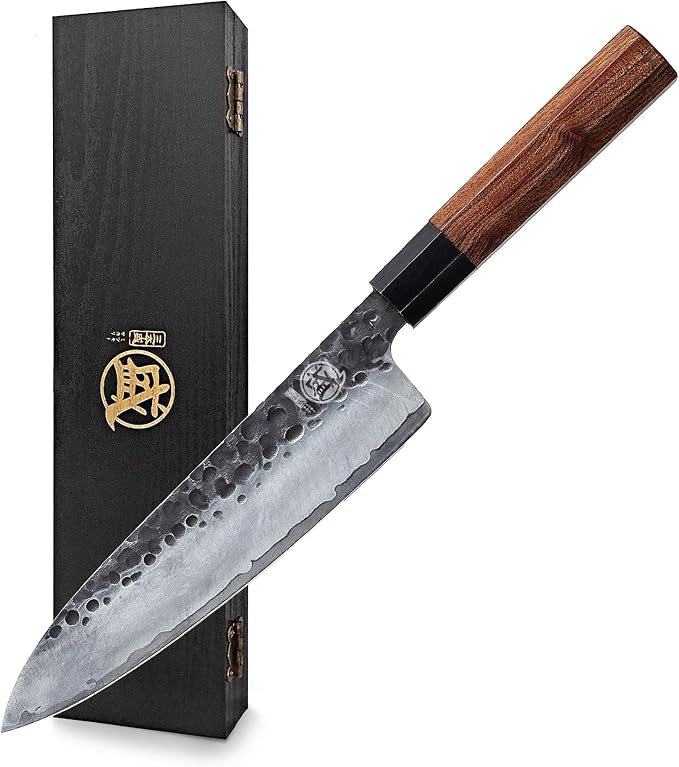
MITSUMOTO SAKARI 22 cm Gyuto Chef Knife
The long blade is this knife’s main point of difference. If you regularly slice large vegetables or proteins, 22 cm gives you more cutting edge for a continuous stroke than the 20 cm gyuto below. The extra length also needs a larger board and safe storage.
Choose it for reach and a Japanese gyuto profile. The supplied product title does not identify an edge steel or even specify a Damascus construction, so check both claims on the live listing before comparing it with named-core knives.
Check before buying: Ask for the precise edge steel, construction, blade height, weight and return terms. Do not assume it uses the same steel as another MITSUMOTO SAKARI model.
Check on Amazon ↗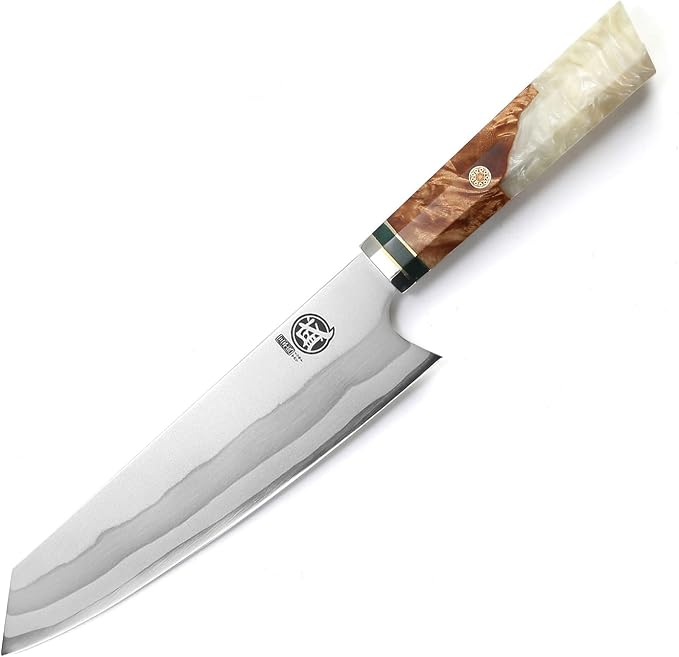
MITSUMOTO SAKARI 21 cm Kiritsuke Chef Knife
The kiritsuke style stands apart through its straighter edge line and angled tip. That combination can appeal if you prefer controlled push cuts and a fine point for detail work, while still wanting a knife long enough for larger ingredients.
The shape is the reason to look at it. “Kiritsuke” on a retail listing does not establish a traditional single-bevel grind, so check whether this model has the edge geometry you expect.
Check before buying: Confirm the edge steel, whether the blade is double bevel, and the care instructions before buying.
Check on Amazon ↗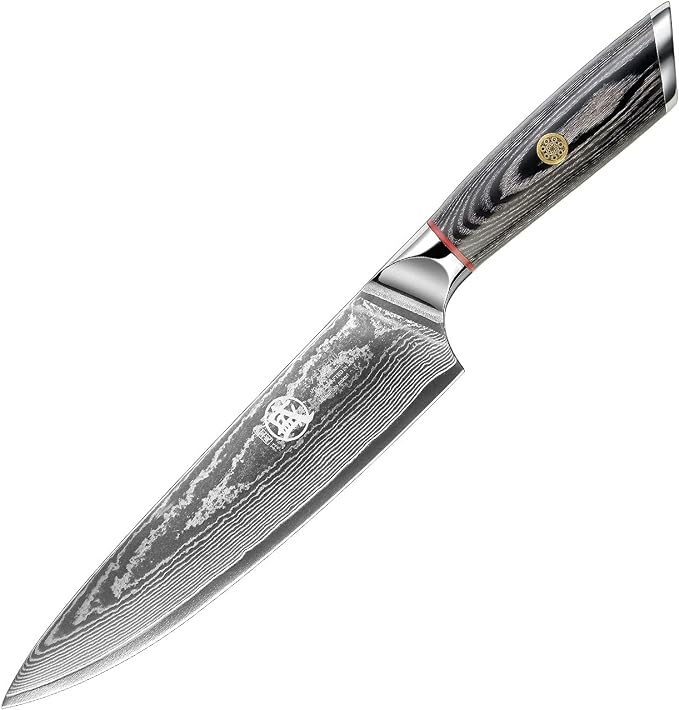
MITSUMOTO SAKARI 20 cm Japanese Gyuto Chef Knife
If you want a single knife for regular chopping and slicing, the 20 cm gyuto is the most familiar starting size in this MITSUMOTO group. It offers more room for a drawing cut than the 6-inch utility knife, with less board demand than the 22 cm gyuto.
This is a useful first comparison when a chef knife is your main purchase. The product title calls it Damascus but does not give the edge steel or a tested sharpness result.
Check before buying: Compare handle grip, blade weight and edge steel with the PAUDIN and SHAN ZU chef knives.
Check on Amazon ↗SHAN ZU 8-inch Damascus Chef Knife
The supplied listing combines an 8-inch chef knife, a stated 67-layer build, an ergonomic G11 handle and a gift box. For a buyer who likes a clean, synthetic-style grip and wants gift-ready packaging, those are the differentiators.
The handle is listed as G11. That is what the supplied title says, and it should be checked against the current listing rather than silently changing it to G10. The layer count is a construction claim, not a sharpness reading.
Check before buying: Confirm the core steel, handle material and whether a gift box is included. No product photo was supplied, so the graphic here is an illustration.
Check on Amazon ↗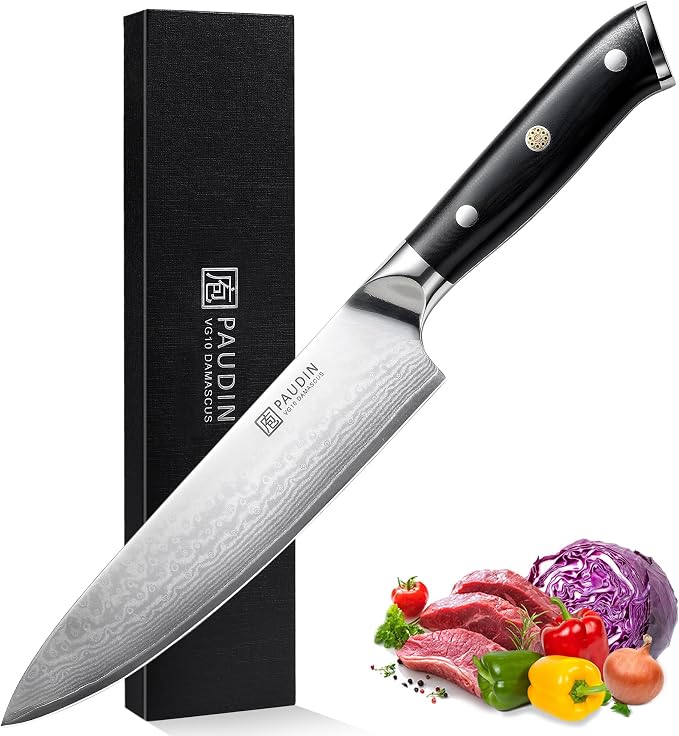
PAUDIN 8-inch VG10 Damascus Chef Knife
Among the supplied 8-inch chef-knife titles, this one gives the clearest steel identifier: it says VG10 core, 67 layers and G10 handle. That makes it easier to research what is at the cutting edge than a product that lists only a Damascus pattern.
A named core and a low-care handle are the practical draw. Takefu Special Steel publishes information about the VG10 grade, but those alloy facts are not an independent test of this PAUDIN knife or proof of where its steel was sourced.
Check before buying: Check the current listing for the exact blade construction, maker warranty, dimensions and seller.
Check on Amazon ↗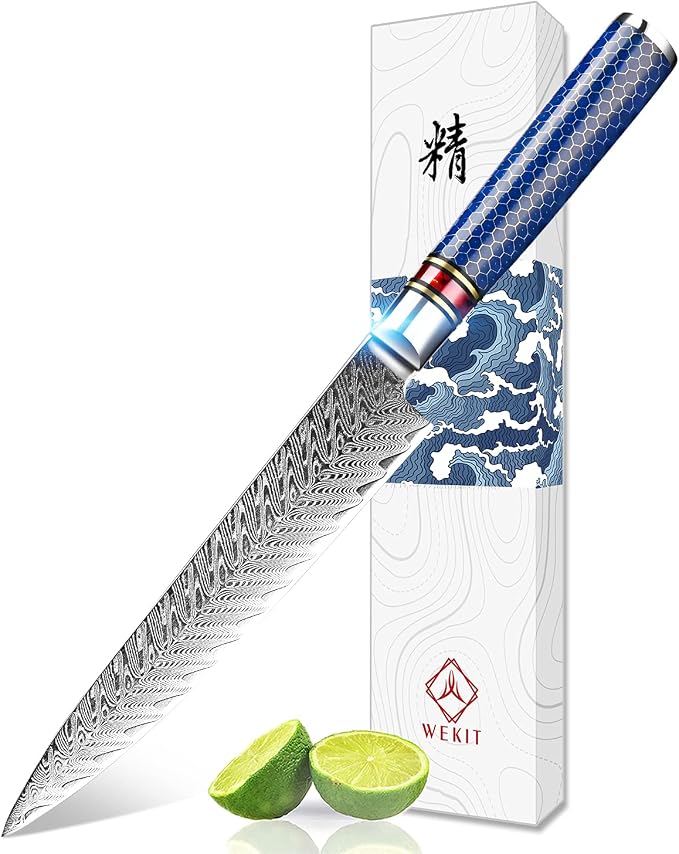
6-inch VG10 Damascus Utility Knife
This is the knife for jobs that feel clumsy with a long blade: trimming berries, mincing a little garlic or working on smaller produce. At 6 inches, it is a useful companion to an 8-inch chef knife, not a replacement for large-board prep.
The supplied title mentions VG10, 67 layers and a gift box. “Sharpest” appears in that title, but no standardised measurement was supplied, so this guide does not repeat it as a performance claim.
Check before buying: Check the maker, handle material and true blade length on the current listing.
Check on Amazon ↗
MITSUMOTO SAKARI 20 cm Japanese Santoku
A santoku style gives another way to approach everyday vegetables, meat and fish. This one is listed at 20 cm, so do not assume it is the shorter, 18 cm santoku size you might see elsewhere. Compare its blade height and tip with a 20 cm gyuto.
It is the shape alternative on this list for someone who likes a broad blade and a different motion on the board. The title says Damascus, but it does not identify the cutting-core steel.
Check before buying: Confirm the actual profile, edge grind, handle and core steel in the current listing.
Check on Amazon ↗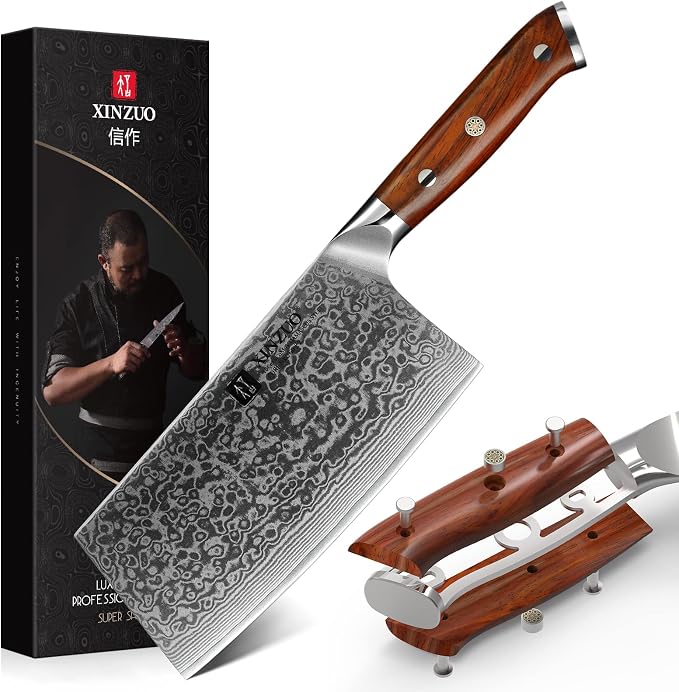
XINZUO 7-inch Damascus Chinese Chef Cleaver
This broad 7-inch blade offers a different style of board work. It can suit vegetable prep and moving cut food from board to pan. The title also mentions a rosewood handle, which brings a different feel and care routine from synthetic grips.
Despite the word “butcher” in the supplied listing title, a thin Chinese chef cleaver should not be assumed suitable for chopping through bones. Use it only for tasks the maker explicitly permits.
Check before buying: Confirm thickness, edge steel, intended use and wood-handle care. Do not use it for bones unless its manufacturer specifically says it is built for that job.
Check on Amazon ↗What is a sharpness index?
Sharpness at one moment is different from how long an edge stays useful.
Edge On Up’s PT50 instructions describe a BESS reading as the grams of force required to sever standardised test media. A lower number means a sharper tested edge at the time of measurement.
None of the eight products here comes with a BESS reading that we can verify. Calling one the “sharpest” or assigning it a score would be guesswork. BESS also measures the edge at one point in time, not its edge retention after a month of cooking or its feel through a thick ingredient.
Hardness is usually expressed as HRC. It is a different measurement from BESS. Steel, heat treatment, edge geometry, sharpening technique and use all contribute to the final experience. The title “high carbon” by itself is not enough to rank one knife over another.
At first cut
How well is the edge sharpened when you receive it? This can change with sharpening and shipping. We have no measured scores for this shortlist.
After repeated prep
Edge retention depends on the steel and heat treatment, plus the board, food, technique and maintenance. A fresh-edge test alone cannot settle it.
Through the ingredient
Thinness behind the edge and blade shape affect whether food slices easily or the knife wedges in a dense carrot.
Care, purchase and import checks.
Good habits protect the blade you chose and keep the decision practical for an Australian buyer.
Keep the working edge
Hand wash, dry promptly, and store the edge where it will not knock against other utensils. Follow the maker’s advice for any rosewood or other natural handle. A wood or suitable plastic cutting board is a better match for an edge than glass or stone. Our cleaning and care guide and sharpening guide go into more detail.
Check the actual offer
The seller, price, package contents and shipping options can change. Compare the current listing with the details on this page, especially if a title does not name the core steel. Ask for the maker’s specification rather than treating a pattern or product photo as a certificate.
Ordering into Australia
Most standard kitchen knives are different from restricted knife designs, but import rules depend on the item’s features. The Australian Border Force weapons guidance identifies prohibited knife types. Check current federal import guidance and any relevant state or territory rules for the specific item before ordering from overseas.
Compare beyond this shortlist
If you are still choosing between a chef knife and other blade styles, use our broader Damascus knives comparison. If steel labels are the deciding factor, start with the Damascus construction guide. These pages answer different questions; a named core and a comfortable shape remain better buying signals than a dramatic photo.
Questions worth asking.
Are Damascus chef knives better than ordinary stainless chef knives?
Not automatically. A Damascus appearance can be attractive, but cutting performance depends on edge steel, heat treatment, blade geometry and sharpening. Compare knives for the food you cut and the care you are willing to provide.
Which length should I choose for my first chef knife?
A 20 cm gyuto or 8-inch chef knife is a sensible starting comparison for many home kitchens. A 22 cm blade gives more reach but also needs more board and storage space. A shorter utility knife handles a different set of jobs.
Does a 67-layer Damascus knife stay sharp longer?
The number 67 describes a claimed layered construction, not an edge-retention test. You would need comparable measured use data to say one listed knife stays sharp longer than another.
Does the 22 cm MITSUMOTO SAKARI gyuto have Damascus steel?
The supplied product title calls it a Japanese gyuto chef knife but does not specify Damascus construction or an edge steel. Check the live listing and ask the seller before treating either as confirmed.
Can I use the XINZUO Chinese chef cleaver for bones?
Do not assume so. Chinese chef cleavers may be built for vegetables and boneless foods. This listing needs a manufacturer specification confirming bone chopping before you use it that way.
Which listed knife has a named VG10 core?
The PAUDIN 8-inch chef knife title states a VG10 core. The 6-inch utility knife title also mentions VG10. These are retailer-title claims to confirm on the current product pages.
How do I know if a Damascus chef knife is genuinely layered?
Ask the manufacturer how the pattern is made and which steel forms the cutting edge. A photo of the blade or a layer-count claim alone cannot verify the construction. The linked authenticity guide covers the common differences.
Editorial method: This guide uses the eight product titles, images and retailer links provided for the article. Blade-use guidance and steel explanations are supported by the sources below. We did not purchase or test these particular knives, measure their sharpness, collect verified owner ratings or check live prices. Comparisons are by disclosed features and likely use, not lab results.
- Steel grade: Takefu Special Steel on VG10.
- Metallurgy: Verhoeven and Clark, Carbon Diffusion Between the Layers in Modern Pattern-Welded Damascus Blades, Materials Characterization.
- Sharpness: Edge On Up PT50 instructions and BESS explanation.
- Australia: Australian Border Force, weapons and firearms guidance.