Best Damascus Santoku Knives in Australia
A beautiful blade is a good start. The right shape, clear steel details and a comfortable fit are what make it useful every evening.
Start by comparing the 18 cm AUS-10 santoku if you want a named cutting-core steel. The UniqueFire resin-handle santoku is another option with a seller-stated VG10 core and colourful presentation. The PAUDIN is a stainless alternative for shoppers who want the santoku shape without requiring Damascus construction. These are listing-based comparisons, not hands-on test winners.
Affiliate disclosure: As an Amazon Associate I earn from qualifying purchases. Amazon buttons are affiliate links. Check the selected model, seller, delivery to your Australian postcode and current price before ordering. Read our affiliate disclosure.
Which santoku deserves a place on your board?
For onions, herbs, mushrooms and boneless chicken, a santoku can be an appealing everyday knife. The broad blade gives you room above the board, while a relatively short cutting edge can feel easier to place than a long chef knife. Whether that suits you depends on your hand, your board and the way you cut.
This guide compares two listings advertised as Damascus santoku knives, then adds a PAUDIN stainless santoku for context. Four longer knives appear later because they answer a different question: would a chef knife or kiritsuke-style blade fit your cooking better?
| Listing | Blade length | Steel description | Reason to compare |
|---|---|---|---|
| kanngou 18 cm AUS-10 Damascus Santoku | 18 cm | AUS-10 core, as listed | AUS-10 claim and a dark handle |
| UniqueFire 7-inch Resin-Handle Damascus Santoku | 7 in / 17.78 cm | VG10 core; 67 layers, seller-stated | VG10 claim and a colourful resin handle |
| PAUDIN 7-inch Stainless Santoku | 7 in / 17.78 cm | 5Cr15MoV stainless; not Damascus, seller-stated | Santoku shape; Damascus is not essential |
Two Damascus options, plus a stainless comparison
Start with the shape you actually want. Then compare the steel claim, handle, seller information and total delivered price. A striking pattern does not settle all four questions.
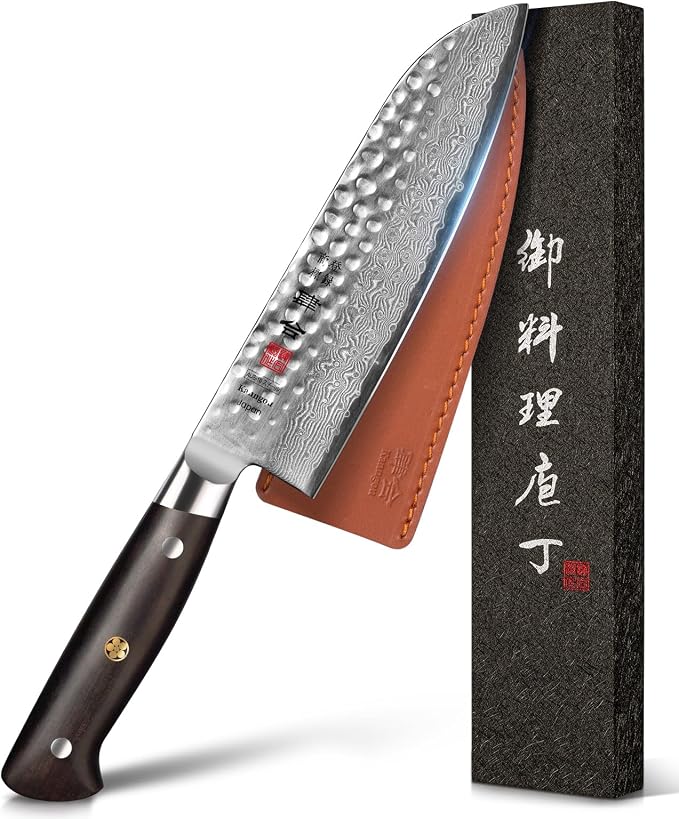
kanngou: an 18 cm santoku with a stated AUS-10 core
The most useful detail in this listing is the named AUS-10 cutting core. That gives you something specific to check beyond the word “Damascus”. The 18 cm blade also sits very close to the familiar 7-inch santoku size, making this a relevant starting point for everyday vegetable and boneless-meat preparation.
- Blade length
- 18 cm
- Steel stated by seller
- AUS-10 core, as listed
The product photograph shows a dark handle, a patterned blade and presentation packaging; the linked listing identifies the handle as ebony. Those details help you compare appearance; they cannot establish hardness, balance or how cleanly the knife moves through an onion. Ask for the precise model specification if those details are missing from the listing.
Reasons to compare
- An explicitly named AUS-10 core in the listing title.
- A santoku-sized blade for cooks comparing everyday prep knives.
What to check
- The listing claims 60–62 HRC and a 10–12° edge angle; we have not independently checked either.
- “Japanese steel” does not, by itself, establish that the finished knife was made in Japan.
Our take: Choose it for further investigation if you prefer its dark handle and want to compare a seller-stated AUS-10 core. Confirm the core, construction and return terms on the exact variant before paying.
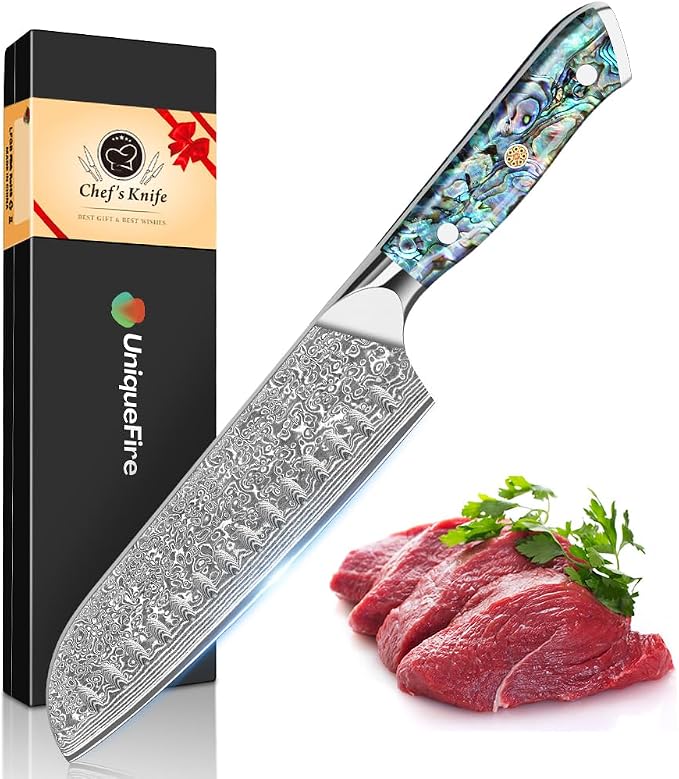
UniqueFire: VG10 claim and a colourful resin handle
This 7-inch listing puts its patterned blade and natural-resin handle at the centre of its appeal. If you are buying a knife as a present, the product photo makes the colourful handle and presentation box easy to compare with the quieter styling of the AUS-10 option.
- Blade length
- 7 inches / 17.78 cm
- Steel stated by seller
- VG10 core; 67 layers, seller-stated
The linked UniqueFire listing identifies a VG10 cutting core and 67-layer construction. Those are seller specifications, not independently authenticated material results. The listing also makes performance comparisons with AUS-10, but we have no controlled test evidence to support declaring this knife more durable than the kanngou option.
Reasons to compare
- A compact 7-inch format with a named VG10 core in the listing.
- Distinctive resin-handle appearance and gift-box presentation in the product image.
What to check
- The seller states VG10 and 60 ± 2 HRC; neither is independently tested here.
- The listing’s “meat cleaver” wording should not be treated as permission to chop bones.
Our take: Consider it if you prefer the resin handle and want to investigate a seller-stated VG10 option. For heavy chopping, choose a tool specifically designed for that task.
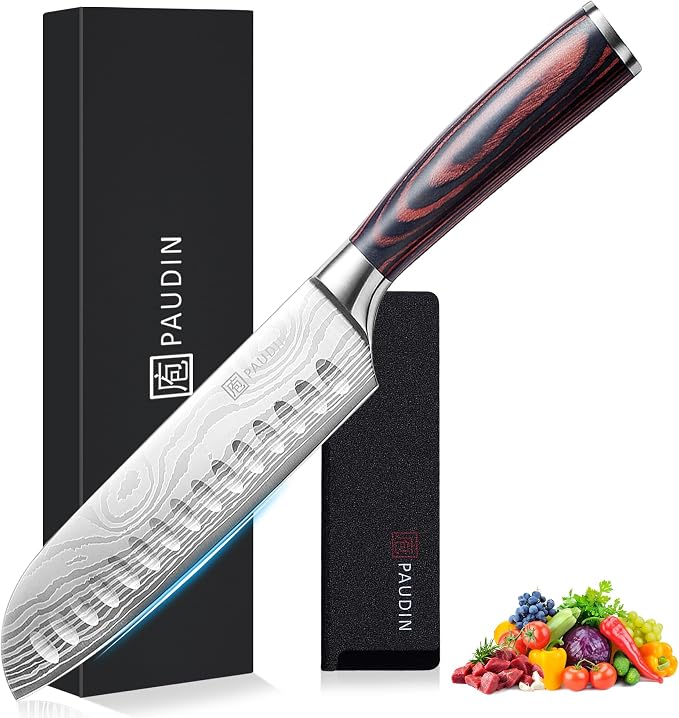
PAUDIN 7-inch stainless santoku
The PAUDIN belongs in this comparison because it gives you another way to buy the santoku shape. The linked listing specifies 5Cr15MoV stainless steel and explicitly says it is not Damascus. We therefore treat this exact listing as a stainless alternative.
- Blade length
- 7 inches / 17.78 cm
- Steel stated by seller
- 5Cr15MoV stainless; not Damascus, seller-stated
Do not generalise from the brand name. A manufacturer can sell several ranges with different steels and construction. Check the model linked here, its current description and the selected variant. A blade photograph, a wave-like finish or another PAUDIN model’s specification cannot authenticate this one.
Reasons to compare
- A direct alternative if you want a santoku and do not require Damascus layering.
- A 7-inch blade for a like-for-like size comparison with the resin-handle listing.
What to check
- The listing identifies 5Cr15MoV; we have not measured its hardness or edge retention.
- Current price and weight must be checked; “budget” and “lightweight” would be unverified labels.
Our take: Compare it when shape, comfort and delivered cost matter more than layered construction. There is no need to pay for a feature you do not actually want.
Find your starting point
Choose your preferred format and what matters most. This tool points you to a section of the guide; it does not score or test the knives.
Start with the 18 cm AUS-10 santoku
Its listing names AUS-10 and 67-layer construction. Compare it with the UniqueFire VG10 option, then check seller support and the delivered total.
Read the matching comparisonSantoku or chef knife: what changes?
Choose a santoku if you want a shorter blade and tend to make controlled forward slices. Consider a chef knife if you prefer more reach and a curved edge for rocking. The distinction is useful, but it is not absolute: some santoku blades have more belly than others, and chef-knife profiles also vary.
Read the edge, not just the name
Shun’s blade-shape guide describes the santoku as an all-purpose kitchen shape. For your purchase, look closely at the side-on photograph: the edge profile tells you more about the motion it accommodates than a long string of words in a marketplace title.
Picture tonight’s dinner. If you mostly dice onions, slice mushrooms and portion boneless meat, a santoku may cover much of the work. If you often slice broad ingredients or prefer longer strokes, the extra reach of a chef knife can be useful. Neither shape replaces a serrated bread knife, a small paring knife or a purpose-built heavy chopper.
Two motions, shown slowly
A flatter edge is often a good match for controlled push slicing. Do not force a blade to rock through a motion its profile does not comfortably allow. For precision kitchen knives, avoid twisting through food or using sideways pressure to pry a cut apart.
Already know you want a longer blade? Browse our Damascus chef knife guide or Japanese Damascus knife guide for a broader comparison.
7 inches and 18 cm are almost the same size
Between the 7-inch and 18 cm options here, the stated length is unlikely to be the decisive difference. Spend more attention on grip comfort, blade height, weight and the shape of the handle. The longer 20–21 cm alternatives are a more meaningful change in reach.
A short blade is not automatically a light one. Steel thickness, handle material and tang construction all affect weight, so ask for an actual figure if hand fatigue is a concern. Left-handed cooks should also confirm handle symmetry and edge geometry instead of assuming that every santoku feels the same in either hand.
Damascus, AUS-10 and VG10 describe different things
Damascus refers to a construction or pattern description; AUS-10 and VG10 are steel names. A listing can therefore describe a Damascus knife with an AUS-10 core without contradicting itself. The useful questions are which steel forms the cutting edge and how the blade is actually constructed.
Pattern outside, cutting core inside
A named core gives you a starting point
The kanngou listing states AUS-10, 67 layers and 60–62 HRC; UniqueFire states VG10, 67 layers and 60 ± 2 HRC. Those are more specific than “premium steel”, but they are seller claims. Neither establishes independently measured edge retention, actual hardness or sharpening quality.
A pattern is not a material certificate
Waves on a blade may be associated with layered steel, but appearance alone cannot establish the construction. “Damascus pattern” is particularly limited wording. Treat it as a description of appearance unless the manufacturer provides more detail.
For VG10, Takefu Special Steel’s own specification provides the alloy’s composition and intended applications. That is evidence about the steel grade, not proof that an individual marketplace knife contains it. The manufacturer also warns about misleading VG10 claims online, making the exact model and supplier worth checking.
Likewise, a claimed 67-layer construction is not a cutting-performance score. It cannot tell you whether a knife will feel comfortable or stay sharp longer than another blade. Do not convert layer counts into a league table. For more background, read our VG10, AUS-10 and 10Cr15CoMoV comparison, Damascus steel guide and real versus fake Damascus guide.
Four larger alternatives, clearly separated
These products are included for readers who decide a longer knife is a better fit. They are not extra santoku recommendations. Their stated blade lengths range from 20 to 21 cm, and their titles describe chef knives or a kiritsuke-style knife.
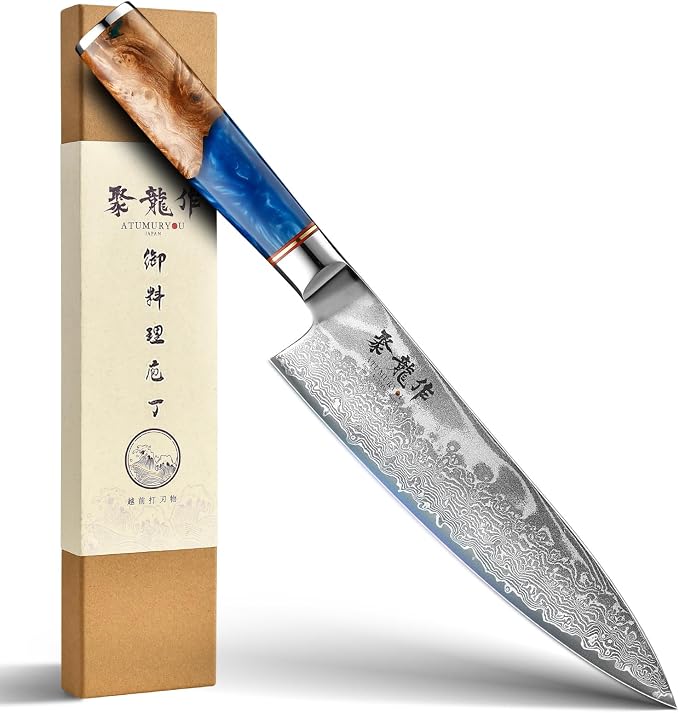
20 cm VG10 Damascus Chef Knife
The listing title identifies a VG10 core and 67-layer Damascus construction. At 20 cm, it offers more stated blade length than the santoku listings. Compare it if longer slicing strokes matter to you.
Before you buy: Verify the core claim, exact model, blade geometry and seller support. Its length and steel title do not establish superior performance.
View Amazon listing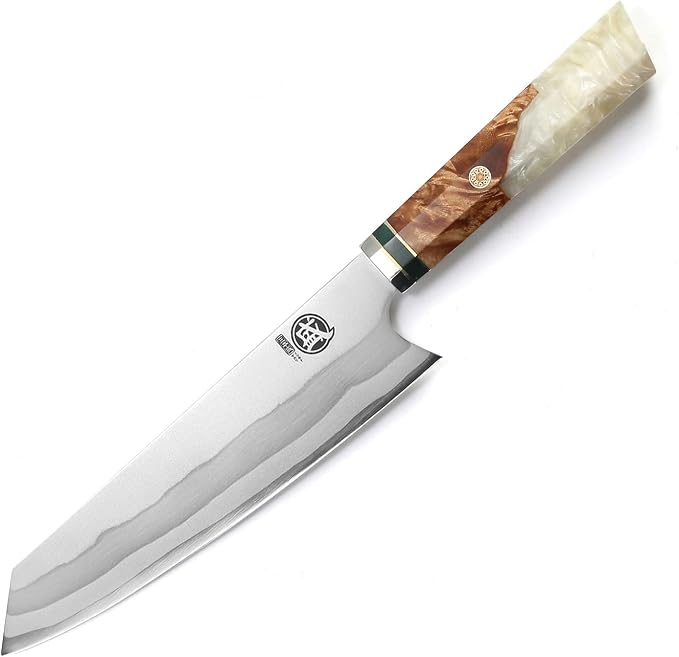
MITSUMOTO SAKARI 21 cm Kiritsuke
This 21 cm MITSUMOTO SAKARI is listed as a kiritsuke chef knife. Consider the format if you want a longer blade and like an angled-tip profile. It is a different purchase from a compact santoku.
Before you buy: Confirm the exact variant and bevel geometry. The seller describes 67-layer 440C Damascus steel, but its precise layer arrangement needs clarification. The name alone does not establish single- or double-bevel construction.
View Amazon listing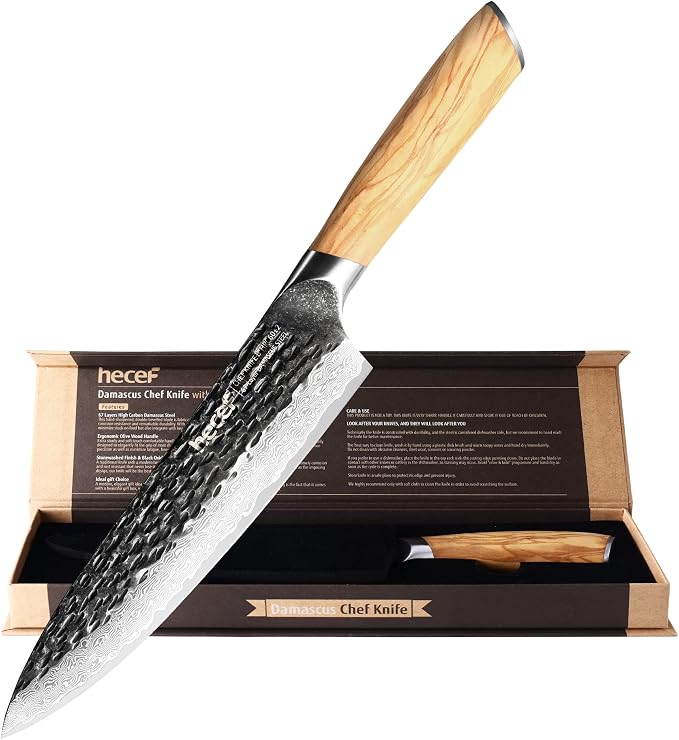
hecef 8-inch Damascus Chef Knife
The hecef title describes an 8-inch Damascus stainless chef knife with an olive-wood handle and gift box. Its handle and presentation may appeal if you prefer natural wood styling over colourful resin.
Before you buy: Ask for the core alloy and care instructions for the handle. Eight inches is 20.32 cm; do not confuse this chef-knife listing with a santoku variant.
View Amazon listing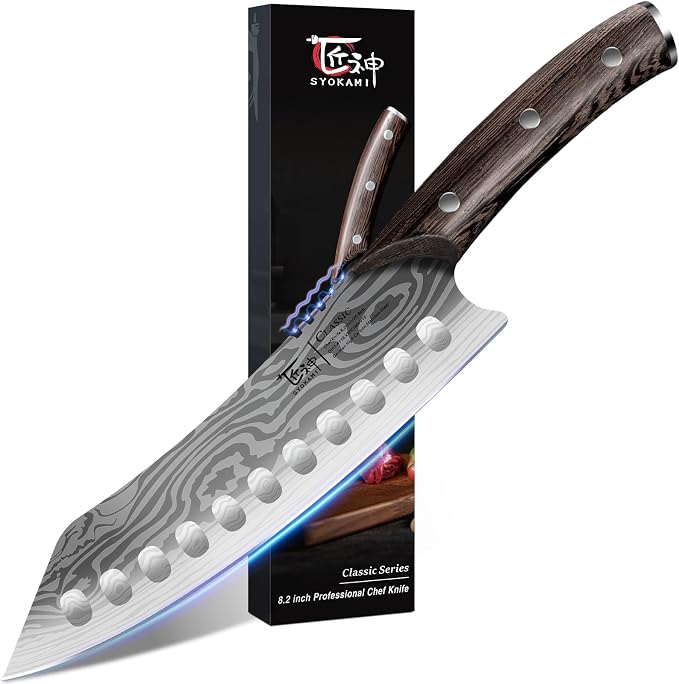
SYOKAMI 8.2-inch Patterned Chef Knife
The SYOKAMI listing says “Damascus pattern” and describes high-carbon German steel. That wording describes appearance and is not enough to verify layered Damascus construction. At 8.2 inches, this is a longer chef-knife alternative.
Before you buy: Confirm the blade material and construction before paying a premium for Damascus. Choose it for its documented features, not an assumption based on the visible pattern.
View Amazon listingAll seven product photographs are used to identify the corresponding listings. Images are for identification and appearance, not evidence of composition or performance.
What to check before ordering in Australia
The most useful final comparison happens after you select the exact variant and enter your postcode. A low headline price can become less appealing once shipping, delivery time or an unsuitable return arrangement is considered.
- Match the product. Check the title, blade length, handle and selected variant against the photograph. Marketplace pages can group multiple sizes or styles together.
- Identify the seller. Read who sells and dispatches the item. An Amazon marketplace listing does not automatically mean the manufacturer is the seller or that stock is held in Australia.
- Compare the delivered total. Use the current item price plus delivery and any charges shown at checkout. Do not compare a knife-only price with another seller’s delivered price.
- Check the delivery window. For gifts, allow room for an inspection before the occasion. A box in a photo is not a promise about every variant’s included accessories.
- Read the return and support details. Keep the listing description and receipt. Ask about a missing specification before purchase, while you can still choose another model.
The ACCC’s online buying guidance explains that consumer rights apply online and recommends checking the business and keeping purchase records. Resolving problems with overseas sellers can be more difficult in practice.
There is no fixed “right price” in this guide because current offers, delivery and selected variants can change. For a framework to compare spending, see how much a Damascus knife costs. If your priority is spending less, compare the wider choices in our budget Damascus knife guide.
Three habits for a knife you enjoy using
A good purchase includes a care routine you will actually follow. Check the instructions for your exact blade and handle; the guidance below is a conservative starting point for fine kitchen knives.
Wash and dry
Hand-wash carefully, then dry the blade and handle promptly. Avoid leaving the knife loose in a sink or wet on the draining board.
Use a suitable board
Use a stable wood or suitable plastic board. Keep glass, stone and ceramic surfaces away from a fine cutting edge.
Protect the edge
Store the clean, dry blade in a suitable guard, block or rack. Do not leave the edge knocking against utensils in a drawer.
Shun’s use-and-care instructions emphasise smooth slicing, appropriate cutting surfaces and avoiding bones or frozen food. Follow the manufacturer’s advice for the knife you buy, including its sharpening method. A pull-through sharpener bundled with a listing should not automatically be assumed suitable for every fine blade.
For the next steps, use our Damascus cleaning and care guide and Damascus sharpening guide. Stop using a visibly damaged blade until it has been assessed or repaired appropriately.
Our comparison method and its limits
We opened all seven affiliate links, checked that they resolved to matching Amazon Australia product titles and reviewed their listed material details. We organised the products and matching product photographs by knife shape and the specificity of their steel descriptions. We then used primary sources for blade-shape guidance, knife care, VG10 information and Australian online shopping advice.
We have not handled or laboratory-tested these knives. We do not claim measured sharpness, edge retention, balance, corrosion resistance or value at a price we have not verified. No star ratings or numerical product scores have been invented. All hardness and steel figures quoted here are attributed to sellers; we have not independently authenticated them.
The shortlist is deliberately small: two products sold as Damascus santokus and one explicitly non-Damascus comparison. The four longer alternatives are grouped separately so that a chef knife is never mistaken for another santoku recommendation.
Think of this page as a structured way to narrow your options and ask better questions. If a listing changes or a detail does not match, contact admin@damascusknife.com.au with the product name and page link.
Damascus santoku questions, answered
Which Damascus santoku should I compare first?
The kanngou 18 cm listing is a useful starting point for a seller-stated AUS-10 core. The UniqueFire resin-handle listing states a VG10 core, providing another option to compare. This is a listing-based comparison, not a tested best-overall award.
Is a 7-inch santoku smaller than an 18 cm santoku?
Only slightly on the stated dimensions. Seven inches equals 17.78 cm, which is 2.2 mm shorter than 18 cm. Handle fit, blade height and weight may matter much more than that small length difference.
Is the PAUDIN knife in this guide genuine Damascus?
The linked PAUDIN listing identifies 5Cr15MoV stainless steel and explicitly says it is not Damascus. We include this exact listing as a stainless santoku alternative. Other PAUDIN models may have different specifications.
Does “Damascus pattern” mean layered Damascus steel?
Not necessarily. The phrase describes appearance. Look for a clear construction statement and a named cutting-core steel, and ask the seller for the exact model specification if it is missing.
Can a santoku cut meat and bones?
A santoku can be used for suitable boneless meat and fish. Do not treat it as a bone chopper because a listing uses the word cleaver. Use a tool specifically designed for bones and follow its maker’s instructions.
Is AUS-10 better than VG10?
A steel name alone cannot establish which finished knife is better for you. Compare the specific blade, its documented construction, heat treatment information, geometry, comfort and support. This guide has no independent performance measurements for the listed products.
Are these knives made in Japan?
That has not been verified for these listings. A Japanese knife style or a claim of Japanese steel is not the same as evidence that the finished knife was manufactured in Japan. Check the exact model’s stated country of manufacture.
Are the prices and Australian stock confirmed?
No live price or stock promise is made here. Open the Amazon listing, confirm the selected model and enter your postcode to check current price, seller, availability and delivery terms.
The choice to make first
Decide whether you want the compact santoku format or the reach of a longer chef knife. For the santoku shortlist, investigate the AUS-10 model for its stated AUS-10 core, the UniqueFire for its stated VG10 core and resin handle, or the PAUDIN if Damascus construction is not essential to you.
Then check the exact listing. A knife with the right shape and a clear specification is an easier purchase to judge than one chosen on pattern alone.
Return to the comparisonSources and further reading
- Shun: blade shapes, for general santoku and chef-knife context.
- Shun: use and care, for the manufacturer’s guidance on technique, cleaning and cutting surfaces.
- Takefu Special Steel: VG10, for primary alloy information and its notice about authenticity claims.
- ACCC: buying online, for Australian consumer guidance.
These sources support general guidance. They do not certify, endorse or test the seven linked marketplace listings. Product-specific claims are attributed to the linked listings throughout.