Santoku vs Chef Knife: Which Should You Buy?
Both can handle most daily prep. The better choice comes down to blade length, edge curve and the cutting motion that feels natural in your hand.
Choose a santoku if you prefer a shorter 17 to 18 cm blade, a flatter cutting edge and controlled push cuts. Choose a chef knife if you want a longer pointed blade, more reach and a curved edge that supports rocking cuts. Smaller boards and smaller hands often suit a santoku. Large ingredients and long slicing strokes usually favour a chef knife.
Affiliate disclosure: As an Amazon Associate I earn from qualifying purchases. Amazon buttons are affiliate links. This comparison is based on blade design and published listing details. We have not conducted hands-on performance tests. Check the exact model, seller, current price and delivery to your Australian postcode before ordering. Read our affiliate disclosure.
Santoku vs chef knife at a glance
A santoku and a chef knife overlap more than their names suggest. Either one can dice an onion, mince herbs, slice boneless meat and portion fish. Their different profiles change how those jobs feel. The santoku is normally shorter and flatter. A typical chef knife is longer, more pointed and more curved through the cutting edge.
| Feature | Santoku | Chef knife | Why it changes the choice |
|---|---|---|---|
| Common blade length | About 14 to 18 cm | About 16 to 26 cm | A shorter blade needs less board space. A longer blade covers more food per stroke. |
| Tip | Spine descends towards a rounded or sheep-foot style tip | Narrow pointed tip | The chef knife gives more reach for tip work and piercing. The santoku tip is less prominent. |
| Edge profile | Usually flatter | Usually more curved | A flatter edge favours push slicing. More curve supports rocking, provided the model has enough belly. |
| Typical feel | Compact and easy to place | More reach and board coverage | Comfort depends on the whole knife, including weight, balance, handle and blade height. |
| Common strengths | Vegetables, herbs, boneless meat and fish | Large vegetables, long slices, herbs, meat and general prep | Both are general-purpose knives. The cook's motion matters more than cuisine labels. |
| Less suitable for | Bones, frozen food, hard twisting and prying unless the maker specifically designs the knife for that work | Use a cleaver or other purpose-built tool for heavy tasks. | |
ZWILLING's knife-type guide describes santoku blades as commonly 14 to 18 cm long and chef knives as commonly 16 to 26 cm long. It also links the curved chef-knife profile with cradle cutting. These are useful category ranges, not rules for every model.
Push cutting or rocking?
The edge profile sets the rhythm. A flatter santoku meets more of the board at once, which suits a forward-and-down slice followed by a lift or gentle pullback. A curved chef knife can pivot through a rocking motion while the tip stays close to the board. You can use several motions with either shape, but forcing a flat blade through an exaggerated rock feels awkward and can leave food uncut near the heel.
Watch the edge follow the board
Shun's use and care guidance recommends a smooth slicing action that moves forward and down, then back to reset. It also warns against using fine kitchen knives on bones, joints or frozen food. Follow the instructions for the exact knife you buy because edge geometry and intended use vary.
Pick a santoku if this feels familiar
You tend to lift the blade between cuts, prepare lots of vegetables and want a compact edge that is easy to place. You do not need a long tip for much of your prep.
Pick a chef knife if this feels familiar
You rock through herbs, slice large produce and like the reach of a 20 cm blade. You use the pointed tip for small cuts and want more curve under the edge.
Try the knife-shape chooser
Select the motion and board space that resemble your kitchen. The result points to the stronger starting shape and explains why. It does not rank brands or predict performance.
Start with a santoku
A shorter blade and flatter edge suit a forward push cut and need less room on the board.
See the santoku examplesShorter blades for controlled prep
These two Amazon Australia listings provide concrete examples of the santoku side of the comparison. Both are around 18 cm and both are sold as layered Damascus knives. The steel, hardness and construction details are seller claims. We have not tested the materials or measured the finished edges.
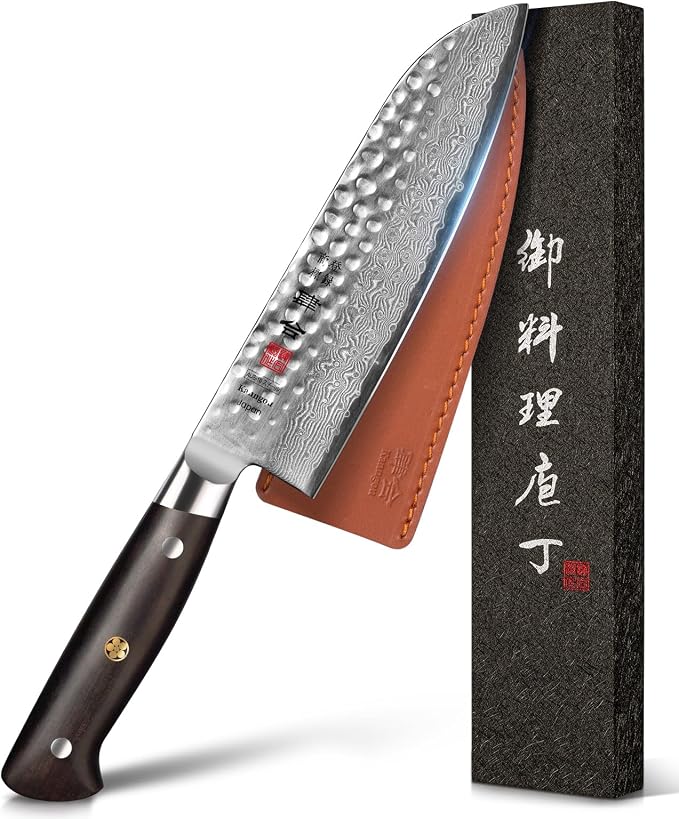
kanngou 18 cm AUS-10 Damascus santoku
The listing states a 67-layer blade with an AUS-10 core, a dark ebony handle and a 60 to 62 HRC hardness range. Its 18 cm length sits at the upper end of the common santoku range and is still shorter than the 20 cm chef knife examples.
- Stated length
- 18 cm
- Seller-stated core
- AUS-10
- Shape reason
- Compact everyday prep
- Check before buying
- Weight and exact seller
Choose this shape if: you want santoku proportions with a conventional dark handle and prefer a named core steel in the listing.
View Amazon listing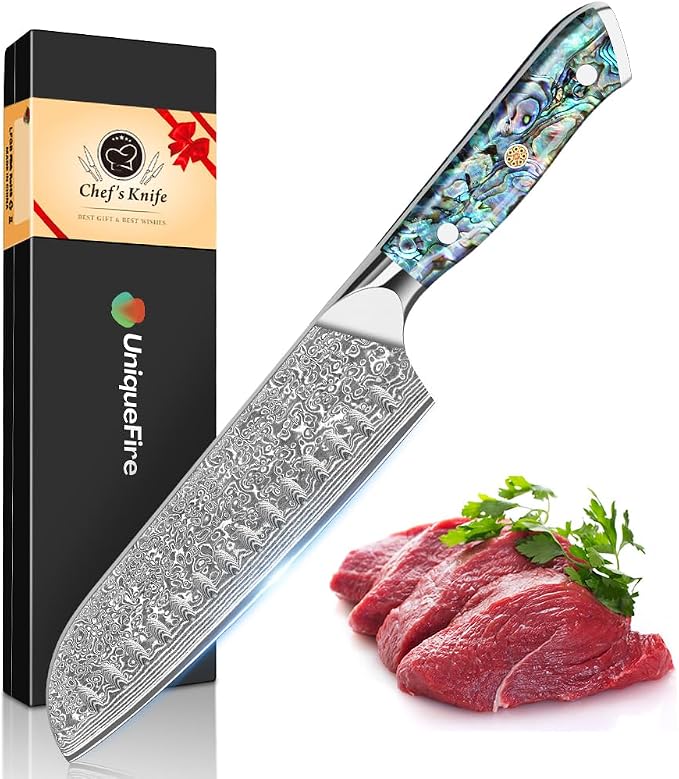
UniqueFire 7-inch VG10 Damascus santoku
The listing describes a VG10 cutting core, 67-layer construction, 60 ± 2 HRC hardness and a colourful natural-resin handle. Seven inches equals 17.78 cm, only 2.2 mm shorter than the 18 cm kanngou on their stated measurements.
- Stated length
- 7 in / 17.78 cm
- Seller-stated core
- VG10
- Shape reason
- Compact push slicing
- Check before buying
- Handle feel and actual weight
Choose this shape if: the colourful handle and gift presentation appeal to you and you want a seller-stated VG10 santoku.
View Amazon listingThe word “cleaver” in a marketplace title does not make a fine santoku suitable for bones. Use the maker's intended-use instructions.
Longer blades for reach and rocking cuts
The first three listings below are chef knives in the 20 to 20.8 cm range. The MITSUMOTO is a 21 cm kiritsuke-style knife, included for readers who want reach but prefer an angled tip and a straighter visual profile. It should not be treated as proof that every kiritsuke handles like a Western chef knife.
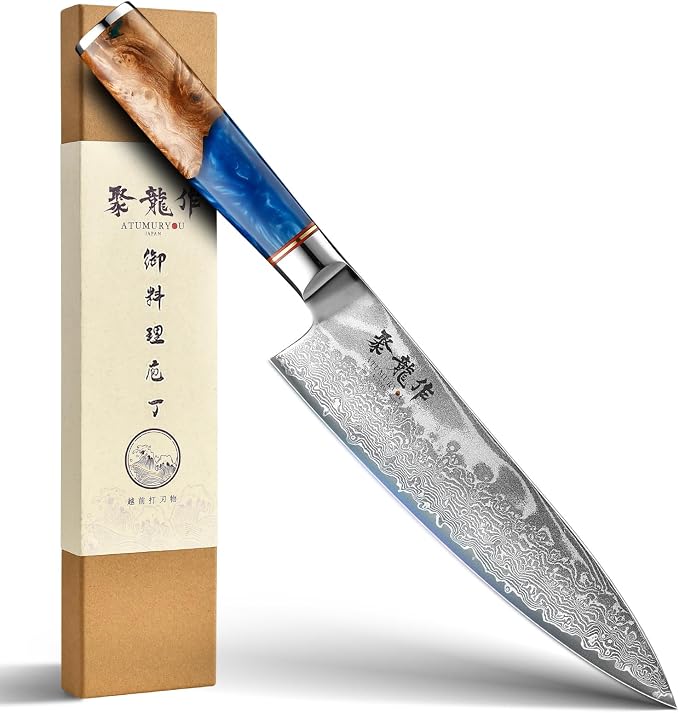
20 cm VG10 Damascus chef knife
The listing states a VG10 core, 67-layer cladding and a 20 cm blade. That extra 2 to 2.2 cm over the santoku examples provides more cutting edge for long slices and large produce. The side-on profile should still be checked for the amount of curve you prefer.
- Stated length
- 20 cm
- Seller-stated core
- VG10
- Shape reason
- More reach
- Check before buying
- Curve, weight and balance
Choose this shape if: a 20 cm edge fits your board and you want a chef knife with a seller-stated VG10 core.
View Amazon listing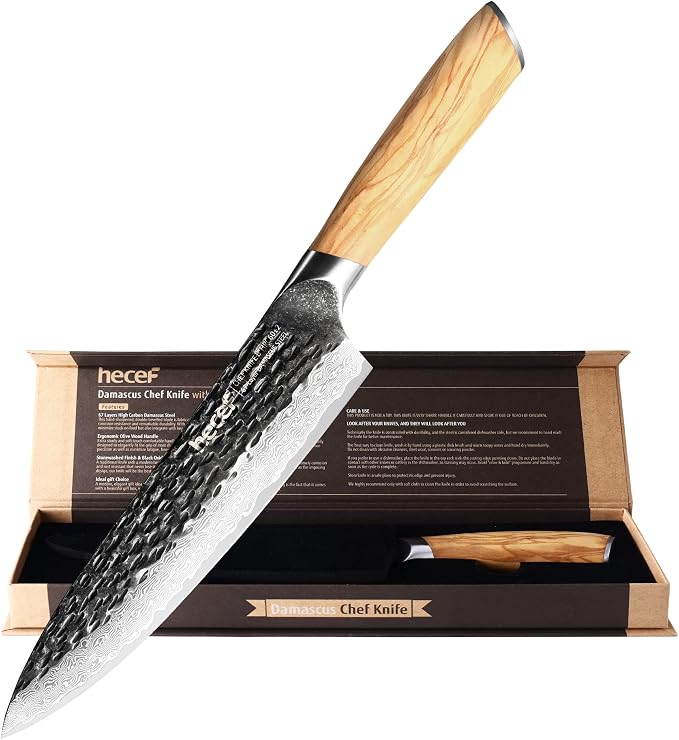
hecef 8-inch Damascus chef knife
This listing describes an 8-inch Damascus stainless chef knife with an olive-wood handle. Eight inches converts to 20.32 cm, placing it close to the common 20 cm chef knife size. The title does not identify the cutting-core alloy, so ask for that specification if steel choice matters to you.
- Stated length
- 8 in / 20.32 cm
- Core steel
- Not identified in title
- Shape reason
- Long everyday edge
- Check before buying
- Core grade and handle care
Choose this shape if: you prefer a classic 8-inch chef knife and the olive-wood handle suits your grip and care routine.
View Amazon listing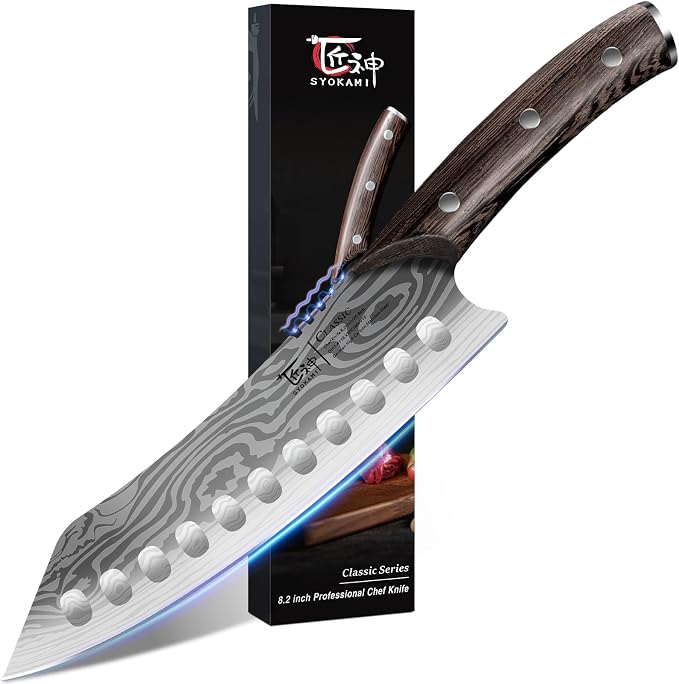
SYOKAMI 8.2-inch patterned chef knife
The linked title says “Damascus pattern” and the listing describes high-carbon German steel. Pattern wording does not establish layered Damascus construction. At 8.2 inches, or 20.83 cm, this is the longest of the three standard chef knife examples.
- Stated length
- 8.2 in / 20.83 cm
- Steel wording
- German steel; Damascus pattern
- Shape reason
- Pointed tip and reach
- Check before buying
- Construction and blade curve
Choose this shape if: you want the longer format and documented features matter more to you than verified layered construction.
View Amazon listing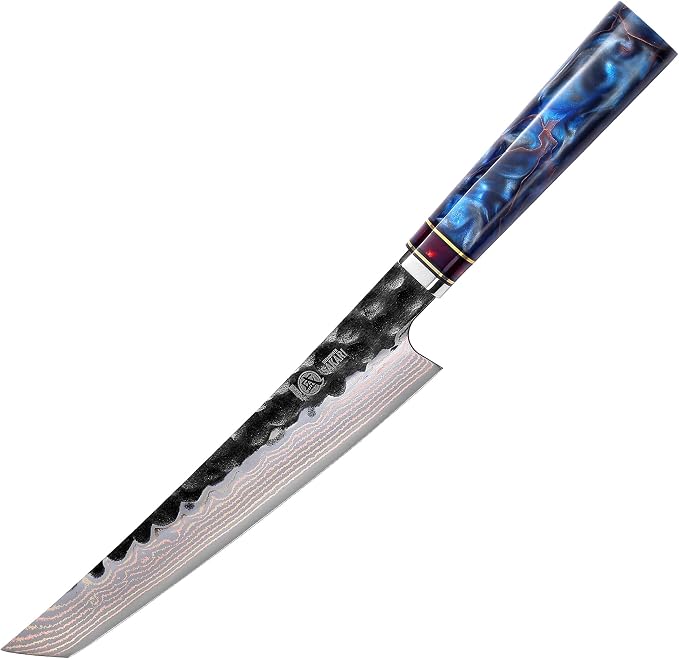
MITSUMOTO SAKARI 21 cm kiritsuke chef knife
The 21 cm MITSUMOTO gives you more reach than either santoku example and an angled kiritsuke-style tip. That tip can suit precise draw cuts, but the overall edge shape may feel different from a rounded Western chef knife during rocking. Check the exact bevel and profile on the linked model.
- Stated length
- 21 cm
- Listing description
- Damascus kitchen knife
- Shape reason
- Reach and angled tip
- Check before buying
- Bevel, edge curve and model
Choose this shape if: you want a longer multipurpose blade and the angled tip suits the way you slice and portion food.
View Amazon listingThe centimetres you feel during dinner prep
The numerical difference between 17.78 cm and 18 cm is tiny. The jump from those santoku sizes to a 20 or 21 cm chef knife is easier to notice. A longer edge can cross a cabbage or slice through a large piece of boneless meat with fewer strokes. It also needs more clear board space and may feel less nimble in a cramped kitchen.
Stated blade lengths on one scale
Blade length is only one part of fit. Blade height affects knuckle clearance. A thick handle may suit a large hand and tire a smaller one. Balance changes where the knife seems to carry its weight. An 18 cm santoku can feel heavier than a 20 cm chef knife if its blade, bolster or handle construction adds mass.
Measure your board
Place a ruler across the usable cutting area, excluding the groove and clutter. A long blade gains little if the tip constantly reaches the board edge.
Check knuckle room
Look at blade height near the heel. Your fingers need clear space when the edge sits flat on the board.
Read the handle shape
Check whether it is symmetrical, rounded, octagonal or contoured. Left-handed cooks should confirm that the grip and bevel suit them.
Which knife works better for common jobs?
| Kitchen job | Likely starting choice | Reason |
|---|---|---|
| Dicing onions | Either | A santoku gives compact control. A chef knife's tip can help with horizontal and vertical guide cuts. |
| Chopping herbs | Chef knife for rocking; santoku for lift cuts | Choose the edge curve that matches your motion. |
| Slicing a large pumpkin | Chef knife, within the maker's limits | More length may cross the ingredient more easily. Hard, dense produce still requires care and the right blade. |
| Preparing stir-fry vegetables | Santoku | The broad, flatter blade suits repeated push cuts and can help move prepared food. Use the spine or blade face carefully, never the sharp edge, to scrape the board. |
| Slicing boneless meat | Either; chef knife for longer pieces | A longer blade reduces the number of strokes on a large cut. |
| Fine tip work | Chef knife | The pointed tip is easier to place for small detail cuts. |
| Bones or frozen food | Neither | Use a tool designed for heavy impact. Fine edges can chip or bend. |
If you still cannot choose, think about your last three dinners. The knife that fits those ingredients and motions is a better starting point than the shape that looks impressive in a product photo.
Damascus does not decide the winner
Damascus describes a pattern or blade construction, depending on the product. Santoku and chef knife describe shapes. You can buy either shape with layered cladding, a patterned finish or a plain monosteel blade. A wave pattern does not tell you whether the knife will fit your hand or move cleanly through the food you cook.
Two of the santoku and chef knife examples claim VG10 cores, while the kanngou claims AUS-10. Heat treatment, blade geometry, thickness behind the edge and sharpening quality also affect performance. A steel name on its own cannot settle the santoku-versus-chef-knife choice. Read our VG10, AUS-10 and 10Cr15CoMoV comparison for the steel question, and our Damascus steel guide for construction and terminology.
The SYOKAMI listing is a useful reminder: its title says “Damascus pattern”, which is an appearance claim. If true layered construction matters to you, look for a clear core and cladding specification for the exact model. Our real versus fake Damascus guide explains what product photos and seller wording can and cannot establish.
Check the exact listing before paying
Amazon pages can group sizes, handle colours or related models. Open the link and confirm that the selected variant still matches the knife described here. Check the seller, dispatch location, total delivered cost and current return information after entering your postcode.
- Confirm the blade length and shape in the selected variant.
- Read the named core steel and construction claim for that exact model.
- Look for weight, blade height and handle dimensions instead of assuming fit from the photograph.
- Check who sells and dispatches the knife.
- Save the listing description and receipt in case the delivered product differs.
The ACCC's online buying guidance says comparison sites may not cover every offer and advises consumers to check commercial relationships, non-price factors, fees and the final price. It also explains that marketplace consumer-guarantee rights generally apply against the seller. This page discloses its Amazon affiliate relationship near the top so you can account for it when using the comparison.
For a broader commercial shortlist, visit our Damascus chef knife guide and Japanese Damascus knife guide. If budget is the main constraint, see how much a Damascus knife costs.
Protect the edge you choose
Neither shape excuses rough treatment. Hand-wash the knife, dry it promptly and use a stable wood or suitable plastic board. Keep fine edges away from glass, stone and ceramic cutting surfaces. Store the clean blade in a suitable block, guard, tray or rack so it does not strike other utensils.
Sharpening should follow the bevel and angle intended for the exact knife. A bundled pull-through sharpener may not suit every hard, thin edge. Our Damascus knife sharpening guide covers stone choice and technique, while the cleaning and care guide covers washing, drying, rust prevention and storage.
What we compared, and what we did not
We compared the two shapes through blade length, edge profile, tip design, board space and cutting motion. The six product examples use the titles, photographs and affiliate links supplied for this site. Product materials, hardness figures and construction details are attributed to the linked sellers.
We did not handle or laboratory-test the knives. We therefore do not publish invented scores for sharpness, comfort, balance or durability. Live prices, ratings and stock are omitted because they can change. The MITSUMOTO appears as a kiritsuke-style alternative, since its angled tip and profile are materially different from a standard Western chef knife.
General blade-shape information comes from manufacturer guides by ZWILLING and Shun. Australian online-shopping guidance comes from the ACCC. If a listing changes or an image no longer matches its product, contact admin@damascusknife.com.au with the product name and page link.
Santoku vs chef knife FAQs
Is a santoku better than a chef knife?
Neither shape is better for everyone. A santoku usually suits cooks who want a shorter, flatter blade and use push cuts. A chef knife usually suits cooks who want more reach, a pointed tip and a curved edge for rocking.
Can a santoku replace a chef knife?
Yes, a santoku can serve as the main knife for many home cooks who prepare vegetables, boneless meat and fish. You may still prefer a longer chef knife for large produce, long slices and tip work.
Which is better for beginners?
The easier knife is the one that fits the cook's hand, board and natural cutting motion. A compact santoku can feel easier to place, while a chef knife offers a familiar pointed tip and more reach. Handle both safely in a shop when possible.
Which knife is better for vegetables?
A santoku is a strong starting choice for repeated vegetable prep because its broad blade and flatter edge suit push cutting. A chef knife may work better on very large vegetables or when you prefer a rocking motion.
Can I rock-chop with a santoku?
You can use a modest rocking motion if the individual santoku has enough curve, but many santoku edges are flatter than chef knives. Do not force an exaggerated rock when the heel does not clear the board naturally.
Is a 7-inch santoku much shorter than an 8-inch chef knife?
Seven inches is 17.78 cm and eight inches is 20.32 cm, a difference of 2.54 cm. That extra length is noticeable on large ingredients and boards, while the santoku needs less space.
Does a Damascus santoku cut better than a plain chef knife?
Damascus pattern or cladding does not determine the winner. Cutting performance also depends on the core steel, heat treatment, blade geometry, edge condition and how well the shape suits your motion.
Can either knife cut bones?
Do not use a fine santoku or chef knife on bones unless the maker specifically designs it for that work. Use a purpose-built cleaver or boning tool and follow its instructions.
Which knife should a left-handed cook buy?
Check the handle shape and bevel of the exact model. A symmetrical handle and double-bevel edge often suit either hand, but product designs vary and should be confirmed before purchase.
Your decision in one sentence
Buy a santoku for compact control and push cutting; buy a chef knife for reach, a pointed tip and rocking cuts. If both sound right, choose the handle that fits your hand and the blade length that fits your board.
Return to the comparisonSources and further reading
- ZWILLING: Types of knives, for general blade lengths, profiles and common uses.
- Shun: Blade shapes, for santoku and chef knife shape context.
- Shun: Use and care, for cutting motion, suitable surfaces and use limitations.
- Australian Competition and Consumer Commission: Buying online, for marketplace and comparison guidance.
These sources support general guidance. They do not test, certify or endorse the six marketplace listings shown in this article.