 DamascusKnife
Australia
-
Best Damascus Knives
Shop by type Best Chef KnivesGyutos, kiritsuke & everyday blades Best Knife Sets & BlocksValue packs for the full kitchen Best Japanese DamascusVG-10 · AUS-10 · 67-layer blades Best Budget (Under A$100)Solid blades without the price tag Best Damascus Knives AustraliaAvailable now on Amazon AU Best Hunting & OutdoorFixed blades & bushcraft picks
- Reviews
-
Learn
BlogKnife guides, tips & advice What Is a Damascus Knife?The steel, the layers, the hype Real vs Fake DamascusHow to spot a printed pattern How to SharpenAngle, grit & technique How to Clean & CareRust, oil & maintenance Damascus Steel GuideVG-10 vs AUS-10 vs 10Cr15CoMoV How Much Should It Cost?What to pay — and what not to
- Compare
- Deals
Damascus Knife / Knife Guides / Best Damascus Paring and Utility Knives Australia
Knife guide
Best Damascus Paring and Utility Knives Australia: Small Knives for Peeling, Trimming, and Detail Work
Best Damascus paring and utility knives Australia come down to one question: do you do your small jobs in your hand, or on a board? If you peel, core, hull, and trim with the food held in your hand most nights, a short paring knife is the first small knife to buy. If your small jobs happen on a board, such as segmenting an orange, trimming silver skin, and slicing small fruit, a slightly longer petty or utility knife is the better first buy. That is the whole verdict, and the rest of this guide shows the working behind it, so you do not buy a small knife that looks right and then sits unused because it suits the wrong kind of work.
See the small knives at a glance ↓ Try the small knife task finder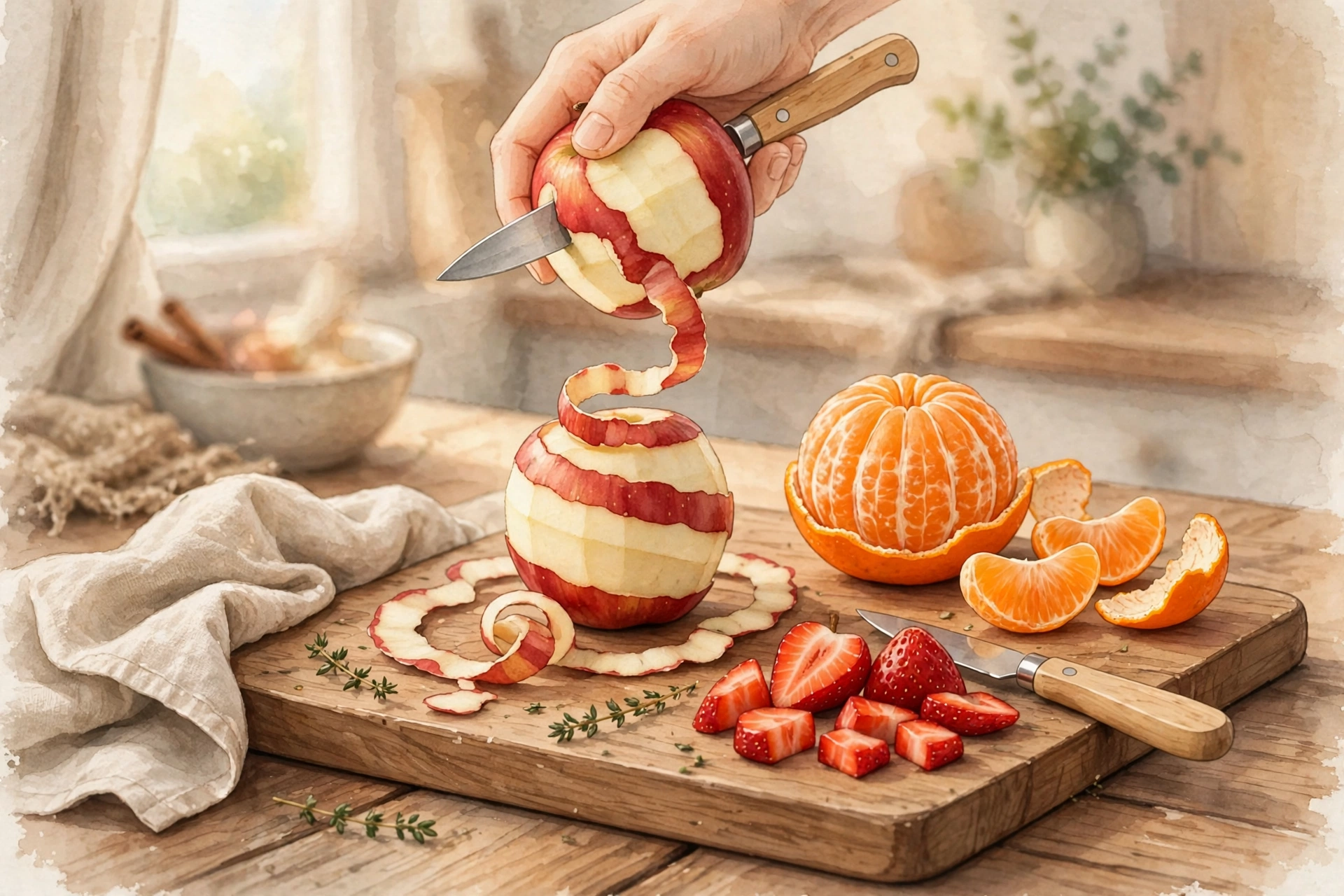
Read this first, because it sets the honesty rule for everything below. No knife on this page was handled, measured, or performance tested for this guide. Blade lengths and steel names come from the supplied product titles and image titles on this site, and the live best Japanese guide says the same about its own listings. That matters for small knives most of all, because shops use the names paring, petty, and utility loosely, and a label alone never proves a blade length, a steel grade, or a handle size. This guide therefore recommends a shape, a length, and a way of working, and names two small knives already visible on this site to look at, but it does not invent a steel claim, a sharpness score, a price, or a buy link for either knife. Check the live retailer listing before buying, because titles, stock, and prices change.
One food safety habit sits behind much of the advice in this guide. The NSW Food Authority advises washing all fruit and vegetables with cool tap water immediately before eating, cutting away bruised or damaged areas, cleaning the knife when finished to avoid contaminating other food, and using separate cutting boards and knives for raw and cooked food: NSW Food Authority, fresh fruit and vegetables. A small knife that has just trimmed raw meat is not a clean vegetable knife, however sharp it is. Wash the board and the blade between raw meat and produce, or keep one small knife for vegetables and use a different knife for meat. That single habit does more for safe small knife work than any steel grade, and it is also the strongest practical reason to own a second small knife at all.
No buy links in this article, and why. This article contains no buy links, no affiliate tag, no ASIN, and no price. The live best Japanese guide shows a listing button for the 13.5 cm utility and petty knife, but the fetched page text did not expose the exact link or tag, so nothing was copied and nothing was invented. The 6 inch utility paring knife appears in site media image titles only, with no dedicated product section fetched, so no buy link is given for it either. If a buy link is added later, it must be an Amazon link copied from a live site page and verified to open the correct listing, and this disclosure must be updated at the same time.
01 Quick reference: small knives at a glance
Which small knife fits which job, in one table? The table below gives the short version. Paring wins in the hand. Petty and utility win on the board. A chef knife, santoku, or nakiri wins on everything larger. Read the table as a work test, not a ranking, because a knife that wins on paper and loses in your hand will still sit in the block.
| Task | Best fit | Why it fits | Watch out for |
|---|---|---|---|
| Peeling an apple, potato, or carrot | Paring knife | Short blade turns easily in the hand and stays close to the food | Cut away from the body, never towards the hand holding the food |
| Coring an apple, hulling strawberries | Paring knife | Short, pointed tip reaches into a core or a hull without cutting away good fruit | A longer blade is clumsy here and removes more fruit than needed |
| Segmenting an orange, slicing kiwi fruit | Petty or utility knife | A little extra length gives a clean board cut and keeps fingers clear of the edge | A very short paring blade forces the hand too close to the board |
| Trimming silver skin from meat | Petty or utility knife | Tip slides under the skin while the edge stays flat on the board | Wash the knife and board before using them on produce afterwards |
| Slicing a small tomato, cutting small fruit | Petty or utility knife | Length and a sharp straight edge give even slices without squashing | A dull edge squashes soft fruit, so keep the edge keen |
| Slicing cabbage, dicing a large onion, cutting a roast | Chef knife, santoku, or nakiri | Length, height, and curve suit board work at scale | A small knife here is slow, uneven, and harder to control |
| Bones, frozen food, hard squash, prying | None of the above | Thin, hard edges chip on hard food | Use a cleaver, a boning knife, or a heavy chef knife instead |
Notice the split. The first two rows are hand work. The next three rows are board work. That split is the whole guide in miniature. Buyers who love a paring knife usually do hand work most nights. Buyers who are disappointed by a paring knife usually bought it for board work, then found the blade too short and the handle too close to the board. Buyers who love a petty knife usually do board work most nights, and buyers who are disappointed by a petty knife usually bought it for in hand peeling, then found the extra length awkward to turn.
02 Best Damascus paring and utility knives Australia in a real kitchen
What does the best Damascus paring and utility knife look like in a real Australian kitchen? It looks like the knife that comes out after the main knife goes back, not the knife that does everything. The chef knife or santoku still does the mixed work: slicing, dicing, and cutting larger ingredients. The small knife comes out for the last part of the prep, or the fiddly part: peeling the potatoes, coring the apples, hulling the strawberries, trimming the silver skin, segmenting the orange for a salad. It goes back dry, with its edge covered, before the next job starts, because a small knife left on a board or in a sink is easy to overlook and easy to grab by the wrong end.
Start with how you actually cook for a week, not with how you wish you cooked. Count the nights you peel, core, or hull something in your hand against the nights you trim or slice small things on a board. If hand work wins most nights, a paring knife will earn its place fast, because every apple and potato becomes easier. If board work wins most nights, a petty or utility knife will earn its place fast, because every orange segment and trimmed piece of meat becomes cleaner. If the two kinds of work split evenly, a petty or utility knife around 13 to 15 cm is the safer single buy, because it covers board work well and still handles light hand work, while a very short paring knife covers hand work well and struggles on the board. The finder in section 08 turns that count into a plain answer.
Hand size and board size decide almost as much as cooking style. A small knife with a handle that feels cramped will not be reached for, even if the blade is perfect, because the hand tires and the grip slips. A small knife on a crowded board feels different from the same knife on a clear board, because fingers need room beside the blade. Hold the knife if possible, or check the live listing for a stated handle length and overall length, and be wary of any listing that gives no handle detail at all, because grip is a feel question that a blade length alone cannot settle.
For the wider buying picture this guide sits inside, see Best Damascus Knives Australia and Best Japanese Damascus Knives. For the set question, whether a small knife should come as part of a set or as a single knife, see Best Damascus Knife Sets. For the vegetable specialist that sits beside a small knife, see Best Damascus Nakiri Knives Australia. The difference in this guide is the single question it answers: which small knife, paring or petty or utility, suits your hands and your jobs first?
03 Paring versus petty versus utility: what each name really means
What do the three names actually mean, and why do shops mix them up? A paring knife is a short knife for work held in the hand. A petty knife is the Japanese name for a small general knife, longer than a paring knife and shorter than a chef knife, used mainly on a board. A utility knife is the Western name for much the same middle size: a small, straight edged knife for trimming, slicing small produce, and detail cuts on a board. In practice, petty and utility often describe the same knife with a different label, and some shops call a 13 to 15 cm knife a paring knife when it is really a petty knife by length. Compare the blade length and the job, not the label alone, because the label will mislead you at least once in every shop.
The paring knife is defined by its shortness. Its blade is short enough to turn in the hand, to follow the curve of an apple or a potato, and to reach into a core without cutting away good fruit. Its tip is pointed enough to hull a strawberry and to start a cut cleanly. Its handle is usually small, which suits a pinch grip in the hand but can feel cramped for a large hand on a long peeling session. A paring knife that feels too long in the hand has stopped being a paring knife in practice, whatever the box says, and a cook who peels a lot will feel that at once.
The petty knife is defined by its middle length. It is long enough to cut on a board without the hand crowding the food, and short enough to control for trimming and detail work. Its tip is fine enough to slide under silver skin and to release orange segments, and its straight edge is long enough to slice a small tomato evenly. A petty knife that is too short for board work forces the hand down onto the board, and a petty knife that is too long for detail work starts to feel like a small chef knife and loses the close control that justifies buying it.
The utility knife is defined by its job, not by a single origin. It is a small, straight edged, general knife for the jobs that are too small for a chef knife and too awkward for a very short paring knife: trimming, slicing small fruit, cutting cheese, slicing a small sandwich, and detail cuts on a board. Some utility knives are a little longer and a little broader than a petty knife, and some are identical to a petty knife with a different name on the box. That overlap is normal, and it is why this guide treats petty and utility as one middle group, with paring as the separate short group, rather than pretending the three names mark three clean sizes.
The practical test is simple. Hold an apple and a knife, and peel it. If the knife turns easily and the peel comes off in a controlled strip, the length suits hand work. Now put an orange on a board and segment it. If the knife reaches cleanly between the membranes without the hand crowding the board, the length suits board work. A knife that passes one test and fails the other is not a bad knife. It is a knife for one kind of work, and buying it for the other kind of work is the mistake, not the knife itself.
Edge shape matters almost as much as length. A paring knife usually has a short, slightly curved edge that follows the curve of fruit, and a pointed tip for starting cuts. A petty or utility knife usually has a straighter edge that sits flat on a board, which gives even slices and a clean trim. A serrated small knife is a different tool again: it suits soft tomatoes and bread rolls, but it cannot trim silver skin cleanly and it is harder to sharpen, so it should not be bought as a first small knife unless soft fruit dominates the cooking. For a first small knife, a straight, sharp edge is the safer choice, because it covers more jobs and sharpens more simply.
04 Blade length, shape, and the job it suits
What blade length suits which small job? A paring blade around 8 to 9 cm suits hand work, because it turns easily and stays close to the food. A petty or utility blade around 13 to 15 cm suits board work, because it gives a clean cut without forcing the hand onto the board. A blade between those two lengths, around 10 to 12 cm, is a compromise: it handles light hand work and light board work, but it does neither as well as the right length for that job. A blade longer than 15 cm starts to feel like a small chef knife, and a blade shorter than 8 cm feels fiddly on anything larger than a strawberry.
The chart below shows relative blade length only, as a planner illustration, not a measurement of any knife and not a ranking of quality. The 13.5 cm length comes from the live site listing for the Japanese utility and petty knife. The 6 inch length, about 15 cm, comes from the site image title for the utility paring knife. The paring length is a typical home cooking range, not a claim about any listed knife, because no dedicated paring knife listing with a stated length was fetched for this guide. Do not read the chart as proof that a longer small knife is better. Longer only means longer, and the right length is the one that suits the hand and the job.
Relative blade length, planner illustration only.
Paring, typical range 8 to 9 cm
Petty and utility, live site listing 13.5 cm
Utility paring, site image title 6 inch, about 15 cm
Bars show relative length only. They do not represent sharpness, edge retention, or quality.
Shape changes what a length can do. A short blade with a pointed tip cores and hulls well, because the tip does the work. A short blade with a rounded or blunt tip peels well but cores poorly, because the tip cannot start a clean cut. A middle blade with a straight edge slices and trims well, because the edge sits flat on the board. A middle blade with a strongly curved edge slices less evenly, because only part of the edge meets the board at once. When two knives share a length, compare the tip and the edge shape, not the centimetres, because the shape is what the hand feels on every cut.
Thickness behind the edge matters too, though listings rarely state it. A thin edge slices soft fruit cleanly and trims silver skin with little drag, but it can chip if forced through hard food. A thicker edge feels sturdier and tolerates a rougher hand, but it wedges in soft fruit and squashes a tomato instead of slicing it. Because this guide did not measure any knife, it cannot name a correct thickness. Check the live listing for a stated thickness or grind, and treat any listing that hides those details as a listing that has not yet earned trust, especially when the price is high.
Weight should feel balanced, not heavy and not feather light. A small knife that is too light can feel skittish on a firm potato or a tough piece of silver skin, because the cook must supply all the force. A small knife that is too heavy tires the hand on a long peeling session and tempts the cook to force cuts instead of letting the edge work. A small knife is held in the hand for a long time, so balance matters more here than on a large knife that rests on a board between cuts. Hold the knife if possible, or check the live listing for a stated weight, and be wary of any listing that gives no weight at all.
05 Grip: in hand work versus board work
How should a small knife be held, and why does the grip change with the job? In hand work uses a pinch grip with the thumb and forefinger close to the blade, and the food held in the other hand. The blade moves, the food turns, and the cut stays small and controlled. Board work uses a handle grip with the hand behind the blade, and the food held flat on the board by the other hand, with fingers curled behind the edge. The grip changes because the job changes: in hand work needs the blade to turn, and board work needs the blade to stay flat and straight. A cook who uses a board grip in the hand will feel clumsy, and a cook who uses a hand grip on the board will feel cramped, because each grip suits only its own kind of work.
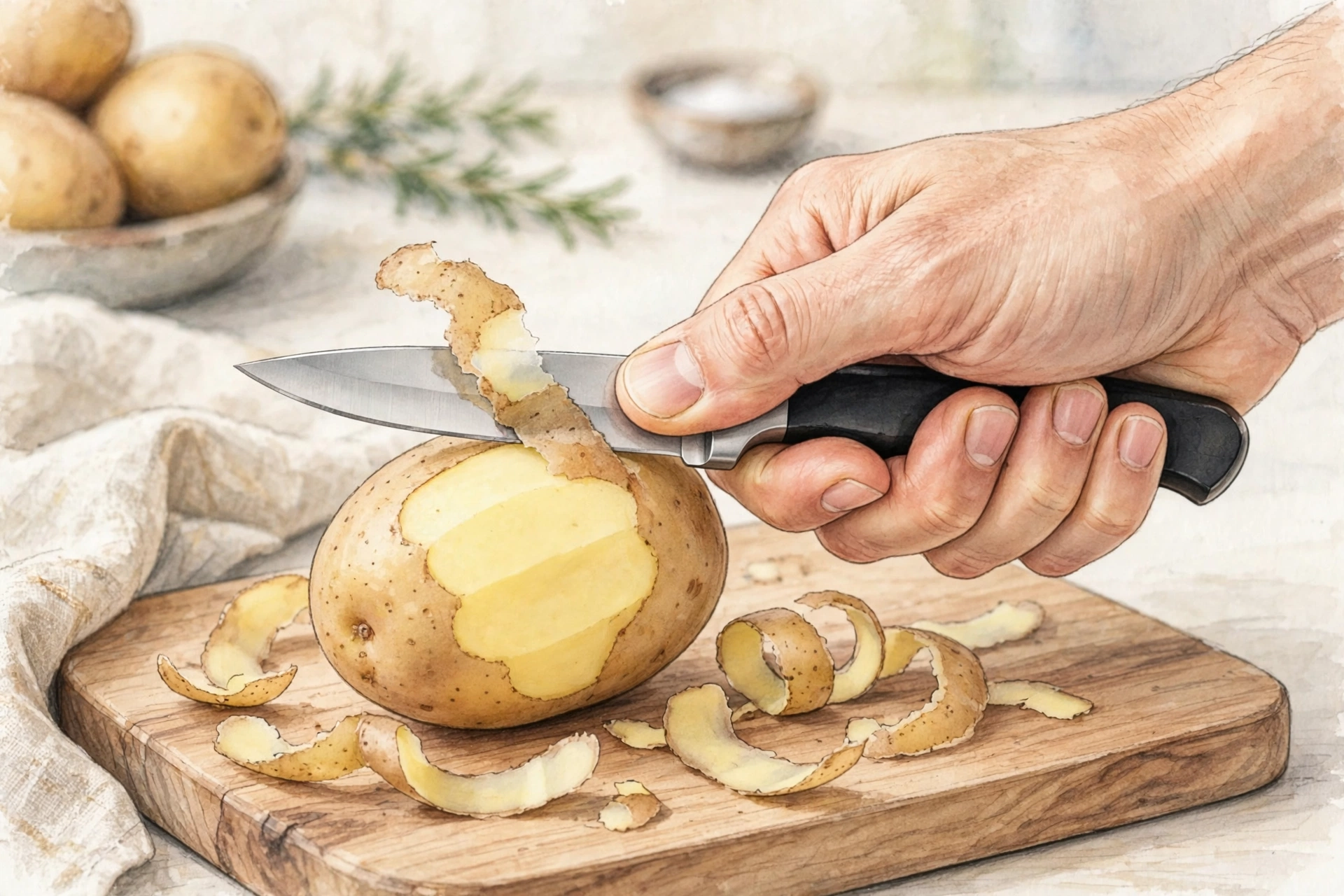
For in hand peeling, the safest habit is also the simplest: cut away from the body, and keep the thumb of the hand holding the food out of the path of the blade. Push the blade with the thumb of the knife hand, in short, controlled strokes, and turn the food between strokes instead of dragging the blade around it. Long, sweeping strokes look fast, but they are how a blade slips and finds a finger. Short strokes feel slower at first, and they are faster in the end, because they do not stop for a cut or a dropped piece of fruit.
For board trimming, the tip does the work and the edge follows. Slide the tip under the silver skin, keep the edge flat against the meat, and pull the skin taut with the other hand while the blade moves forward in short strokes. Do not saw, do not force, and do not lift the blade and stab down, because a small blade that lifts and stabs is a blade that slips. For segmenting an orange, cut away the peel and pith first, then slide the tip between the membranes and lift each segment out, keeping the fingers of the guiding hand behind the blade at all times.
For small fruit on a board, a sharp edge matters more than force. A dull edge squashes a tomato, tears a strawberry, and makes a kiwi fruit slide, because the cook presses harder to compensate. A sharp edge slices with light pressure, and light pressure keeps the fruit still and the fingers safe. If a small knife starts to squash soft fruit, it needs sharpening, not a stronger hand, and the sharpening guide on this site covers the routine in detail. A small knife that is kept sharp is also a safer knife, because it does what the hand asks on the first stroke, instead of slipping on the second.
Small knives cause small cuts that still need care. A paring knife is easy to overlook because it is small, and that is exactly why it causes cuts: it sits on a board, in a sink of soapy water, or on a bench where a hand reaches without looking. Put the knife down with the edge away from the reaching hand, never leave it in soapy water where it cannot be seen, and put it away dry with its edge covered as soon as the job is done. In a house with children, keep small knives out of reach and in a covered store, because a small knife is easy for a child to grab and hard for an adult to notice missing.
06 The small knives already on this site
Which small knives does this site already list, and what is honestly known about each one? Two small knives are visible on this site, and this guide names both, with their limits stated plainly. Neither knife was handled or tested for this guide, neither has a buy link in this article, and neither has a price stated here. The first knife has a dedicated listing section in the live best Japanese guide, so more is known about it. The second knife appears in site media image titles only, so less is known about it, and this guide says so instead of filling the gaps with guesses.
13.5 cm VG10 Japanese utility and petty knife: the site listed middle small knife
Best fit: Small fruit, trimming, and fine work on a board, as a second knife after a chef knife.
What is known: 13.5 cm blade, petty and utility use, VG10 stated in the supplied title, full tang construction, red sandalwood handle, gift box included, listed in the live best Japanese guide as the small tasks knife of that shortlist.
What is not stated in the supplied title: Edge angle, bevel type, weight, blade thickness, and country of manufacture.
Check before buying: Confirm the edge steel, the bevel, the weight, and the maker care guidance on the live listing. No buy link is included in this article, because the exact listing link and tag were not exposed in the fetched page text; the publisher may add the verified Amazon link from the live best Japanese page at publish time, and must not invent one.
Why does this knife suit board work first? Because 13.5 cm is a middle length. It is long enough to segment an orange and trim silver skin on a board without crowding the hand, and short enough to control for detail cuts that a chef knife would make clumsy. It is not the best peeling knife in the hand, because a longer blade turns less easily than a short paring blade, but it is the better single small knife for a cook who does board work most nights and hand work only sometimes. That is the trade off to weigh, not a flaw in the knife.
6 inch utility paring knife: the site media small knife, with limits stated
Best fit: General small knife work, subject to checking the live listing, because the details below come from an image title, not a dedicated product section.
What is known: 6 inch blade, utility paring use, VG10 named and 67 layers named in the site image title, Japanese style named in the same title, image used in site chef and budget guides.
What is not stated: No dedicated product section for this knife was fetched for this guide, so no handle material, weight, edge angle, bevel type, tang construction, or country of manufacture is stated here, and no buy link is given for it.
Check before buying: Find the live listing for this exact knife and confirm every detail above on that listing before paying, because an image title alone is not a product specification. If the live listing cannot be found, treat this knife as unverified and do not buy on the strength of an image title.
Why feature a knife with so little verified detail? Because hiding it would be worse. Readers who browse this site will see that image, and a guide that pretends it does not exist leaves them to guess. Naming it with its limits stated lets a reader check it properly, or set it aside, instead of buying on a guess. A best list with one well described knife and one clearly limited knife serves a reader better than a list of invented names with invented prices.
The contrasts on this site already give the buyer useful context. The 18 cm santoku with a stated AUS-10 core is the middle ground for cooks who want one larger knife. The 18 cm nakiri is the vegetable specialist for board vegetables. The 20 cm chef knife and the 21.9 cm XINZUO gyuto are the longer all rounders for cooks who want reach. None of those are small knife picks, and none should be mistaken for one, but each one sharpens the decision: if any of those already covers the small jobs, a small knife becomes optional, and if none of them makes peeling, trimming, or detail work enjoyable, a small knife earns its place.
07 Steel, edge, and what a layer count does not prove
What should a buyer actually look for in Damascus steel on a small knife? The steel at the edge, first, and the grind, second. Damascus on a modern kitchen knife usually means layered steel or patterned cladding around a separate core, and the core is what cuts. A listing that names the core, such as VG10 or AUS-10, gives a specific claim to check. A listing that says only a layer count, such as 67 layers, gives no edge information at all, because layers describe the outside, not the cutting steel. The live best Japanese guide makes exactly this point about its own listings, and it is worth repeating here, because layer counts sell small knives that edge steel alone would not.
VG10 and AUS-10 are named steel grades associated with Japanese steelmakers, and they appear in other listings on this site, such as the 13.5 cm petty with a stated VG10 core and the 18 cm santoku with a stated AUS-10 core. Those grades are useful as comparison points, not as proof of quality in any finished knife, because heat treatment, grind, and sharpening decide how a named steel actually performs. A well treated, well ground blade in a modest steel can out cut a poorly treated blade in a famous steel, and no listing title can tell the buyer which one they are looking at. On a small knife, the grind matters even more than on a large knife, because a small blade that wedges in soft fruit has failed its main job, whatever steel it claims.
For the small knives on this site, the honesty limits are plain. The 13.5 cm petty states VG10, but it does not state an edge angle, a bevel type, a weight, or a country of manufacture in its supplied title. The 6 inch utility paring knife names VG10 and 67 layers in an image title only, with no dedicated product section fetched to confirm anything else. Neither gap makes either knife a bad knife, but both gaps mean the buyer cannot verify the edge from the title alone. Ask the seller for the full edge steel specification, the bevel type, and the maker care guidance before buying, and treat any answer that only repeats the layer count as no answer at all. A double bevel edge suits most home cooks, because it cuts straight and sharpens evenly on both sides, while a single bevel edge suits trained Japanese knife users and punishes a careless sharpener.
Pattern deserves a short, honest note. A Damascus pattern can come from genuinely layered steel, from patterned cladding, or from a surface treatment that only looks layered. Only the first two put layered steel through the blade, and only the core steel decides the edge. If the pattern matters to the buyer for looks, that is a fair reason to choose a knife, but it should be chosen as looks, not mistaken for performance. On a small knife, the pattern is also harder to see and easier to mark, because the blade is small and the hand covers much of it during use. Pay extra for a pattern only if the pattern itself is worth the price to you, not because a layer count promises a sharper edge.
08 Best Damascus paring and utility knives Australia small knife task finder
Which small knife fits your most common small job? Pick the task you do most, and whether you do it in your hand or on a board. The finder gives you a plain answer: paring knife, or petty or utility knife, with the grip and the cut to use in one line. It is a guide to shape and grip, not a test of any knife, and it never replaces holding the knife or checking the live listing.
Pick a task and a work style, then press Show my small knife fit.
09 How the three small profiles compare, at a glance
How do paring, petty, and utility compare side by side? By length, by grip, and by the work each one does best. The table below collects the whole guide into one comparison, and the figure below it shows the three sizes side by side. Read the figure as a general illustration of relative size, not as a measured drawing of any listed knife, because the paring length is a typical range and the other two lengths come from site titles, not from measurement.
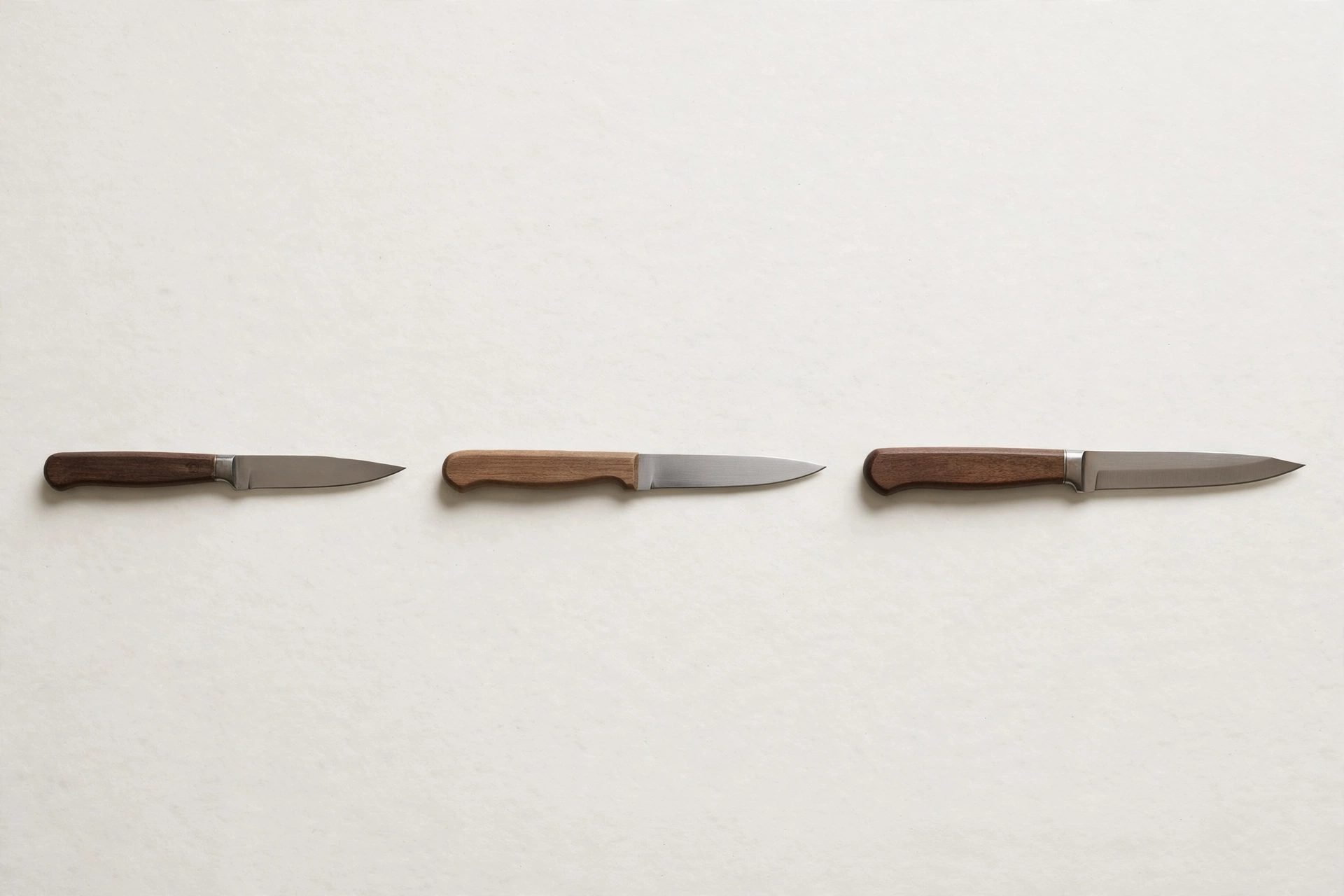
| Feature | Paring knife | Petty knife | Utility knife |
|---|---|---|---|
| Typical blade length | 8 to 9 cm, typical range | 13.5 cm, live site listing | 6 inch, about 15 cm, site image title |
| Main grip | Pinch grip in the hand | Handle grip on a board | Handle grip on a board |
| Best motion | Short strokes, food turned by hand | Tip work plus straight board cuts | Straight board cuts plus general trimming |
| Best food | Apples, potatoes, strawberries, small hand fruit | Citrus segments, silver skin, small fruit on a board | Small fruit, trimming, cheese, small sandwiches |
| Weakness | Too short for board work, handle can feel cramped | Less nimble in hand than a paring knife | Overlaps petty closely, so the label alone misleads |
| Buy first if | You peel, core, and hull in hand most nights | You trim and slice small things on a board most nights | You want one middle small knife for general board jobs |
Read the table as a work test, not a ranking. If the cook already peels in the hand happily, a paring knife rewards them at once. If the cook already trims on a board happily, a petty or utility knife rewards them at once. If the cook does both, the choice turns on which kind of work happens most nights, and the finder in section 08 turns that count into a plain answer. A knife that covers both kinds of work badly is worse than a knife that covers one kind of work well, because the badly covered work is where cuts and frustration happen.
Length changes the comparison too. A 13.5 cm petty and a 6 inch utility knife share a middle size but not a label, so length alone never settles the choice between them. Compare the tip, the edge shape, the handle, and the weight, because those are what the hand feels on every cut. When two knives share a length, the one with the better grip and the keener edge wins, whatever name is on the box, and the one with the missing specifications should be set aside until the listing proves more.
10 Using a small knife safely and well
How do you use a small knife well without cutting yourself? By keeping the cut small, the edge sharp, and the hand out of the path of the blade. Small knife work goes wrong when the cook hurries, when the edge is dull, or when the knife is used for a job it does not suit. A sharp paring knife with short strokes is safer than a dull paring knife with long strokes, because the sharp edge does what the hand asks on the first stroke, instead of slipping on the second. A small knife used on a cabbage or a roast is also a risk, because the blade is too short to control the food, and the hand ends up too close to the edge.
Keep the work area clear and dry. A wet board slides, a crowded board pushes fingers towards the edge, and a knife laid on a pile of peelings disappears from view. Wipe the board, keep the peelings to one side, and put the knife down with the edge away from the reaching hand whenever it is not in use. Do not catch a falling knife, because a falling knife will cut a catching hand, and a knife that hits the floor can be picked up and washed, while a cut hand cannot be undone as easily. Let it fall, step back, and pick it up by the handle.
Cut away from the body in hand work, and keep the guiding fingers curled behind the edge in board work. Those two habits cover almost every small knife cut, because most cuts happen when the blade moves towards a hand or a body part, or when a guiding finger sits flat in front of the edge. Teach the habits to anyone who cooks in the house, and practise them slowly at first, because a slow habit that holds is worth more than a fast habit that slips once a week.
Children change the safety rules, and small knives need extra care in a house with children. Store small knives dry, with the edge covered, in a block, a drawer insert, or a blade guard, and keep them out of reach, never loose in a drawer where a hand can find the edge. Do not leave a small knife on a bench, in a sink of soapy water, or on a board while children are nearby, because a small knife is easy to overlook and easy to grab. Teach children to ask an adult before touching any knife, and put the knife away as soon as the job is done, because a knife left out is a knife that will be found.
Food safety belongs in the same section, because a small knife touches both raw meat and produce in many kitchens. Wash the knife and the board between raw meat and produce, or keep a separate small knife for vegetables, as the NSW Food Authority guidance quoted at the start of this guide advises. A small knife that trims silver skin and then slices a strawberry without washing has moved bacteria from meat to fruit, and no steel grade prevents that. Clean, separate, and dry are the three words to remember: clean the blade, separate raw from ready to eat food, and dry the blade before storing it.
11 Care, sharpening, and storage
How do you care for a Damascus paring or utility knife so it stays sharp and safe? Hand wash it, dry it at once, and store it dry with the edge covered. That short routine covers most of the care a small knife needs, because the two things that damage a small knife fastest are moisture and knocking edges. A knife left soaking dulls in the sink, rusts at the edge, and cuts a hand that reaches in without looking. A knife left loose in a drawer knocks against other steel on every drawer pull, and a knocked edge is a dull edge, however good the steel claims to be.
Hand washing takes less than a minute and saves the handle as well as the blade. Wash in warm soapy water, wipe the blade dry at once, and let the handle dry before storing, especially if the handle is wood, as on the 13.5 cm petty knife listed on this site. Wood handles need drying after washing and occasional care, while synthetic handles tolerate wet hands better in daily use, though a Damascus knife should still be hand washed and dried. Do not put a Damascus small knife in a dishwasher as a routine, because heat, detergent, and knocking against other items dull the edge and mark the pattern, and the maker guidance on the live listing should be followed where it gives a clear care rule.
Sharpening a small knife follows the same routine as sharpening other double bevel kitchen knives, following the maker guidance for that knife, and keeping the angle steady on both sides. If you are new to whetstones, practise on a cheaper knife first, or have the small knife sharpened by a professional, because uneven grinding can change the edge and mark the pattern, and a small blade shows uneven grinding sooner than a large blade does. A honing rod keeps a keen edge aligned between sharpenings, but it does not replace sharpening once the edge is truly dull, and a small knife that squashes soft fruit needs sharpening, not more honing. For the routine in detail, see How to Sharpen a Damascus Knife and How to Clean and Care for a Damascus Knife.
Storage should keep the edge covered and apart from other knives, in a block, on a magnetic strip, in a drawer insert, or in a blade guard. Never leave a small knife loose in a drawer, where the edge knocks against other steel and dulls, and never leave it soaking in a sink, where it can rust and where a hand can find the edge by accident. A blade guard is the cheapest good store for a small knife, and it also makes the knife safer to carry between kitchens. If the knife came with a gift box, as the 13.5 cm petty knife does, the box is a store for gifting, not a daily store, because a box that is opened and closed daily wears fast and leaves the knife loose in the end.
Check the knife before each use, and retire it from food work if the edge is chipped, the handle is loose, or the blade is bent. A small chip can sometimes be worked out by sharpening, but a loose handle or a bent blade is a safety problem, not a sharpening problem, and a knife that cannot be held safely should not be used on food. When a knife is retired, wrap the blade before disposal, so no hand finds the edge in a bin or a bag, and check the maker warranty before paying for a repair, because a manufacturing fault and a misuse fault are different cases.
12 Buying checklist, and what to avoid
What should you check before paying for a Damascus paring or utility knife? The checklist below, in order, with the most costly mistakes first. Work through it on the live listing, not on the guide alone, because listings change and this guide cannot check a listing for you at the moment you buy.
- Job first: Hand work most nights means a paring knife first. Board work most nights means a petty or utility knife first. Mixed work with one small knife means a petty or utility knife around 13 to 15 cm first. If the listing does not state a blade length, do not buy it as a first small knife.
- Length and handle: Check the blade length, the handle length, and the overall length. A handle that feels cramped in your hand is the wrong knife, even if the blade length looks right, and a listing that hides handle detail has not earned trust.
- Edge steel, not layer count: Check the named edge steel, the bevel type, and the grind. A layer count alone is not an edge specification, and an answer that only repeats the layer count is no answer.
- Weight and thickness: Check a stated weight and a stated thickness where the listing gives them. A small knife that is too light feels skittish, a small knife that is too heavy tires the hand, and a thick edge wedges in soft fruit.
- Maker care guidance: Check the maker guidance for washing, drying, and sharpening, especially for a wood handle. If the listing gives no care guidance, follow the routine in section 11 and do not trust a listing that promises dishwasher safety without proof.
- Origin honesty: Check whether the listing states where the finished knife was made. A Japanese style name, a Japanese steel grade, and a Damascus pattern do not prove that a finished knife was made in Japan, and a listing that implies otherwise without stating it should be read with care.
- Live listing check: Check the current title, stock, and price on the live listing before paying, because titles, stock, and prices change, and this guide states no price as current for any knife.
What should you avoid? Avoid buying a small knife on a layer count alone, because layers describe the outside, not the edge. Avoid buying a paring knife for board work, or a petty knife for in hand peeling, because the wrong length for the job will sit unused. Avoid buying a small knife with no stated blade length, no stated handle detail, and no stated edge steel, because three missing facts together mean the listing has not been written for a careful buyer. Avoid using a small knife on bones, frozen food, hard squash, or prying, because thin, hard edges chip on hard food, and a chipped small knife is a dull and unsafe knife. Avoid leaving a small knife loose in a drawer or soaking in a sink, because both habits dull the edge and invite a cut.
For the wider buying method behind this checklist, see How to Choose a Damascus Chef Knife in Australia and How We Review Knives. For the larger knives this small knife sits beside, see Best Damascus Chef Knives and Best Damascus Santoku Knives Australia. The method is the same in every guide on this site: compare the job, the length, the edge steel, and the grip first, and treat the pattern and the layer count as looks, not as proof.
The short verdict, once more. If you peel, core, and hull in your hand most nights, buy a short paring knife first. If you trim, segment, and slice small things on a board most nights, buy a petty or utility knife around 13 to 15 cm first. If you do both kinds of work evenly, buy the petty or utility knife first, because it covers board work well and still handles light hand work. Check the edge steel, the handle, and the live listing before paying, keep the knife sharp, clean, and dry, and put it away with its edge covered as soon as the job is done.
Disclosure. This article contains no buy links, no affiliate tag, no ASIN, and no price, for the reasons stated at the start. If a buy link is added later, it will be an Amazon link copied from a live site page and verified to open the correct listing, and this disclosure will be updated at the same time. No knife on this page was handled or performance tested for this guide, and no claim in this guide should be read as a hands on test result.
13 Frequently asked questions
What do readers ask most about small Damascus knives? The seven questions below, with plain answers that match the guide above. If a question is not answered here, the sections above cover the job, the length, the grip, and the care in more detail, and the finder in section 08 gives a personal answer for the most common tasks.
Which small knife should I buy first: a paring knife, a petty knife, or a utility knife?
Buy a paring knife first if you peel, core, hull, and trim in your hand most nights. Buy a petty or utility knife first if your small jobs happen on a board, such as segmenting citrus, trimming silver skin, and slicing small fruit. If you can buy only one small knife and you do both kinds of work, a petty or utility knife around 13 to 15 cm covers more ground than a very short paring knife, but it will feel less nimble in hand.
What is the difference between a paring knife and a petty knife?
A paring knife is the shortest small knife, made for work held in the hand, such as peeling, coring, and hulling. A petty knife is a longer small knife, made for work on a board, such as trimming, slicing small produce, and detail cuts that still need a little reach. The names overlap in shops, so compare the blade length and the job, not the label alone.
What size paring knife is best for home cooking?
A blade around 8 to 9 cm suits most hands for peeling, coring, and hulling, because it turns easily and stays close to the food. A blade much shorter than that feels fiddly on larger fruit, and a blade much longer than that starts to feel like a petty knife and loses the in hand advantage. Handle size matters as much as blade length, so a knife that feels cramped in your hand is the wrong size even if the blade length looks right on paper.
Can a paring knife replace a chef knife?
No. A paring knife is a second knife, not a smaller chef knife. It cannot slice a cabbage, dice a large onion evenly, or cut through a large roast with the same control as a chef knife, a santoku, or a nakiri. It earns its place on peeling, coring, trimming, and detail work, and it should sit beside a larger knife, not instead of one.
Is a Damascus paring knife sharper than a plain steel paring knife?
Not by itself. Damascus describes layered or patterned steel around a core, and sharpness depends on the steel at the edge, the grind, and the sharpening, not on the pattern. A plain steel paring knife with a good edge can out cut a patterned paring knife with a poor edge, so compare the edge steel and the grind first, and treat the pattern as looks unless the listing proves more.
How do I keep a small knife safe around children?
Store it dry, with the edge covered, in a block, a drawer insert, or a blade guard, and keep it out of reach of children, never loose in a drawer where a hand can find the edge. Do not leave a small knife on a bench, in a sink of soapy water, or on a board while children are nearby, because a small knife is easy to overlook and easy to grab. Teach children to ask an adult before touching any knife, and put the knife away as soon as the job is done.
How do I clean and store a Damascus paring knife?
Hand wash it in warm soapy water, dry it at once, and store it dry with the edge covered or held apart from other knives. Do not leave it soaking, do not put it loose in a drawer, and do not leave it wet on a board, because moisture and knocking edges dull the edge and can mark the pattern. If the knife has touched raw meat, wash it and the board before using it on produce or ready to eat food, or keep a separate knife for vegetables.