Santoku vs Chef Knife
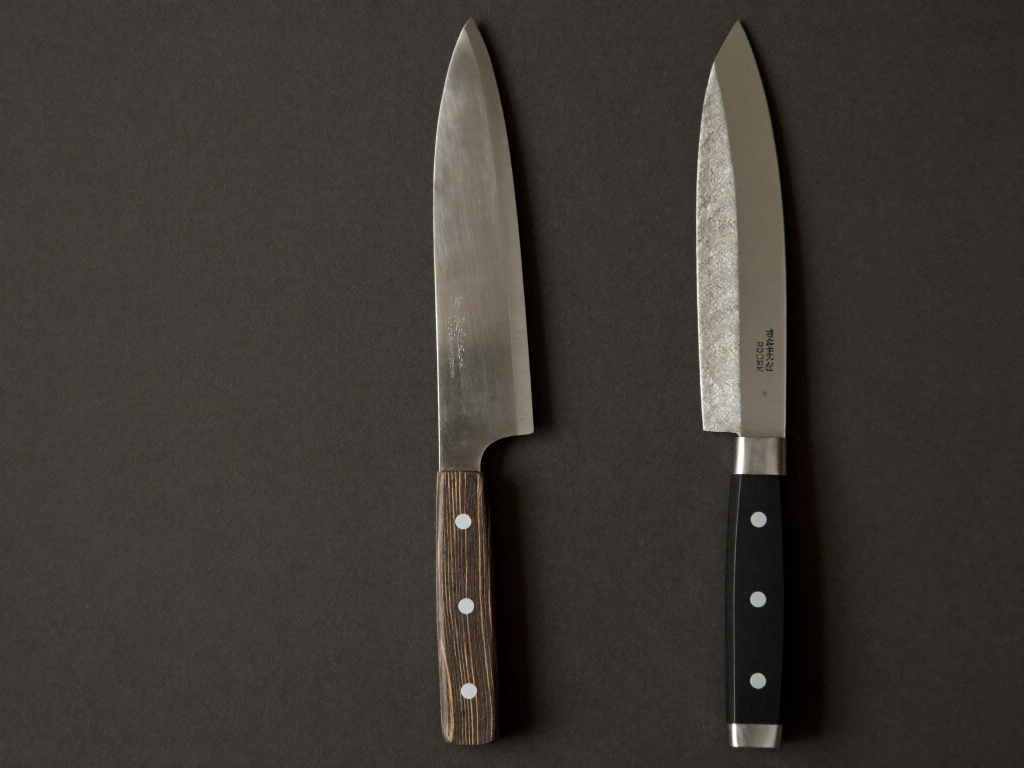
Damascus Knife Australia · Knife shape guide Santoku vs Chef Knife: Which Should You Buy? Both can handle most daily prep. The better choice comes down to blade length, edge curve and the cutting motion that feels natural in your hand. Blade shape explained6 real listingsAustralian buying advice Santoku and chef knife profiles facing each other A shorter santoku with a descending spine appears above a longer chef knife with a pointed tip and curved edge. Santoku · flatter edge Chef knife · curved edge Two versatile knives, two different rhythms Original profile illustration. Product photographs appear below. The direct answer Choose a santoku if you prefer a shorter 17 to 18 cm blade, a flatter cutting edge and controlled push cuts. Choose a chef knife if you want a longer pointed blade, more reach and a curved edge that supports rocking cuts. Smaller boards and smaller hands often suit a santoku. Large ingredients and long slicing strokes usually favour a chef knife. Affiliate disclosure: As an Amazon Associate I earn from qualifying purchases. Amazon buttons are affiliate links. This comparison is based on blade design and published listing details. We have not conducted hands-on performance tests. Check the exact model, seller, current price and delivery to your Australian postcode before ordering. Read our affiliate disclosure. Quick comparisonCutting motionKnife chooserSantoku examplesChef knife examplesSize and comfortCareFAQs Every product claim is attributed to its listing. No ratings or prices are invented.Pause animations 01 / The differences that matter Santoku vs chef knife at a glance A santoku and a chef knife overlap more than their names suggest. Either one can dice an onion, mince herbs, slice boneless meat and portion fish. Their different profiles change how those jobs feel. The santoku is normally shorter and flatter. A typical chef knife is longer, more pointed and more curved through the cutting edge. General shape comparison. Individual models vary, so inspect the actual blade profile before buying. Feature Santoku Chef knife Why it changes the choice Common blade length About 14 to 18 cm About 16 to 26 cm A shorter blade needs less board space. A longer blade covers more food per stroke. Tip Spine descends towards a rounded or sheep-foot style tip Narrow pointed tip The chef knife gives more reach for tip work and piercing. The santoku tip is less prominent. Edge profile Usually flatter Usually more curved A flatter edge favours push slicing. More curve supports rocking, provided the model has enough belly. Typical feel Compact and easy to place More reach and board coverage Comfort depends on the whole knife, including weight, balance, handle and blade height. Common strengths Vegetables, herbs, boneless meat and fish Large vegetables, long slices, herbs, meat and general prep Both are general-purpose knives. The cook’s motion matters more than cuisine labels. Less suitable for Bones, frozen food, hard twisting and prying unless the maker specifically designs the knife for that work Use a cleaver or other purpose-built tool for heavy tasks. ZWILLING’s knife-type guide describes santoku blades as commonly 14 to 18 cm long and chef knives as commonly 16 to 26 cm long. It also links the curved chef-knife profile with cradle cutting. These are useful category ranges, not rules for every model. One easy mistake: a shorter knife is not automatically lighter, and a Japanese-style label does not tell you where the finished knife was made. Look for an actual weight, country of manufacture and steel specification for the exact model. 02 / How each blade moves Push cutting or rocking? The edge profile sets the rhythm. A flatter santoku meets more of the board at once, which suits a forward-and-down slice followed by a lift or gentle pullback. A curved chef knife can pivot through a rocking motion while the tip stays close to the board. You can use several motions with either shape, but forcing a flat blade through an exaggerated rock feels awkward and can leave food uncut near the heel. Watch the edge follow the board Animated comparison of a santoku push cut and chef knife rocking cut The santoku moves forward and down over a board. The chef knife rotates around its curved tip. Santoku push slice Chef knife rock Forward + down, then reset Let the curved edge roll through This simplified animation shows the difference in motion. It is not a knife-skills lesson. Use a stable board, slow down and keep fingertips behind the blade. Shun’s use and care guidance recommends a smooth slicing action that moves forward and down, then back to reset. It also warns against using fine kitchen knives on bones, joints or frozen food. Follow the instructions for the exact knife you buy because edge geometry and intended use vary. Pick a santoku if this feels familiar You tend to lift the blade between cuts, prepare lots of vegetables and want a compact edge that is easy to place. You do not need a long tip for much of your prep. Pick a chef knife if this feels familiar You rock through herbs, slice large produce and like the reach of a 20 cm blade. You use the pointed tip for small cuts and want more curve under the edge. 03 / Match the knife to your kitchen Try the knife-shape chooser Select the motion and board space that resemble your kitchen. The result points to the stronger starting shape and explains why. It does not rank brands or predict performance. How do you normally cut? I push forward and liftI rock the blade through foodI use both motions What is your board and ingredient size? Small to mediumLarge board or large produceIt changes from meal to meal Start with a santoku A shorter blade and flatter edge suit a forward push cut and need less room on the board. See the santoku examples The chooser needs JavaScript. Use the comparison table above or the product examples below. 04 / Two santoku examples Shorter blades for controlled prep These two
Best Damascus Santoku Knives Australia
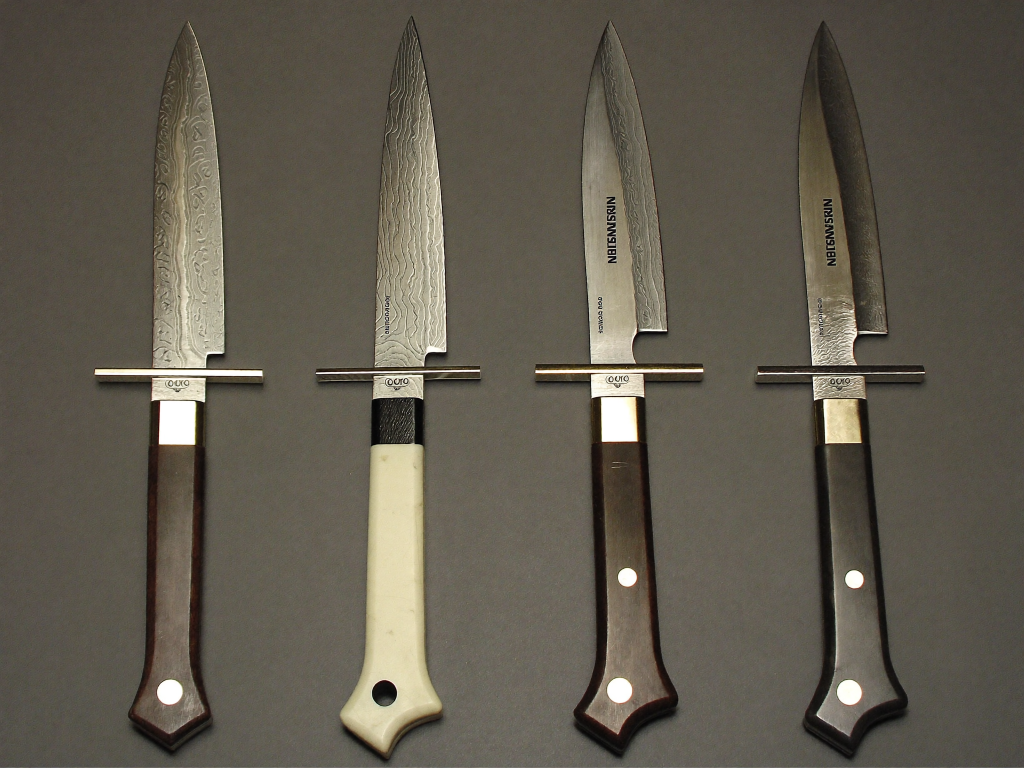
Damascus Knife Australia · Shape & steel guide Best Damascus Santoku Knives in Australia A beautiful blade is a good start. The right shape, clear steel details and a comfortable fit are what make it useful every evening. 2 seller-described Damascus santokus1 stainless alternative4 larger alternatives A santoku profile with a layered blade illustrationA broad blade with a descending spine, a relatively flat edge and a dark handle. Stylised artwork, not a product photograph. THE EVERYDAY PREP KNIFE A flatter cutting edge Vegetables · boneless meat · fishOriginal santoku illustration. Product photos appear below. The quick answer Start by comparing the 18 cm AUS-10 santoku if you want a named cutting-core steel. The UniqueFire resin-handle santoku is another option with a seller-stated VG10 core and colourful presentation. The PAUDIN is a stainless alternative for shoppers who want the santoku shape without requiring Damascus construction. These are listing-based comparisons, not hands-on test winners. Affiliate disclosure: As an Amazon Associate I earn from qualifying purchases. Amazon buttons are affiliate links. Check the selected model, seller, delivery to your Australian postcode and current price before ordering. Read our affiliate disclosure. Quick comparisonSantoku picksKnife chooserShape & motionSteel & layersLarger alternativesFAQs Illustrated buying guide · No invented ratings or live pricesPause animations 01 / The shortlist Which santoku deserves a place on your board? For onions, herbs, mushrooms and boneless chicken, a santoku can be an appealing everyday knife. The broad blade gives you room above the board, while a relatively short cutting edge can feel easier to place than a long chef knife. Whether that suits you depends on your hand, your board and the way you cut. This guide compares two listings advertised as Damascus santoku knives, then adds a PAUDIN stainless santoku for context. Four longer knives appear later because they answer a different question: would a chef knife or kiritsuke-style blade fit your cooking better? Specifications below are taken from the linked Amazon product titles and listing details. They are not independent material tests. Listing Blade length Steel description Reason to compare kanngou 18 cm AUS-10 Damascus Santoku 18 cm AUS-10 core, as listed AUS-10 claim and a dark handle UniqueFire 7-inch Resin-Handle Damascus Santoku 7 in / 17.78 cm VG10 core; 67 layers, seller-stated VG10 claim and a colourful resin handle PAUDIN 7-inch Stainless Santoku 7 in / 17.78 cm 5Cr15MoV stainless; not Damascus, seller-stated Santoku shape; Damascus is not essential What “best” means here: a practical shortlist organised by the information available, rather than a claim that these knives outperform the entire Australian market. We have not measured edge retention, hardness, weight or cutting performance. 02 / The santoku listings Two Damascus options, plus a stainless comparison Start with the shape you actually want. Then compare the steel claim, handle, seller information and total delivered price. A striking pattern does not settle all four questions. AUS-10 option to investigate kanngou: an 18 cm santoku with a stated AUS-10 core The most useful detail in this listing is the named AUS-10 cutting core. That gives you something specific to check beyond the word “Damascus”. The 18 cm blade also sits very close to the familiar 7-inch santoku size, making this a relevant starting point for everyday vegetable and boneless-meat preparation. Blade length 18 cm Steel stated by seller AUS-10 core, as listed View Amazon listing ↗ The product photograph shows a dark handle, a patterned blade and presentation packaging; the linked listing identifies the handle as ebony. Those details help you compare appearance; they cannot establish hardness, balance or how cleanly the knife moves through an onion. Ask for the precise model specification if those details are missing from the listing. Reasons to compare An explicitly named AUS-10 core in the listing title. A santoku-sized blade for cooks comparing everyday prep knives. What to check The listing claims 60–62 HRC and a 10–12° edge angle; we have not independently checked either. “Japanese steel” does not, by itself, establish that the finished knife was made in Japan. Our take: Choose it for further investigation if you prefer its dark handle and want to compare a seller-stated AUS-10 core. Confirm the core, construction and return terms on the exact variant before paying. VG10 option with a resin handle UniqueFire: VG10 claim and a colourful resin handle This 7-inch listing puts its patterned blade and natural-resin handle at the centre of its appeal. If you are buying a knife as a present, the product photo makes the colourful handle and presentation box easy to compare with the quieter styling of the AUS-10 option. Blade length 7 inches / 17.78 cm Steel stated by seller VG10 core; 67 layers, seller-stated View Amazon listing ↗ The linked UniqueFire listing identifies a VG10 cutting core and 67-layer construction. Those are seller specifications, not independently authenticated material results. The listing also makes performance comparisons with AUS-10, but we have no controlled test evidence to support declaring this knife more durable than the kanngou option. Reasons to compare A compact 7-inch format with a named VG10 core in the listing. Distinctive resin-handle appearance and gift-box presentation in the product image. What to check The seller states VG10 and 60 ± 2 HRC; neither is independently tested here. The listing’s “meat cleaver” wording should not be treated as permission to chop bones. Our take: Consider it if you prefer the resin handle and want to investigate a seller-stated VG10 option. For heavy chopping, choose a tool specifically designed for that task. Stainless alternative / explicitly not Damascus PAUDIN 7-inch stainless santoku The PAUDIN belongs in this comparison because it gives you another way to buy the santoku shape. The linked listing specifies 5Cr15MoV stainless steel and explicitly says it is not Damascus. We therefore treat this exact listing as a stainless alternative. Blade length 7 inches / 17.78 cm Steel stated by seller 5Cr15MoV stainless; not Damascus, seller-stated View Amazon listing ↗ Do not generalise from the brand name. A manufacturer can sell several ranges with different steels
What Does 67-Layer Damascus Steel Mean on a Knife?
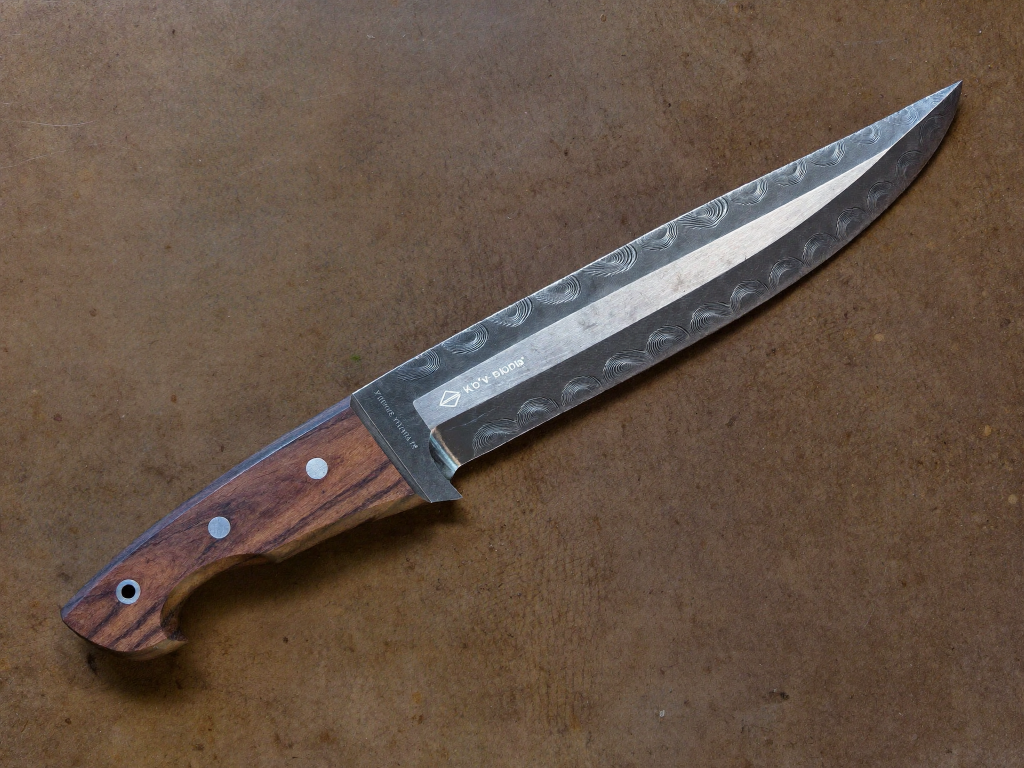
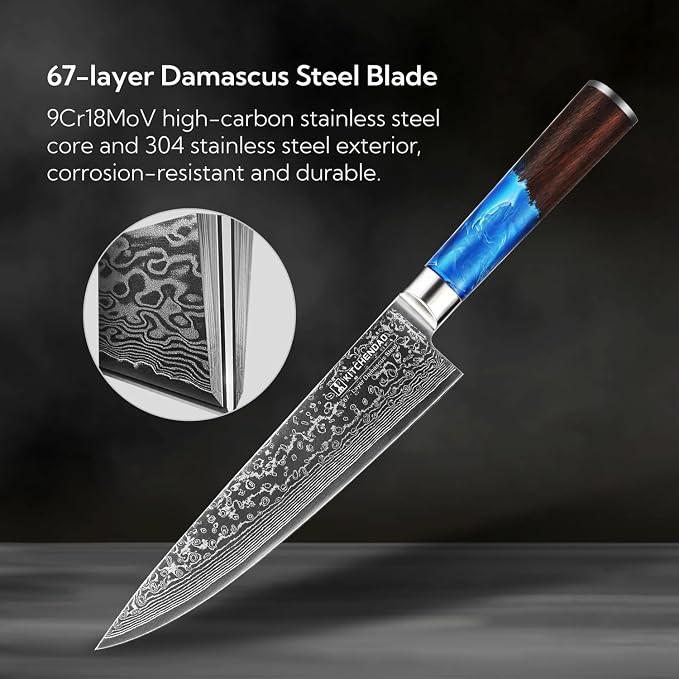
Damascus steel / read the listing What does 67-layer Damascus steel actually mean? On many kitchen knives, “67 layers” means a central cutting core with 33 patterned cladding layers on each side. The count describes the blade’s layered construction. It does not tell you how sharp the edge is, how long it will stay sharp, or whether that particular knife is well made. Check the maker’s construction diagram before applying the 33 + 1 + 33 explanation to a specific knife. Layer counts and the way brands describe them vary. The most useful follow-up question is: What steel forms the cutting edge? Blade pattern photograph supplied for this guide. The photo alone does not verify a 67-layer construction. This is an educational buying guide. Product descriptions are based on published listings and have not been verified by cutting tests on the named knives. Inside the blade Explore the patterned sides, the cutting core and the edge. This is a construction diagram, not a picture of a particular product. Whole blade Patterned sides Cutting core At the edge An illustrated knife with an exploded 33 plus 1 plus 33 layer cross-section The upper panel shows a patterned knife blade and a bright central cutting edge. The lower panel separates 33 cladding layers, one cutting core and 33 cladding layers. The drawing is schematic and not to scale. 01 / From the outside Pattern on blade face 02 / Through the thickness 33 1 33 Layered cladding Cutting core Layered cladding 33 patterned layers + one cutting core + 33 patterned layers = 67 in this documented construction.The animation and controls explain the construction. Actual layer thickness, pattern and count vary by model; the graphic is not to scale. Where are the 67 layers? Imagine looking at a thin slice through the thickness of a knife blade. In a clad construction, a harder steel sits in the centre and reaches the cutting edge. Patterned steel lies on both sides. Grinding exposes the alternating layers, and finishing can bring out the flowing pattern you see on the blade face. The construction is easier to verify when the maker names both the cladding and core. Katsura Cutlery describes its VG10 Damascus series as a VG10 cutting core with 33 layers on each side, 67 in total. Shun describes a different 69-layer arrangement: 34 cladding layers on each side and one VG-MAX cutting core. A materials study of knife steels also examines a laminated VG10-centred Damascus material and distinguishes its core from the surrounding layers. Other constructions exist. Pattern welding can combine steels throughout a billet instead of wrapping a separate core. A printed or etched imitation may only resemble a layered structure. The words “67-layer Damascus” in a title cannot settle which process was used. For a closer look at claims and patterns, read our real vs fake Damascus guide. Does more layers mean a sharper knife? No. An edge’s initial sharpness depends on how it is ground and finished. Its behaviour in use depends on the steel at the edge, heat treatment, geometry, the food and cutting surface, and maintenance. Counting the decorative layers does not measure those things. Metallurgist Larrin Thomas tested pattern-welded combinations in a published comparison of Damascus and other knife steels. The CATRA edge-retention tests in that work showed no clear difference attributable to layer count. Those tests concern the particular materials and methods studied; they are not performance scores for any Amazon kitchen knife. A useful distinction: in a knife with a separate core, sharpening exposes and renews that cutting steel. You are not trying to maintain a 67-layer stack at the very apex of the edge. Do not assume the same edge construction for a fully pattern-welded blade. What the number tells you, and what it leaves open Claim on the listing What you can take from it What to check next 67 layers The maker is claiming a particular layered construction. Ask for a diagram or an explanation of how the layers are counted. VG10 or AUS-10 core A named steel is claimed for the cutting core. Check that the name applies to the edge, not just an outer layer or an unrelated variant. Hardness in HRC A maker-supplied hardness target or claim. Check whether it is a measured range for that model and how the knife is ground. Hand forged or Japanese style Descriptions of a process or design, depending on the wording. Look for a specific maker, origin statement and manufacturing details. Damascus pattern A visible surface appearance. Confirm whether the pattern comes from layered steel or a finish. Origin claims deserve their own check. A Japanese-style blade is a shape or design description and does not establish where a knife was made. Australia’s ACCC explains how country-of-origin claims work and why a buyer should read the actual place-of-manufacture wording instead of inferring it from style. How to compare two 67-layer knives Suppose two listings both say “67 layers”. One identifies a VG10 cutting core, an 18 cm Santoku blade and a synthetic handle. Another gives a 21 cm Gyuto length but does not identify its core in the title. The shared layer count does not make them equivalent. First choose the size and shape that suit your cooking, then verify the core and seller details on each current listing. Start at the edge Find the exact cutting-core steel in the maker’s specifications. Our VG10 vs AUS10 vs 10Cr15CoMoV guide explains those names and their limits as buying shortcuts. Then choose the job A blade that is too long for your board or awkward in your grip will not become useful because it has more layers. Use our Australian chef knife guide to compare length, handle and shape. Read beyond the title Check the manufacturer’s model number, blade length, construction, seller, delivered price and return terms. A product title can merge features from different variants. Plan for upkeep The surface pattern does not make a knife maintenance-free. Wash and dry it promptly, store
Santoku vs Gyuto: Which Damascus Knife Should You Buy?
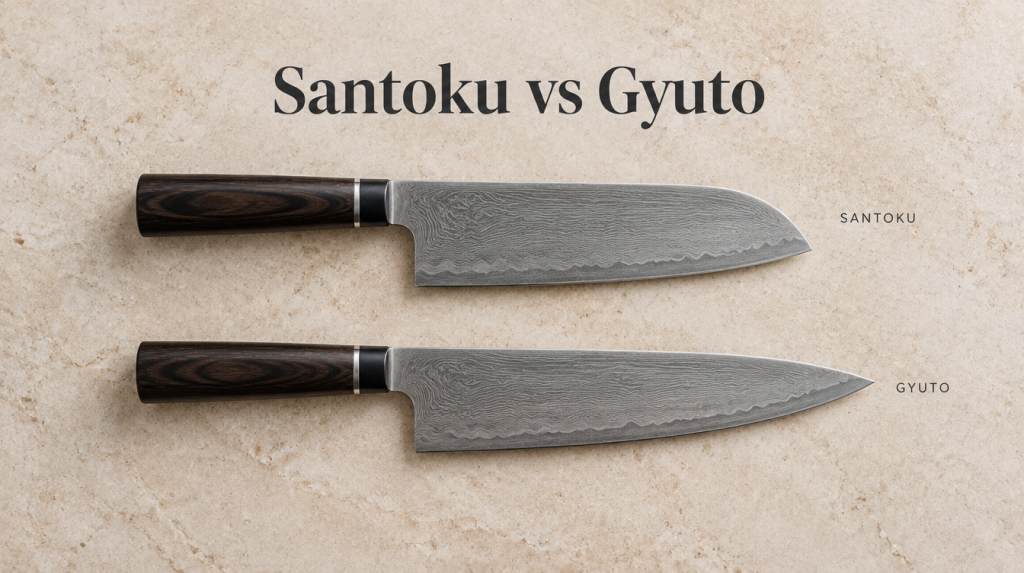
Japanese knife shapes / Australian buying guide Santoku vs Gyuto: which Damascus knife should you buy? Choose a Santoku if you want a compact, flatter-edged knife for everyday chopping. Choose a Gyuto if you want more blade length, a pointed tip and room for longer slicing strokes. Either can handle most home cooking. The shape and fit matter more than the Damascus pattern. For a smaller board and lots of vegetables, start by comparing Santoku knives around 16.5 to 18 cm. For large ingredients, frequent meat prep or one longer all-purpose blade, compare Gyutos around 20 to 24 cm. Those are shopping ranges, not rules: check the actual dimensions and grip of each model. As an Amazon Associate, this site earns from qualifying purchases. Product references below describe listings, not knives we have tested. Check the current seller, specifications and delivered price before buying. See the difference in the edge Santoku and Gyuto blade outlinesSchematic comparison of a shorter, flatter Santoku with a longer, more curved Gyuto. Not to scale. Santoku Shorter, flatter edge Gyuto Qualitative blade-profile diagram. Actual tip, belly and length vary by model. The outlines do not represent a measured product. What changes when you cut? A Santoku usually puts more of its edge near the board at once. Its tip slopes down and the blade often feels easy to steer through onions, carrots and other routine prep. A Gyuto generally has a more pronounced tip, more length and more curve toward the front. It gives you reach for a larger cabbage or a long slice through a piece of meat, while still handling vegetables. The two designs overlap. Japanese maker Tojiro describes Santoku as an everyday knife for meat, fish and vegetables, and gives home-use length ranges of 165 to 180 mm for Santoku and 160 to 240 mm for Gyuto. Shun’s blade-shape explanation also notes that the chef-knife profile is generally more suited to a rocking motion, while the Santoku tends to have a flatter edge. These are tendencies, so compare the photograph and measurements of the exact knife you are buying. Question Santoku Gyuto How does it feel on a small board? Its common shorter length is easier to accommodate. A longer model needs more clear board space. What cut feels natural? Push cuts and short, controlled chopping strokes. Longer slices, tip work and, on curved examples, rocking cuts. What about large ingredients? Check whether its length gives you enough reach. Often the easier choice for large produce and longer slices. Is it a specialist knife? No. It can be an everyday main knife. No. It can also be an everyday main knife. Pick by your usual prep, not the pattern Santoku may fit Vegetables and a compact kitchen If you usually make small batches of stir-fry, salads or weeknight dinners, a Santoku’s shorter footprint can feel comfortable. Look closely at the edge profile if you use a rocking motion: some Santokus allow a little rocking, but a relatively flat one rewards a different stroke. Gyuto may fit One longer knife for mixed work If you prep large vegetables, trim meat and want a longer drawing slice, a 20 or 21 cm Gyuto is a sensible starting point. A taller heel can also give your knuckles space, although handle height and your grip determine how it feels in practice. Neither blade replaces a bread knife for a crusty loaf. A short utility or petty knife can also be handier for peeling and small fruit. If you are buying your first serious kitchen knife, start with the shape you will use every day and add a second knife only when a task calls for it. Our chef knife buying guide goes deeper into size, grip and listing checks. Where Damascus fits into the decision “Damascus” on a listing can describe patterned outer layers around a cutting core, a pattern-welded blade or a decorative finish. It does not tell you the edge angle, heat treatment, thickness behind the edge or whether the handle fits your hand. Read our Damascus steel guide and pattern identification guide if the listing relies heavily on its appearance. Compare stated core steel only where the manufacturer actually supplies it. For example, one of the Santoku listings already featured on this site states an AUS-10 core, while a longer XINZUO Gyuto listing advertises 67 layers but does not identify its core in the supplied title. That does not establish which cuts better. It tells you what to verify before purchase. Our VG10, AUS10 and 10Cr15CoMoV comparison explains the steel names without treating them as a substitute for an actual knife assessment. Amazon Australia examples to compare These models give you concrete dimensions to compare. They appear in our existing buying pages, which contain the product details supplied for those guides. The descriptions here are based on those listings; we have not bought or tested the knives, and availability can change. Santoku / 18 cm Damascus Santoku with stated AUS-10 core A shorter all-purpose option for someone who wants a named core steel and a compact blade. Check the current listing’s maker, seller, construction and total delivered price. See it in the Japanese knife guide Santoku / 20 cm MITSUMOTO SAKARI Japanese Santoku This longer Santoku is closer to chef-knife length. Its listing names Damascus, but the core grade is not specified in the title used for our guide. Confirm the exact variant before comparing it with another blade. See it in the chef knife guide Gyuto / 20 cm MITSUMOTO SAKARI VG-Pro chef knife A roughly 20 cm Japanese chef-knife option. “VG-Pro” is the listing’s wording; confirm the exact alloy and blade geometry from the seller’s specifications. See it in the Australian picks Gyuto / 21.9 cm XINZUO Japanese-style Gyuto The extra length gives this model a different board presence from the 18 cm Santoku. The existing listing describes 67 layers and a wood and G10 handle. Verify the current seller’s core-steel details and shipping. See it in the Japanese knife
How to Choose a Damascus Chef Knife in Australia
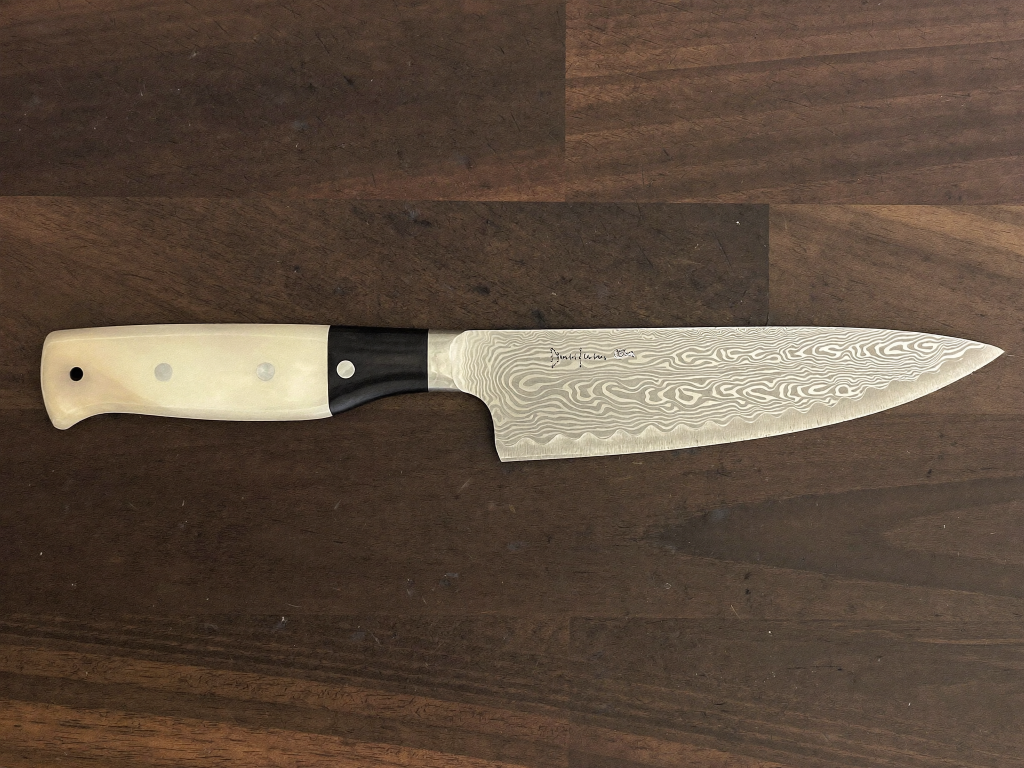
Kitchen knife buying guide How to Choose a Damascus Chef Knife in Australia The pattern may catch your eye. The knife still has to feel right when you chop an onion on a Tuesday night. Affiliate disclosure: Some links on DamascusKnife.com.au may earn us a commission if you purchase through them. Our selection advice below is based on the specifications and buying checks explained in this guide. Quick answer: For most home cooks, start with a 20 cm (approximately 8 inch) chef knife with a clearly named core steel, a comfortable handle and enough blade height for your knuckles to clear the board. Choose a shorter 18 cm blade if your hands or worktop are small; consider 21–24 cm if you regularly prepare larger batches. Compare the knife’s edge, geometry, balance and seller details before paying extra for the Damascus pattern. Chef knife buying prioritiesA stylised chef knife with labels for blade profile, cutting edge, core steel, handle and overall fit.HANDLE FITCORE + GEOMETRYLENGTHEDGE CAREThe pattern is visible. Fit, construction and edge care determine whether the knife earns its place in your kitchen. Jump to a section What Damascus means Pick the length Check the core steel Check the fit and cutting feel Shop in Australia Geometry and real cutting Find your starting size Shop in Australia Care and FAQs First, know what you are buying “Damascus” describes a visible patterned construction, not one universal blade recipe. Many modern kitchen knives have a hard cutting core clad in patterned layers; some patterned blades are made by welding different steels together. The visible layers and the cutting edge can therefore be different materials. Ask what steel forms the edge, not just how many layers are on the sides. Knife Steel Nerds has tested pattern-welded combinations and examined common performance myths. Its research is a useful reminder that a layer count or striking pattern alone cannot tell you how a finished knife will cut or hold an edge. Read the pattern-welded steel testing alongside our Damascus steel guide if you want the deeper explanation. Product-listing test: Can you find the core steel, blade length, overall weight, handle material, care instructions, seller identity and return terms? If the page only says “67 layers” and “razor sharp,” keep looking. What a good chef knife actually needs to do Picture three ordinary jobs: finely chopping an onion, slicing ripe tomatoes and breaking down a cabbage. The knife should start each cut without skating, pass through the food without unreasonable force, and remain comfortable for the full session. Damascus patterning can make it a pleasure to own, but it does not replace those basics. Most buyers can simplify the search to three questions. First, is the blade size practical for my board and ingredients? Second, does the steel and construction match the care I am willing to give? Third, can I trust the seller’s description enough to know what is being delivered? The sections below turn those questions into checks you can apply to any listing. You do not need an expensive collection to cook well. A chef knife handles most chopping, slicing and mincing; a small paring knife takes care of close work. Buy the knife that fits your routine before buying extra shapes because they look attractive in a block. Choose a blade length that suits your kitchen Length changes the amount of food you can cut in one stroke and the space the knife needs on the board. There is no magic size for every hand. A longer blade can make batch prep easier; a shorter one can feel more controlled in a compact kitchen. 18 cm A good starting point for a small board, a smaller hand or someone who finds a full-size chef knife unwieldy. Check that the handle and blade height still leave room for your fingers. 20–21 cm The versatile middle ground for most home cooking: vegetables, herbs, boneless meat and everyday slicing. Start here if you are unsure. 23–24 cm Useful when you routinely work through large vegetables or lots of ingredients. Make sure your chopping board and storage space can accommodate the blade safely. Guide to chef knife blade lengths18 centimetres suits compact workspaces; 20 to 21 centimetres is the everyday middle ground; 23 to 24 centimetres suits larger preparation tasks.18 cmCompact20–21 cmEveryday starting point23–24 cmLarge prepMatch the blade to your board, hand and cooking habits.These are shopping starting points, not a performance ranking. Chef knives also differ in profile. A curved belly supports a rocking chop, while a flatter section can suit a more up-and-down push cut. Look at the actual blade photograph from the side. If you mostly slice vegetables, either can work; choose the motion you naturally use. If you are considering a shorter, flatter alternative, compare it with a santoku before ordering. Which length should you examine first? Choose the description closest to your kitchen. This is a guide to where to start, not a verdict on your ideal knife. Small board or tight space Everyday mixed cooking Frequent large-batch prepBegin around 18 cm. Check blade height and handle clearance. A short blade can still feel bulky if its handle is oversized or its balance is far forward.Begin around 20–21 cm. This is the broadest starting range for varied prep. Compare weight and profile next.Examine 23–24 cm options. The longer edge can help with big ingredients, but it needs a stable, generously sized board and safe storage. Read the core steel before the layer count The steel at the cutting edge, its heat treatment and the edge geometry all matter to real-world use. Some listings name VG-10, AUS-10 or 10Cr15CoMoV; those names identify steel families, but they do not guarantee that two finished knives perform the same way. A thin edge may glide through food but require gentler handling. A thicker edge may feel sturdier but wedge through a dense carrot. Use our VG-10 vs AUS-10 vs 10Cr15CoMoV comparison to understand the labels. When a listing omits the core steel, ask the
VG10 vs AUS10 vs 10Cr15CoMoV: Which Knife Steel Is Better?
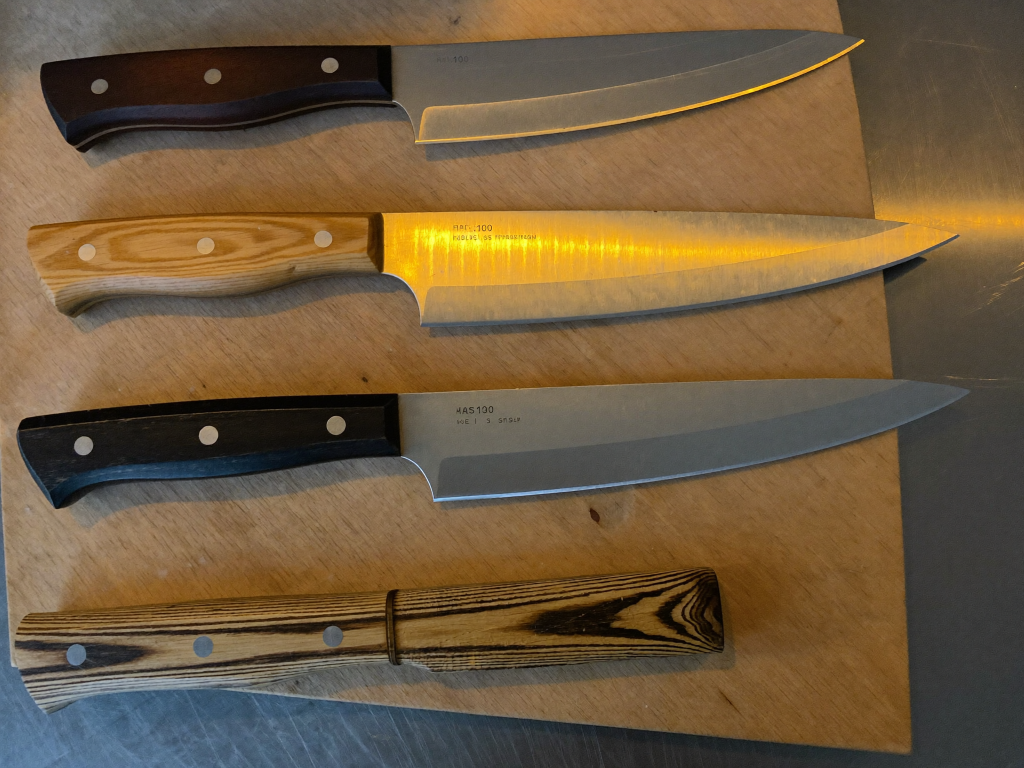
Knife steel comparison VG10 vs AUS10 vs 10Cr15CoMoV: Which Knife Steel Is Better? VG10, AUS10 and 10Cr15CoMoV all sit in the useful high-carbon stainless kitchen-knife category, but the names do not tell the whole story. Their chemistry differs, manufacturer traceability differs, and the finished knife can change dramatically depending on heat treatment, hardness, blade geometry and sharpening. Composition Edge retention Corrosion resistance Toughness Sharpening Damascus knives VG10 AUS10 10Cr15CoMoV Short answer VG10, AUS10 or 10Cr15CoMoV? VG10 is the easiest of the three to verify when it is genuine Takefu VG10, AUS10 is an excellent everyday stainless steel with a slightly different alloy recipe, and properly made 10Cr15CoMoV can sit remarkably close to VG10 on paper. That does not mean every VG10 knife automatically outcuts every AUS10 knife, or that 10Cr15CoMoV is simply another name for VG10. Heat treatment, actual hardness, carbide structure, edge angle and blade thickness can have as much influence on the finished knife as the steel name printed in the listing. Choose VG10 when Material traceability and a proven Japanese blade-steel specification matter to you. Choose AUS10 when You want a balanced stainless kitchen knife that is generally straightforward to maintain. Choose 10Cr15CoMoV when The knife comes from a credible maker that states its heat treatment and finished hardness. VG10 vs AUS10 vs 10Cr15CoMoV: three popular stainless steels used in modern kitchen and Damascus knives. In this comparison Quick comparison What is VG10? What is AUS10? What is 10Cr15CoMoV? Chemical composition Edge retention Toughness and chipping Corrosion resistance Sharpening Why heat treatment matters Using these steels in Damascus knives Which should you buy? FAQ At a glance VG10 vs AUS10 vs 10Cr15CoMoV comparison These are material-level tendencies rather than guaranteed performance figures for every knife. A finished knife should be judged using its actual hardness, geometry, heat treatment and manufacturer documentation. Factor VG10 AUS10 10Cr15CoMoV Steel family High-carbon martensitic stainless High-carbon martensitic stainless High-carbon martensitic stainless Common origin Japan Japan China Published carbon About 1.00% About 0.95 to 1.10% About 0.95 to 1.05% in one supplier specification Published chromium About 15.00% About 13.00 to 14.50% About 14.50 to 15.50% in one supplier specification Cobalt About 1.55% Not part of the usual AUS10 reference composition Present in the supplier specification reviewed Corrosion behaviour Good stainless performance with normal care Good stainless performance with normal care Good stainless potential when correctly processed Sharpening Generally manageable on normal water stones Generally manageable Generally manageable at typical kitchen-knife hardness Biggest advantage Strong producer-level documentation when genuine Balanced everyday characteristics Potentially strong value for similar alloy chemistry What to verify Authenticity, HRC and maker HRC, heat treatment and geometry Actual material source, HRC and heat treatment Genuine VG10 data is published by Takefu Special Steel. AUS10 reference ranges can be compared through the ZKnives steel database. Meet the steels What are these three knife steels? V What is VG10? VG10 is an original stainless blade steel produced by Takefu Special Steel in Japan. Takefu lists representative chemistry of about 1% carbon, 15% chromium, 1% molybdenum, 0.25% vanadium and 1.55% cobalt. The company lists a hardness capability of HRC 60 or above and describes VG10 as suitable for kitchen knives and other cutting tools. Genuine VG10 refers to a documented proprietary blade steel rather than simply a marketing phrase. A What is AUS10? AUS10, also written AUS-10 or AUS-10A, is a Japanese stainless knife steel associated with the AUS family. Commonly published reference ranges place its carbon around 0.95 to 1.10%, chromium around 13 to 14.5%, with smaller additions of molybdenum and vanadium plus nickel. AUS10 is its own steel rather than simply a lower-grade version of VG10. 10 What is 10Cr15CoMoV? 10Cr15CoMoV is a high-carbon stainless blade-steel designation commonly encountered in Chinese knife manufacturing. Published specifications can place it around 0.95 to 1.05% carbon, 14.5 to 15.5% chromium, roughly 1% molybdenum and smaller additions of vanadium and cobalt. That explains why it is frequently compared with VG10, but similar chemistry does not prove every 10Cr15CoMoV blade is identical to genuine Takefu VG10. With 10Cr15CoMoV, manufacturer transparency matters more than a vague “VG10 equivalent” claim. Inside the alloy Chemical composition: what actually changes? The three steels overlap heavily in carbon and chromium, but alloying details are not identical. More importantly, percentages do not operate independently. Heat treatment determines how the alloy develops into the microstructure of the finished blade. Published alloy fingerprint The following bars illustrate approximate published chemistry. They are not performance scores. Chromium VG10 ~15.0% AUS10 13-14.5% 10Cr15CoMoV 14.5-15.5% Carbon VG10 ~1.0% AUS10 .95-1.10% 10Cr15CoMoV .95-1.05% Cobalt VG10 ~1.55% AUS10 Not typical 10Cr15CoMoV 1.3-1.8% Alloy percentages should not be converted directly into edge-retention, toughness or corrosion scores. Element VG10 AUS10 reference range 10Cr15CoMoV reference range Why it matters Carbon ~1.00% 0.95-1.10% 0.95-1.05% Supports hardness and carbide formation. Chromium ~15.00% 13.00-14.50% 14.50-15.50% Supports corrosion resistance and hardenability. Molybdenum ~1.00% 0.10-0.30% ~0.90-1.00% Contributes to hardenability and wear behaviour. Vanadium ~0.25% 0.10-0.25% 0.25-0.35% Can support grain refinement and carbide formation. Cobalt ~1.55% Not usually listed 1.30-1.80% Influences heat-treatment response. Nickel Not highlighted in Takefu’s VG10 table ~0.49% Specification dependent Can influence toughness and corrosion behaviour. A chemistry table is not a finished-knife test. Two blades using nominally similar steel can perform differently after austenitising, quenching, tempering, grinding and sharpening. Cutting performance Which holds an edge longest? There is no defensible universal answer saying every VG10 blade holds an edge longer than every AUS10 or 10Cr15CoMoV blade. Cutting performance depends strongly on hardness, carbide structure, edge angle, thickness behind the edge and sharpening quality. A thin, well heat-treated AUS10 chef knife can therefore outperform a poorly ground VG10 knife in actual kitchen use. The same principle applies to 10Cr15CoMoV. Practical answer: all three have enough carbon and alloy content to provide strong everyday kitchen-knife edge retention when the manufacturer processes the steel properly. For more background, read our complete Damascus steel guide. Edge stability VG10 vs AUS10 vs 10Cr15CoMoV for toughness and chipping What matters Harder is not automatically better Hardness can help a
How Much Does a Damascus Knife Cost? Australian Price Guide
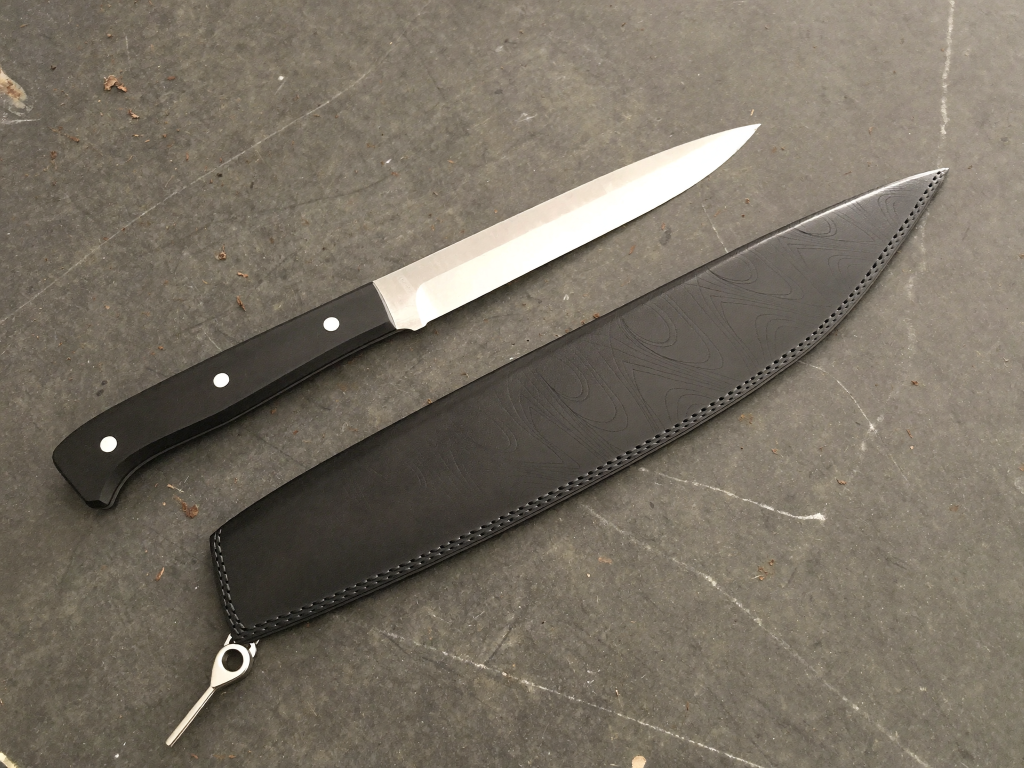
Australian Damascus Knife Guide How Much Does a Damascus Knife Cost? A Damascus knife can cost less than A$100 or several hundred dollars for a single kitchen knife. Handmade and collector pieces can cost considerably more. The pattern on the blade is only one part of the price. Cutting steel, heat treatment, blade geometry, manufacturing method, finishing, handle materials and the amount of handwork all matter. How much does a Damascus knife cost in Australia? Quick answer: a practical shopping range for a single Damascus kitchen knife is roughly A$60 to A$500+. Entry-level knives are available below A$100, many named-steel production knives sit around A$120 to A$300, and premium production knives commonly move above A$300. Handmade work can go well beyond those figures. The important part is that price and layer count do not tell you everything about quality. A knife with a clearly identified cutting steel, sensible blade geometry and good manufacturing can be a more useful purchase than a more expensive knife sold primarily around an impressive-looking pattern. Under A$80 Budget territory. Examine steel and construction claims carefully. A$80 to A$150 Entry-level Damascus and Damascus-clad kitchen knives. A$150 to A$300 A large part of the named-steel production-knife market. A$300+ Premium production, specialist and artisan territory. Affiliate disclosure: DamascusKnife.com.au may earn a commission from qualifying purchases made through some links on this page. This does not increase the price you pay. Amazon prices and availability can change, so always check the live product listing before purchasing. Damascus knife prices vary widely because the word Damascus can describe knives made with very different steels, manufacturing methods and levels of finishing. In this guide Damascus knife price ranges Why Damascus knives cost more Does layer count affect price? Australian market price guide Real knives to compare Are cheap Damascus knives fake? How much should you spend? Budget estimator Handmade Damascus prices Frequently asked questions Damascus knife price ranges explained There is no official price that makes a Damascus knife genuine or high quality. Instead, it is more useful to treat the market as several broad pricing bands and then inspect what you actually receive within each band. Typical price Market tier What you may find What to check Under A$80 Budget Lower-cost chef knives, smaller knives, lesser-known brands and products marketed heavily around appearance. Cutting steel, construction method, seller information, returns policy and whether the word Damascus refers to layered construction or mainly the visual pattern. A$80 to A$150 Entry Damascus-clad kitchen knives, more identified steel types and products with better specification information. Core steel, blade geometry, handle construction, hardness claims and manufacturing details. A$150 to A$300 Mid-range Many VG-10, AUS-10 and comparable stainless-core Damascus kitchen knives from established production ranges. Whether the additional price reflects better steel, heat treatment and finishing rather than simply a larger advertised layer count. A$300 to A$500 Premium Premium production knives, specialist steels, higher-end handles and more elaborate finishing. Steel specification, blade grind, maker reputation, manufacturing origin and what the additional cost actually provides. A$500+ Artisan Handmade knives, specialist makers, intricate patterns, custom handles, unusual materials and collector-oriented pieces. Maker provenance, individual craftsmanship and whether you are paying primarily for utility, artistic work, rarity or all three. Damascus knife price spectrum Price generally increases as you move from large-scale production toward premium materials, individual finishing and handmade work, but a higher price is not a guarantee of better cutting performance. Damascus knife price spectrum in Australian dollars A visual scale showing budget knives below 80 Australian dollars, entry knives from 80 to 150 dollars, mid-range knives from 150 to 300 dollars, premium knives from 300 to 500 dollars and artisan knives above 500 dollars. Under A$80 Budget A$80-A$150 Entry A$150-A$300 Mid-range A$300-A$500 Premium A$500+ Artisan The price tag alone cannot tell you how well a knife will cut. Why are some Damascus knives so expensive? Two knives can both have a visible Damascus pattern yet require completely different materials, manufacturing methods and amounts of skilled labour. These factors usually tell you more than the advertised layer count. 1 The cutting steel Many modern Damascus kitchen knives are laminated. A harder cutting core sits between layers of patterned steel. In that design, the core forms the cutting edge. Knowing the core steel is therefore much more useful than seeing only a claim such as “67 layers.” 2 Heat treatment Steel grade alone does not determine the finished knife. Heat treatment is used to develop the hardness and microstructure required by the manufacturer. Two knives made from nominally similar steel can behave differently if they are processed differently. 3 Blade geometry A beautiful knife can still feel thick and inefficient when cutting food if too much steel remains behind the edge. Producing a thin, even and appropriate grind takes manufacturing control and skilled finishing. 4 Layered construction Creating patterned layered steel involves additional processing compared with making a straightforward blade from a single piece of steel. More elaborate patterns can require repeated forging, manipulation, grinding, polishing and etching. 5 Handle and finishing Synthetic handles can be relatively inexpensive. Stabilised timber, carefully selected hardwoods, premium composites and individually fitted materials can add cost. Polishing, rounding edges, fitting handles and producing an even final finish also take time. 6 Production scale A factory producing thousands of knives can spread equipment and labour costs across a large production run. A bladesmith producing one knife at a time may personally forge, grind, heat treat, finish and sharpen each blade. Does a higher Damascus layer count mean a better knife? No. Layer count can describe part of a knife’s construction and appearance, but it is not a universal quality score. What layer count can tell you How a manufacturer describes its layered construction Something about the intended visual pattern The approximate number of layers in a laminate or billet Potential manufacturing complexity What layer count cannot tell you How thin the blade is behind the edge Whether heat treatment is appropriate How comfortable the handle will feel How well the knife
Damascus Steel Guide
Steel guide · History, metallurgy, buying Damascus Steel Guide: What It Is, How It Is Made and What Actually Matters Damascus steel is famous for the pattern, but the pattern is only the beginning. This guide separates historical wootz from modern pattern-welded steel, explains Damascus cladding on kitchen knives, and shows you which details matter when you are choosing a blade. Quick answer Damascus steel is not one specific steel grade. Historically, the name is associated with patterned crucible steel often called wootz. In modern knives, “Damascus” usually means either pattern-welded layers of different steels or decorative patterned cladding around a separate cutting core. A good Damascus knife can be excellent, but the pattern and layer count alone do not tell you how well it will cut. What Damascus means History How it is made Layer count Performance Patterns Buying checklist Care FAQ First, “Damascus steel” can mean three different things The easiest way to understand Damascus is to stop treating the name as a single recipe. The label is used for three related but technically different blade constructions. Knowing which one you are looking at prevents most of the confusion around sharpness, rust resistance, layer counts and price. Historical Wootz / crucible Damascus A high-carbon crucible steel whose visible bands form from its internal microstructure. It is not made by stacking alternating sheets of steel. Modern Pattern-welded Damascus Different steels are forge-welded into a billet and manipulated so the layers create a visible pattern after finishing and etching. Common in kitchen knives Damascus-clad core steel Patterned outer layers surround a separate hard cutting core. The core reaches the edge and usually has the biggest influence on edge retention. For a shorter introduction, see our What Is a Damascus Knife? guide. This page goes deeper into the steel itself, including what metallurgy research says about the pattern. The historical steel was not folded modern Damascus The material that gave Damascus its legendary reputation is generally associated with wootz, a high-carbon crucible steel produced in South Asia and traded widely. Historical research and metallographic work show that the characteristic watered pattern could arise from bands of iron carbide, or cementite, inside the steel as the ingot was carefully forged. That matters because old Damascus and modern pattern-welded Damascus reach a similar visual destination by very different routes. Research by metallurgists J. D. Verhoeven, A. H. Pendray and E. D. Gibson describes wootz patterns as bands of cementite particles generated within crucible steel during processing. You can read the Materials Characterization study on wootz Damascus steel blades. Earlier research on Indian wootz also describes the material as an unusually high-carbon crucible steel and discusses how it was produced before being forged into blades. The useful point for a modern knife buyer is simple: a kitchen knife advertised as “Damascus” today is almost never made by the historical wootz process. Terminology note: modern pattern-welded Damascus is not “fake” just because it is not historical wootz. Pattern welding is a legitimate forging method with its own history and skill. The problem begins only when a seller implies that a modern layered knife is the same material as historical crucible Damascus. How modern pattern-welded Damascus is made Modern pattern-welded steel begins with two or more steels chosen to bond together and show contrast after finishing. The smith stacks the material, heats it to forging temperature, forge-welds it into a solid billet, then draws, cuts, folds, twists or otherwise manipulates the billet. The blade is ground and heat-treated, then polished and etched so the different alloys react at different rates and reveal the pattern. 1. STACK 2. FORGE WELD 3. MANIPULATE 4. ETCH The pattern is designed into the billet, then made visible by polishing and differential etching. Heat treatment and blade geometry still determine whether the finished knife is genuinely good. A frequently repeated explanation says the light and dark bands in modern Damascus are simply “hard high-carbon steel and soft low-carbon steel.” That is too simplistic. A study of carbon diffusion in modern pattern-welded Damascus blades found that carbon can diffuse enough during forging to reduce the expected hardness differences between layers. The authors argued that differences in alloying elements can be more important to the contrasting etch. This is also why a beautiful pattern does not automatically prove a superior blade. The billet still needs sound welds, appropriate alloys, controlled heat treatment and good grinding. Does a higher Damascus layer count mean a better knife? No, not by itself. Layer count mainly changes the scale and density of the visual pattern. It is not a universal performance rating. Two knives can both advertise 67 layers and cut very differently because they use different core steels, heat treatments, edge geometries and manufacturing tolerances. Myth “More layers always means stronger steel.”Layer count describes construction, not a guaranteed increase in toughness, hardness or edge life. What matters Core steel, heat treatment and geometry.Those details tell you far more about how a kitchen knife is likely to sharpen, hold an edge and behave in use. Myth “A 67-layer knife has 67 cutting edges.”On many Damascus-clad kitchen knives, the central core forms one cutting edge while the surrounding layers provide cladding and pattern. Useful context “67 layers” often means 33 layers per side plus one core.That construction is common, but makers count and describe layers differently, so check the specification rather than assuming. The metallurgical literature on pattern-welded blades even notes that practical visual patterns can involve many layers, but the research is about pattern formation and diffusion, not a claim that a specific number is a universal quality threshold. Treat layer count as a design specification, not a performance score. What actually determines how a Damascus knife performs? When a Damascus knife is built around a separate core, the most useful performance information is usually hidden under the pattern. Start with the core steel, then look at how that steel was heat-treated and ground. Core steel The alloy at the cutting edge influences achievable hardness, wear
How to Clean and Care for a Damascus Knife
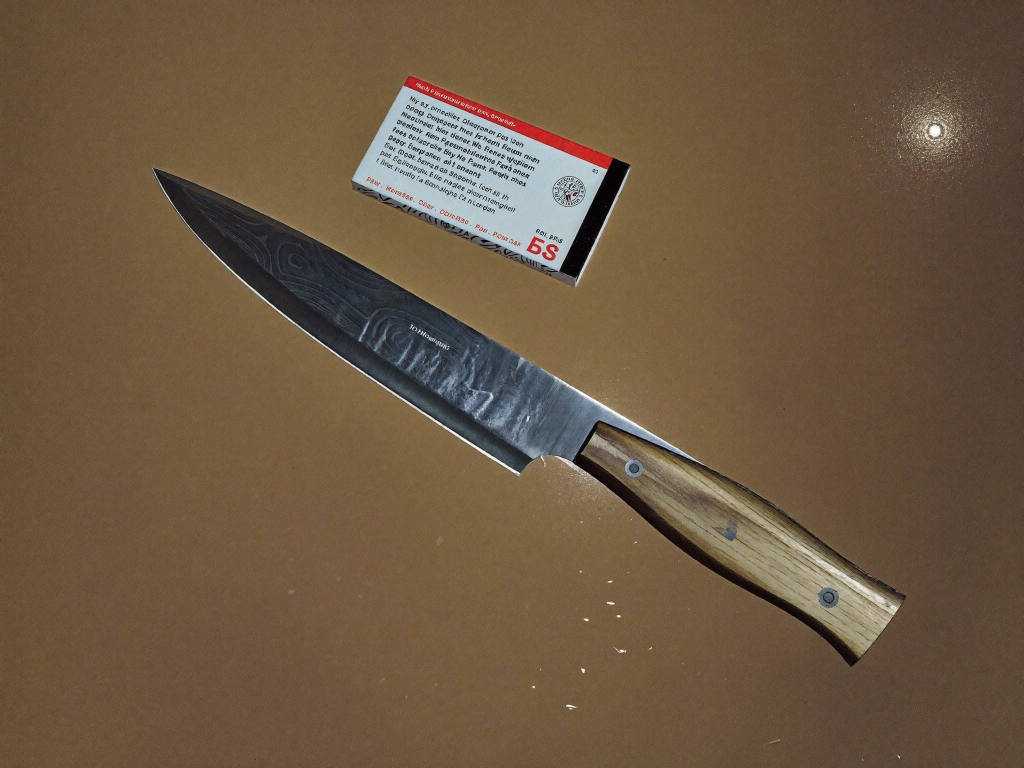
Knife care · The full routine How to Clean and Care for a Damascus Knife Short answer: hand wash, dry it straight away, keep a thin film of oil on the steel, store it edge-free, and treat rust the moment it appears. The rest of this page is the whole cycle, drawn as five stations and one honest warning. THE CARE CYCLE 5 STATIONS · ONE ROUTINE Wash start here Dry seconds, not minutes Oil thin film only Store edge never touches Edge weekly, light Wash Dry Oil Store Edge Rust first aid The danger zone Water is the enemy in disguise. The edge gets all the attention, but the blade fails through moisture, neglect and bad storage, one dishwashing cycle at a time. Station 01 Wash Warm water, mild soap, soft sponge, thirty seconds. Rinse the blade under warm water as soon as you finish cutting. Acid from tomatoes, citrus and onions is already at work in that time. Wash with mild dish soap and a soft sponge only, moving along the blade, never across it. Pay attention to the join where blade meets handle. That corner traps water and holds it against the steel all night. Never, ever soak. A soaking blade is a rusting blade in slow motion, and the chemistry behind it is worth knowing. Rust needs oxygen and water together, and steel corrodes through an electrochemical reaction at the surface. That is why the single most protective habit is drying, not oiling. The UCF chemistry textbook on corrosion spells out the reaction, and it makes the rest of this page make sense. Station 02 Dry Dry it before you reach for the next task. It takes eight seconds. Use a clean, lint-free cloth and dry the whole blade in one direction, edge away from your hand. Dry the handle too. Wood and resin handles soak up enough water to swell, split and eventually loosen the tang inside. Let it air out for a minute on a dry towel or magnetic strip, edge pointing safe, then put it away. The instruction is so unglamorous that makers repeat it like a mantra. MISAKI’s official care notes for their Damascus lines put it first: clean by hand immediately after use and dry straight away. The people who forge the steel are telling you the exact same thing this article is telling you. Station 03 Oil A thin film, not a coating. You want it visible, not dripping. Use a food-safe knife oil, such as food-grade mineral oil, or a camellia oil specifically labelled for kitchen knives. Avoid cooking oils that can oxidise or become sticky during storage. Wipe a little oil along a soft cloth, then run it down both sides of the blade. You are sealing the steel against air and moisture, not making it greasy. Oiling matters most when the knife rests for days, in humid kitchens, and before long storage. A knife used daily in a dry climate needs it far less often. The same chemistry that makes rust need oxygen and water is what makes oil work: a continuous film cuts both off. When the UCF corrosion chapter explains that iron rusts in the presence of oxygen and water, the oil film is your side of the bargain. Station 04 Store The edge should never touch anything. That is the whole rule. Drawer junk-drawer storage is how edges die: rattling against forks and spoons chips the thin steel invisibly. A magnetic strip, a knife block, or a blade guard in a drawer. All three do the same job and all three are fine, pick based on your kitchen and your kids. Store edge down in a block or edge away on a strip, and never let the pattern side rub against another blade. Long rest, weeks or months? Oil it first, then store it dry and flat out of humidity. Station 05 Edge Maintain the edge lightly and sharpen only when performance drops. Less steel removed means a longer-lived knife. If your knife maker recommends honing, use a few light passes at the correct bevel angle. Many hard Japanese-style edges are better maintained with a fine ceramic rod or stropping rather than a grooved steel. When slicing performance no longer returns with light maintenance, that is the whetstone cue. Full guidance lives in the sharpening guide, including the angle dial. Avoid aggressive pull-through or electric sharpeners unless your knife maker specifically recommends one. They can remove more steel than needed and may scratch a patterned finish. light passes, same angle Rust first aid, stage by stage Rust on Damascus is embarrassing when it happens and always avoidable. But it happens, usually after a soak or a humid week. The right response depends on how far it has gone, so match the stage before you grab anything abrasive. Stage 1 · Light Fine orange spots and a dull film. Clean the blade, make a paste of baking soda and water, rub gently with a soft cloth in circles, rinse and dry. It goes. Link to the real vs fake guide if you are also wondering what kind of steel you are cleaning. Stage 2 · Spots Visible spots with a slight texture. A fine abrasive pad with oil, moving with the blade grain, removes surface rust. Stop often, check, and accept a slight pattern change in the treated area. If it resists, step down to the next stage. Stage 3 · Pitting Dark, cratered, textured rust that has bitten into the steel. This is beyond a paste. A professional or a careful fine-stone session can remove it, but pitting changes the blade permanently. Prevention is the only clean fix, and it is free. Everything in stage two and beyond involves removing material, which is why the pattern in the treated zone may fade or shift. On real layered steel the structure still runs through the blade, so this is cosmetic. On a surface finish, it is a different story, and sharpening and abrasive care
Damascus vs Stainless Steel Knives: Which Is Better?
Knife steel comparison Damascus vs Stainless Steel: Which Is Better for a Kitchen Knife? Damascus steel is not automatically better than stainless steel, and the two are not always opposites. Many modern Damascus kitchen knives actually use stainless steel. If you are choosing between them, look beyond the pattern and compare the cutting steel, heat treatment, blade geometry, corrosion resistance, construction and maintenance. Short answer Is Damascus steel better than stainless steel? Not automatically. A high-quality Damascus knife can be an excellent cutter, but its pattern does not make it sharper or tougher by itself. A good stainless steel knife can perform just as well or better. For everyday cooking, stainless steel usually offers easier care. Damascus makes the most sense when you want strong knife performance plus the distinctive appearance and craftsmanship of patterned steel. Want simple maintenance? Stainless steel is usually easier to live with. Want the Damascus appearance? Choose a properly specified layered or clad knife. Want the best cutting performance? Compare the edge steel, heat treatment and geometry. Damascus vs normal steel ↗ The pattern is obvious. The performance difference is not. Steel composition, heat treatment, blade geometry and the actual cutting edge tell you more than appearance alone. Damascus steel is easy to recognise visually, but the visible pattern alone cannot tell you how well a finished knife will cut. Jump to a section Damascus and stainless are not opposites Damascus vs stainless comparison How each type is constructed What metallurgy research tells us Sharpness and edge retention Rust and corrosion resistance Toughness and chipping Maintenance and sharpening Appearance and authenticity Price and value Which should you choose? Frequently asked questions Start here A Damascus knife can also be a stainless steel knife The phrase “Damascus vs stainless steel” makes the choice sound simple. One knife is Damascus. The other is stainless. Pick a side. Real kitchen knives are not quite that tidy. Stainless steel refers to a broad group of steels designed to offer substantial resistance to corrosion. Damascus, as the term is commonly used for modern kitchen knives, usually refers to a layered or patterned construction. Those descriptions can overlap. A modern Damascus chef knife might have a stainless cutting core such as VG-10 or AUS-10 surrounded by patterned stainless cladding. Another Damascus blade might be made from forge-welded layers of two steels. A plain stainless chef knife might use one steel throughout the blade and display no visible pattern. The useful distinction: Damascus tells you something about the appearance or construction of the blade. Stainless tells you something about the corrosion-resistant nature of the steel. Neither word, by itself, proves that a knife is superior. That is why buying a knife solely because the product title says “Damascus steel” can be misleading. You still need to know what the cutting edge is made from, how the blade was heat treated and whether the geometry suits the kind of cooking you do. If you want the complete background first, read our guide to what a Damascus knife is. It explains the difference between modern pattern-welded steel, clad kitchen knives and the historical materials commonly associated with the Damascus name. At a glance Damascus steel vs stainless steel knife comparison Feature Damascus knife Plain stainless knife Sharpness Can be extremely sharp, but the pattern itself does not create sharpness. Can also be extremely sharp when properly ground and sharpened. Edge retention Depends mainly on the cutting steel, heat treatment, hardness and edge geometry. Also depends on steel grade, heat treatment, hardness and geometry. Corrosion resistance Varies. Stainless Damascus can resist corrosion well, while reactive pattern-welded steels need more care. Generally designed for good corrosion resistance, although stainless does not mean rust-proof. Appearance Major difference Distinctive flowing, layered or patterned finish. Usually plain, brushed, polished, hammered or coated. Maintenance Depends on the alloys used. Reactive Damascus may need prompt drying and additional care. Usually simpler for daily kitchen use. Layer count May describe construction and appearance, but does not measure sharpness or edge retention. Usually irrelevant because monosteel knives are not marketed by layer count. Price Often higher because patterned construction and finishing can require additional work. Available across a very wide price range, from inexpensive to premium. Best reason to buy You want a capable knife with the added visual character of patterned steel. You want straightforward performance without paying specifically for decorative layering. Knife comparison ✓ Compare what is underneath the finish. A patterned blade can be excellent, but the cutting steel and construction tell you much more than the surface pattern. Damascus and conventional stainless knives can both be capable kitchen tools. The useful comparison starts with the blade construction and cutting steel. The table deliberately does not declare a universal winner. There is no useful rule saying that every Damascus knife is sharper than every stainless knife, or that every stainless knife is tougher than every Damascus knife. A well-made knife needs several things to work together. The steel needs appropriate heat treatment. The blade needs sensible geometry. The edge needs to be sharpened properly. The handle needs to suit the user. The knife also needs to be used for jobs appropriate to its design. Under the surface How Damascus and stainless kitchen knives are constructed Two knives can look similar on a product page while being built in completely different ways. Understanding a few common constructions makes shopping much easier. 1 Stainless monosteel One main steel forms the blade and the cutting edge. There is no Damascus layering requirement. The finished knife may have a polished, satin, stonewashed, hammered or coated surface. 2 Stainless-core Damascus A distinct cutting core runs down to the edge while patterned cladding sits on the sides. This construction is common in modern Japanese-style kitchen knives. 3 Pattern-welded Damascus Different steels are forge-welded together and manipulated to create layers and patterns. Grinding, polishing and etching can reveal contrast between the materials. Blade construction, simplified Ask what reaches the cutting edge before becoming impressed by the