 DamascusKnife
Australia
-
Best Damascus Knives
Shop by type Best Chef KnivesGyutos, kiritsuke & everyday blades Best Knife Sets & BlocksValue packs for the full kitchen Best Japanese DamascusVG-10 · AUS-10 · 67-layer blades Best Budget (Under A$100)Solid blades without the price tag Best Damascus Knives AustraliaAvailable now on Amazon AU Best Hunting & OutdoorFixed blades & bushcraft picks
- Reviews
-
Learn
BlogKnife guides, tips & advice What Is a Damascus Knife?The steel, the layers, the hype Real vs Fake DamascusHow to spot a printed pattern How to SharpenAngle, grit & technique How to Clean & CareRust, oil & maintenance Damascus Steel GuideVG-10 vs AUS-10 vs 10Cr15CoMoV How Much Should It Cost?What to pay — and what not to
- Compare
- Deals
Damascus Knife / Knife Guides / Damascus Knife Storage and Safety
Ownership guide
How to Store Damascus Knives Safely: Magnetic Strip, Block, Drawer, and Blade Guards Compared
Damascus knife storage and safety comes down to one rule: every knife goes back dry, with its edge covered or held apart from other knives, as soon as the job is done. A block on the bench, a magnetic strip on the wall, a drawer insert with separate slots, and a blade guard in a drawer all pass that rule, and a loose knife in a drawer, a knife left in a sink, and a knife left on a board all fail it. That is the whole verdict, and the rest of this guide compares the methods that pass, so you can pick the one your kitchen, your landlord, and your household will actually use every time.
See storage methods at a glance ↓ Try the storage planner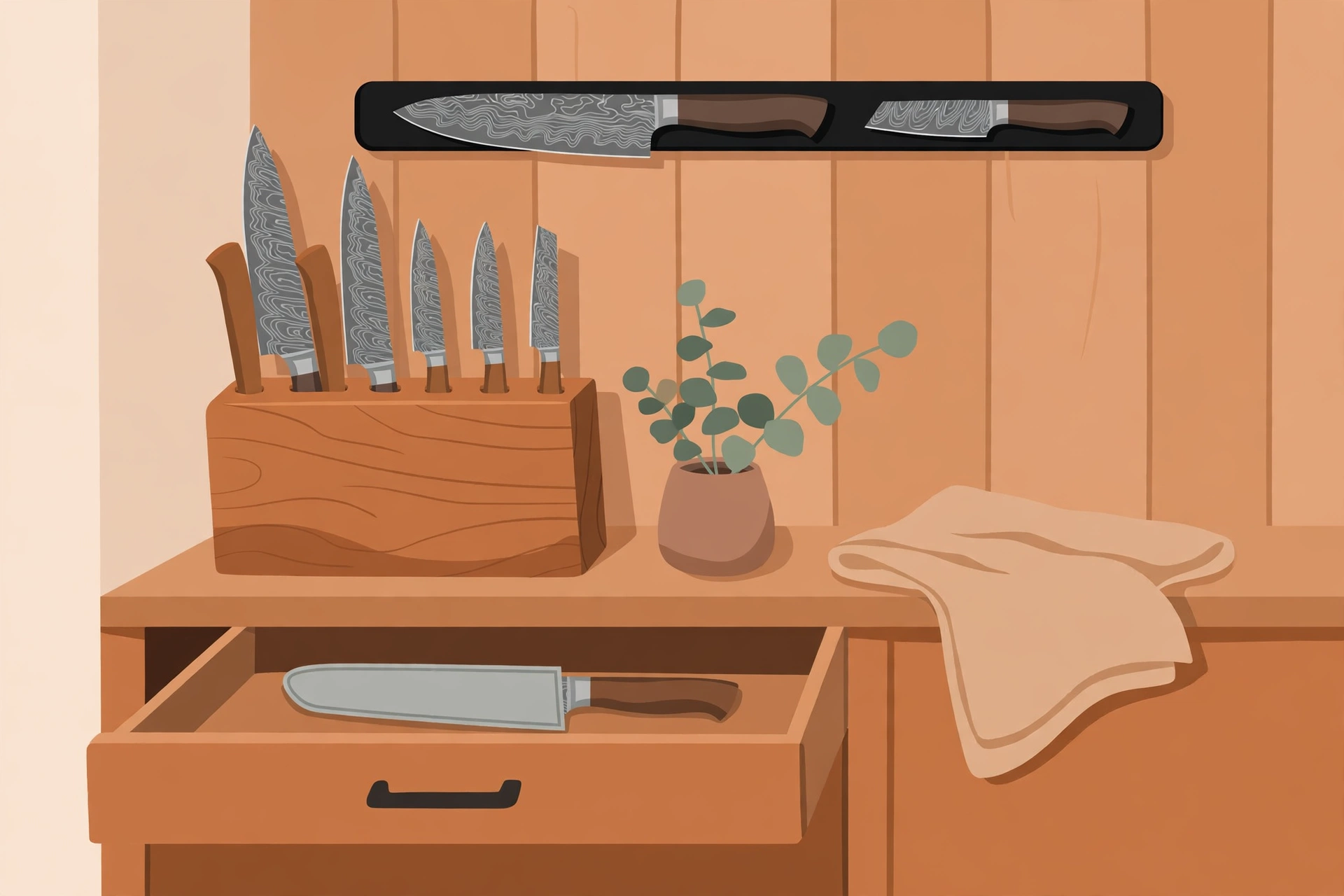
Read this first, because it sets the honesty rule for everything below. No knife on this page was handled, measured, or performance tested for this guide, and no storage product on this page was tested either. This guide recommends storage types, not named storage products, because no strip, block, insert, guard, or roll was verified as a linked product on this site, and none was invented. It contains no buy links, no affiliate tag, no ASIN, and no price. If a buy link is added later, it must be an Amazon link copied from a live site page and verified to open the correct listing, and this disclosure must be updated at the same time. Check the live listing before buying any storage product, because sizes, magnet strength, and slot widths change, and a block or guard that does not fit your longest blade is a purchase wasted.
One food safety habit sits behind the drying rule in this guide. The NSW Food Authority advises washing all fruit and vegetables with cool tap water immediately before eating, cutting away bruised or damaged areas, cleaning the knife when finished to avoid contaminating other food, and using separate cutting boards and knives for raw and cooked food: NSW Food Authority, fresh fruit and vegetables. A knife that trimmed raw meat and was put away dirty is not a clean knife when it comes out again, however good its store is. Wash it, dry it, then store it, in that order, every time.
No buy links in this article, and why. This article contains no buy links, no affiliate tag, no ASIN, and no price. No storage product was verified as a linked product on this site, so nothing was copied and nothing was invented. Recommend the storage type, measure your knives and your space, and check the live listing for the exact product before paying.
01 Quick reference: storage methods at a glance
Which storage method fits which kitchen, in one table? The table below gives the short version. A block suits most kitchens with bench space. A strip suits kitchens with wall space and no small children reaching the wall. A drawer insert suits kitchens with a spare drawer and a latch. A blade guard suits renters, small kitchens, and any knife that travels. A roll suits a cook who carries knives between kitchens. Read the table as a fit test, not a ranking, because the best store is the one that gets used every time, not the one that looks best in a photo.
| Method | Best fit | Edge protection | Watch out for |
|---|---|---|---|
| Knife block on the bench | Most kitchens with bench space | Good, if each blade has its own slot | Slots must fit your longest blade, and the block must sit steady |
| Magnetic strip on the wall | Kitchens with free wall space | Very good, edges held apart and visible | Needs firm fixing, and must be out of reach of children |
| Drawer insert with slots | Kitchens with a spare drawer | Good, if slots keep blades apart | Drawer needs a latch in a house with children, and blades must be dry |
| Blade guard in a drawer | Renters, small kitchens, single knives | Good, if the guard fits the blade snugly | A loose guard slides off, and a wet blade in a guard stays damp |
| Knife roll or case | Cooks who carry knives between kitchens | Good, if each knife has its own pocket | Rolls must be closed before carrying, and knives must be dry first |
| Gift box | Gifting and moving house, once only | Fair, for a single trip | Not a daily store, it wears fast and hides the knife |
| Loose in a drawer | No kitchen, never | None, edges knock on every drawer pull | Cuts hands that reach in, and dulls every edge in the drawer |
Notice the split. The first five rows all keep edges covered or apart. The last row keeps nothing safe, and it is the row most kitchens fall into by accident, one knife at a time. A cook who owns one good knife and stores it loose in a drawer will dull it faster than a cook who owns five knives and stores each one in a guard, because the drawer knife knocks against spoons, peelers, and tins on every pull, while the guarded knives touch nothing at all.
02 The safest everyday storage choice
What is the safest everyday storage choice for a Damascus knife? The store you will use after every job, with the knife dry and the edge covered or held apart. For most kitchens that means a block on the bench or a strip on the wall, because both are visible, both are one motion to use, and both keep the knife in sight so it is not forgotten. For a kitchen with small children, the safest choice changes: a locked drawer with guarded knives, or a high store children cannot reach or see, beats a visible strip at child height, because a store a child can reach is not a safe store, however good it is for the edge.
Start with three facts about your kitchen, not with a product photo. First, how much bench space can a block take without pushing the cook into a corner? Second, is there a wall that can hold a strip firmly, at adult height, away from the stove and the sink? Third, is there a drawer that can take an insert, with a latch if children live in the house? Answer those three, and the planner in section 08 will rank the methods for you. A kitchen that answers yes to the first question wants a block. A kitchen that answers yes to the second wants a strip. A kitchen that answers yes to the third wants an insert. A kitchen that answers no to all three still has blade guards, which fit any drawer and cost the least, and which beat a loose drawer by a wide margin.
Knife count changes the answer too. One or two knives are easy: a guard each, or a small block, and the job is done. Four to seven knives need a block with enough slots, a strip long enough for the set, or an insert wide enough for the drawer, and a guard for any knife that does not fit the main store. Eight knives or more need a main store plus guards for the overflow, because a store that holds only part of a set leaves the rest loose, and the loose knives are the ones that get dull and cut hands. Count your knives before buying a store, and count the longest blade too, because a store that fits the chef knife but not the bread knife is a store that fails on the first day.
For the buying picture this guide sits inside, see Best Damascus Knives Australia and Best Damascus Knife Sets. For the specialist knives this store will hold, see Best Damascus Nakiri Knives Australia and Best Damascus Paring and Utility Knives Australia. The difference in this guide is the single question it answers: where does each knife go after it is washed and dried, so its edge stays sharp and no hand finds a bare blade?
03 Magnetic strips
How do you use a magnetic strip without damaging a Damascus edge? Place the spine on the strip first, then roll the flat of the blade onto the magnet, and lift the knife off spine first, handle in hand, so the edge never drags across the strip. Dragging is the damage: an edge pulled sideways across a hard strip dulls faster than an edge that only touches the flat of the blade to the magnet, and a Damascus pattern can mark where the edge scrapes. The roll on, roll off habit takes one day to learn and then becomes automatic, and it is the whole difference between a strip that protects edges and a strip that wears them.
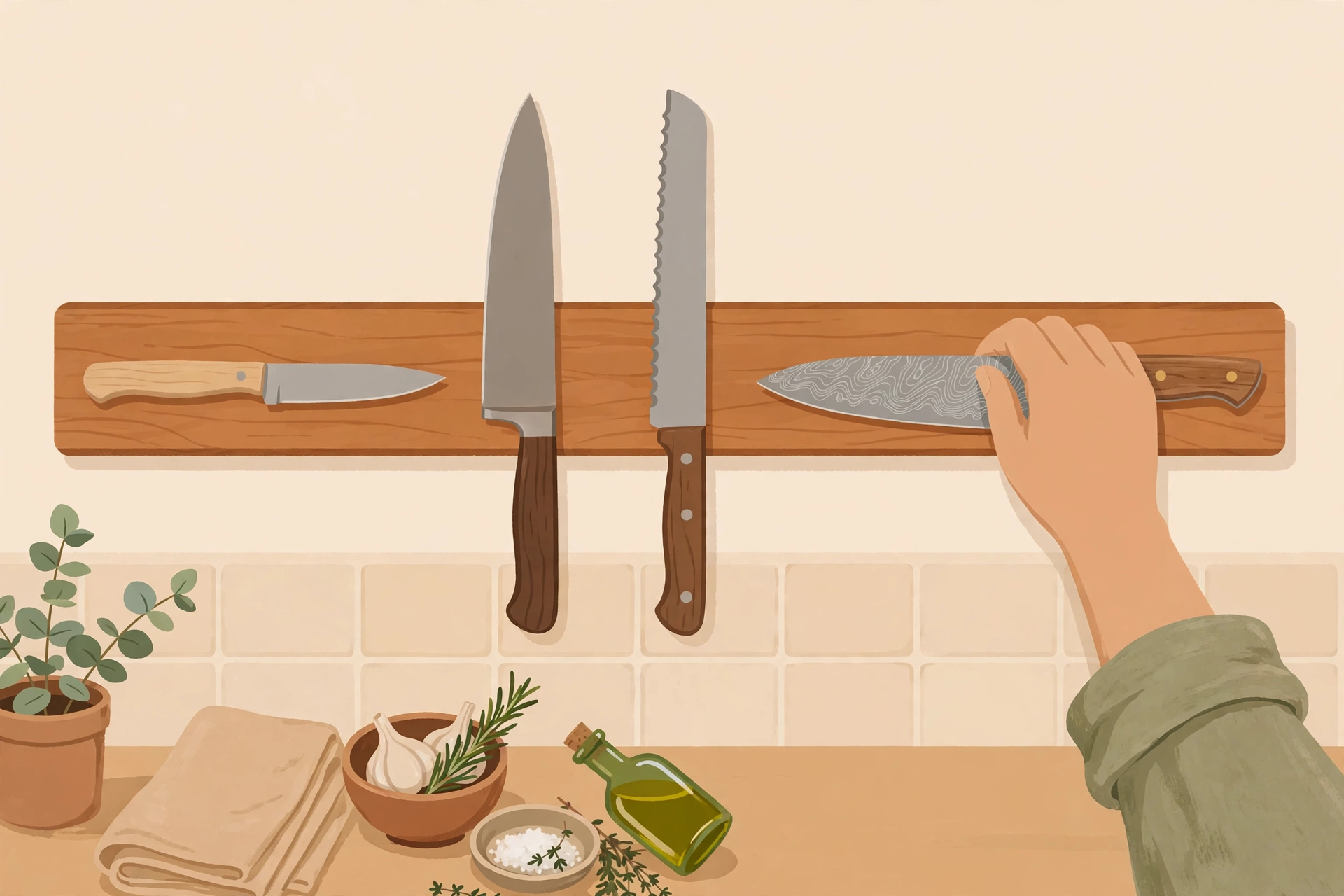
A strip has three real strengths. First, it keeps every edge apart and visible, so no blade touches another blade and the right knife is found at a glance. Second, it frees bench and drawer space, which matters in a small kitchen where a block would crowd the cook. Third, it dries well, because a knife on a strip sits in open air, not in a closed slot where damp can linger. A strip also has three real limits. It needs a wall that can hold it firmly, it puts knives where a child can see them if the wall is low, and it leaves blades open to a knock from a passing elbow or a falling pan, so the strip must sit where traffic does not pass close.
Fixing matters more than magnet strength. A strip held by two short screws into a stud, or by fixings rated for the wall type, stays put when a heavy chef knife is pulled off. A strip held by weak adhesive on a dusty or uneven wall can peel off and drop every knife at once, which is a foot injury waiting for a moment. Check the fixing every few months, tighten what has loosened, and rehang a strip that wobbles, because a strip that moves when a knife is pulled off will soon come down on its own. Keep the strip away from the stove, where heat and steam reach it, and away from the sink splash zone, where blades stay damp. A strip above the bench, at adult shoulder height, with a clear pull off space below it, is the usual good spot.
Which knives suit a strip, and which do not? Long, flat blades suit a strip well, because their flat sides sit fully against the magnet. Very short knives suit a strip less well, because a short blade has less flat area to hold it, and a heavy knife on a weak strip can slide. Serrated blades suit a strip if the flat side sits cleanly, but a serrated edge that drags on removal dulls at the points first, so the roll off habit matters even more. If a knife will not sit firmly on the strip, do not force it: give that knife a guard in a drawer, and keep the strip for the knives it holds well.
04 Knife blocks
What makes a good knife block, and what makes a bad one? A good block holds each blade in its own slot, wide enough for the blade and long enough for the longest knife, with the block steady on the bench so it does not slide when a knife is pulled out. A bad block crowds blades into shared slots, forces a long blade into a short slot so the tip presses on the bottom, or slides across the bench and needs two hands to hold steady. The block that came with a set is often a good block for that set, because its slots were cut for those knives, but it is often a bad block for a mixed set, because a new knife rarely matches an old slot.
Slide a knife into a block edge first, with the spine leading, so the edge does not scrape down the slot wall on every insertion. Pull it out the same way, spine leading, handle in hand, and never yank a knife sideways out of a slot, because a sideways pull drags the edge across the slot edge and dulls it at the same spot every time. A block with slots that open at the top suits most kitchens, because the knife drops straight in. A block with slots that open at an angle suits a bench with low overhead cupboards, because the knife slides in without hitting the cupboard above. Check the clearance above the block before buying, because a block that cannot be used under your cupboards will end up on the floor of a pantry, unused.
Blocks have two quiet weaknesses to check. First, a block can trap damp: a knife put away wet drips into its slot, and a closed slot dries slowly, so a wet knife in a block can stay damp for hours and mark the steel. Dry the knife first, every time, and wipe the block slots when they feel damp. Second, a block hides the knives, so a knife left out on the bench is easy to forget, because the block looks full even when one knife is missing. Count the knives back into the block after cooking, and check the bench, the sink, and the board before leaving the kitchen, because a knife left out overnight is a knife a child or a pet can find in the morning.
Universal blocks, the kind with flexible rods or a brush insert instead of fixed slots, suit a mixed set better than a fixed slot block, because they take different blade lengths and shapes. They still need the same habits: dry knife, spine leading, steady block, and a regular clean, because food and dust collect in the rods over time and a dirty block is a store that marks blades. Whatever block you choose, measure your longest blade and your bench depth first, and buy the block that fits both, not the block that looks best in a photo.
05 Drawer inserts and blade guards
How do you store knives in a drawer without dulling them or cutting a hand? Give every knife its own slot in an insert, or its own guard, so no edge touches another knife and no hand finds a bare edge. An insert is a tray that sits in the drawer with separate slots, one per knife, usually with the blades lying flat and the handles at the front. A guard is a sleeve that covers one blade, in plastic, wood, or felt lined material, and it turns any drawer into a safe drawer for that knife. Use one or the other, or both together for a knife that moves between kitchens, and never use neither, because a bare knife in a drawer is the single most common storage mistake in home kitchens.
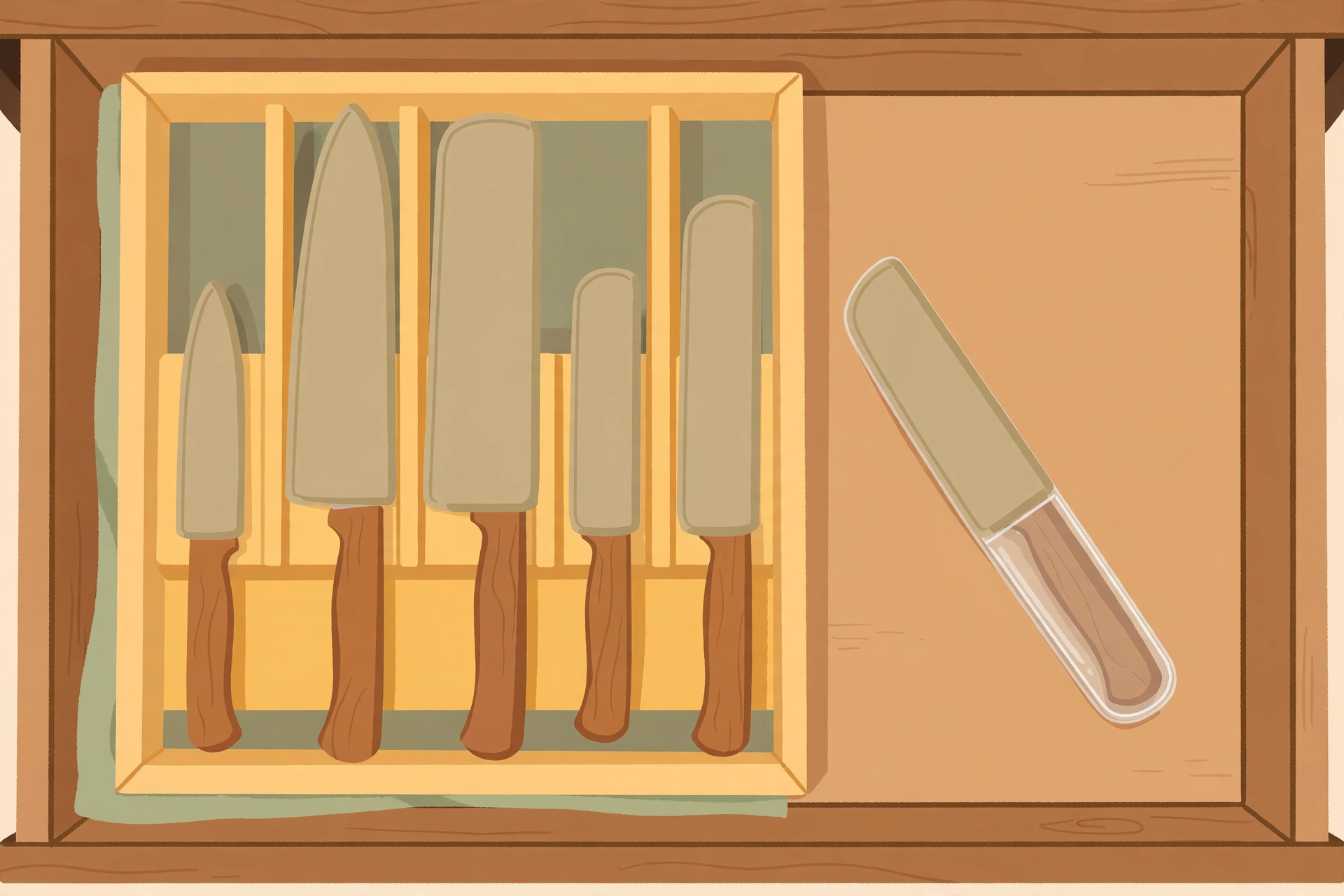
Measure the drawer before buying an insert, because an insert that is too wide will not sit flat, and an insert that is too short will leave long blades poking past its end. Measure the drawer depth too, because a deep drawer with a shallow insert leaves room for knives to slide out of their slots when the drawer is pulled hard. A good insert sits flat, fills the drawer width, and holds each blade without forcing it. A felt or cork lined insert protects edges better than a hard plastic insert, because the lining cushions the blade, but any insert beats a bare drawer by a wide margin, so do not wait for the perfect insert while knives sit loose.
A guard must fit the blade it covers. A guard that is too tight forces the edge against its mouth on every insertion, and a guard that is too loose slides off in the drawer and leaves the edge bare again. Measure the blade length and width, buy the guard made for that size, and test the fit: the guard should slide on with light pressure and stay on when the knife is tipped upside down over a bench. A guard that fails that test is the wrong guard, not a guard to tape shut. Replace a cracked guard at once, because a cracked guard can split under pressure and leave a sharp edge against a hand that thought it was safe.
Drawers need one more habit: dry before guarding. A wet blade slid into a closed guard stays damp inside the guard, and damp inside a guard marks steel faster than damp in open air, because it cannot dry. Dry the blade fully, then guard it, then close the drawer. In a house with children, add a latch to the knife drawer, because a guard slows a child down but does not stop one, while a latched drawer keeps the whole drawer out of reach. A latch costs little, fits most drawers, and turns a drawer store from a child accessible store into a child resistant one.
06 Rolls, cases, and carrying a knife
How do you carry a Damascus knife without cutting a bag or a hand? Guard every blade, put each guarded knife in its own pocket of a roll or case, close the roll fully before lifting it, and carry it by its handle or strap, never by a loose end. A roll is a flat wrap with pockets, one per knife, that rolls up and ties or buckles shut. A case is a rigid or padded box with slots or straps for each knife. Both work, and the choice turns on how far the knives travel: a roll suits a short trip to a friend’s kitchen, while a case suits a longer trip where the knives will be knocked about in a car boot.
Never carry a bare knife in a bag, a tea towel, or a pocket, because a bare blade in a bag cuts the bag, then the hand that reaches in, and a blade wrapped in a tea towel slides out of the towel at the first bump. Never carry a knife loose in a car, because a loose knife in a car becomes a projectile in a sudden stop, and a knife on a car seat slides under braking and ends up where a hand will find it blind. Guard it, pocket it, close the roll, and put the roll where it cannot slide: on the floor behind a seat, or in a boot with bags packed around it so it stays put.
Packing order matters in a roll. Put the longest, heaviest knife in the middle pocket, so the roll stays balanced when it is rolled up, and put small knives at the ends, where they cannot slide past a larger blade. Check every pocket before closing, because a knife left out of its pocket ends up loose inside the roll, which is a bare knife in a bag by another name. When you arrive, unpack in reverse: open the roll flat, take each knife out by its handle, wash and dry it if it travelled damp, and put it straight into its home store, so no knife sits out on a strange bench while everyone cooks.
For a move between homes, a roll or a case beats a gift box for a set, because a set in one box shifts in transit and blades knock together, while a roll keeps each blade apart. Wrap the roll in a towel inside the moving box, label the box clearly as sharp, and tell anyone helping with the move that the box holds knives, because a helper who lifts a box of knives like a box of books is a helper about to be cut. At the new kitchen, unpack the knives first, before the boxes pile up, so they go straight into a store and not onto a bench in a half unpacked room.
07 Households with children and pets
How do you store knives safely when children or pets share the house? Keep every knife dry, with its edge covered, in a store children cannot reach or open, and put every knife away as soon as the job is done, because the most dangerous knife in a house with children is not the sharpest knife, it is the knife left out. A block on a high bench, a strip at adult height, or a latched drawer all work, and a low drawer, a bench knife, and a sink knife all fail, because a child who can reach a knife will reach for it, and a child who can see a knife will ask for it. These are general household safety practices, and they are worth following even when no single regulator rule covers your exact kitchen, because the risk they prevent is plain to see.
Height alone is not enough, because children climb. A strip at adult height above a bench a child can climb onto is a strip at child height by another route, and a block on a bench beside a chair is a block a child can reach from the chair. Push the bench clear of climbable furniture near the knife store, keep chairs away from the bench where knives sit, and check the route a child would take, not just the height of the store. A latched drawer beats height alone, because a latch stops a child who climbs, while height only slows one down. Fit latches to every drawer and cupboard that holds knives, and test them, because a latch a child can open with one pull is decoration, not protection.
Pets change the risk in a different way. A dog that jumps up at a bench can knock a block over, and a cat that walks a bench can push a knife off a strip that is already loose. Keep the knife store away from the bench edge where a pet jumps, keep the block steady and heavy enough that a bump does not topple it, and never leave a knife on a board at pet height while you turn away, because a pet that noses a board can slide a knife off it. A knife dropped by a pet lands edge first as often as not, so a store that keeps knives off the bench edge protects pets and feet alike.
Teach, as well as store. Teach children to ask an adult before touching any knife, to never pull a knife from a block or a strip themselves, and to tell an adult at once if they find a knife out of its store. Teach adults in the house the same rule: put the knife back, every time, without exception, because a house where one adult leaves knives out teaches children that knives left out are normal. The safest store in the world fails if the adults in the house do not use it, and the simplest store succeeds if they do.
Never leave a knife in a sink of soapy water. A knife under soapy water cannot be seen, and a hand that reaches in to wash up finds the edge blind. Wash the knife first, by hand, dry it, and put it away, before anything else goes into the sink. In a house with children, this one habit prevents more cuts than any store, because the sink is where hands go without looking, and a hidden edge in a sink is a cut waiting for the next person who washes up.
08 Damascus knife storage and safety planner
Which storage method fits your kitchen? Pick your bench space, whether wall drilling is allowed, how many knives you own, and whether children live in the home. The planner ranks the methods for that household, with the trade off for each, so you can buy once and use it every time. It is a guide to storage type, not a test of any product, and it never replaces measuring your knives and your space.
Pick your bench space, drilling, knife count, and household, then press Show my storage plan.
09 What storage does to an edge
Why does storage matter so much for a Damascus edge? Because an edge dulls by contact, not by time. A knife that sits still in a slot, on a strip, or in a guard touches nothing, so its edge stays as it was. A knife that slides in a drawer, drags across a strip, or scrapes down a block slot touches hard material on every move, and every touch takes a little edge away. A Damascus pattern marks the same way: a blade that knocks against other steel shows marks where it knocked, while a blade that touches nothing shows nothing. Storage is edge care, not just tidiness, and the cheapest edge care is a store that keeps blades apart.
The chart below shows relative edge contact only, as a planner illustration, not a measurement of any knife and not a ranking of quality. A guarded knife touches nothing in storage, so its contact is the lowest. A knife in its own slot or on a strip touches only the slot or the magnet flat, so its contact is low. A knife loose in a drawer touches other steel on every drawer pull, so its contact is the highest, and a knife left on a bench touches whatever is put on top of it. Do not read the chart as proof that one store makes a knife sharper. A store never sharpens a knife. It only stops the knife getting duller between uses, which is still worth a great deal over months of cooking.
Relative edge contact in storage, planner illustration only.
Blade guard or own slot, edge touches nothing or one surface
Magnetic strip, flat of blade touches the magnet
Block slot, edge can scrape if pushed in edge first
Loose in a drawer, edge knocks other steel on every pull
Bars show relative contact only. They do not represent sharpness, edge retention, or quality.
Layered blades deserve a short, honest note here. The XINZUO Yu series chef knife and the KITCHENDAO 67 layer chef knife both have live review pages on this site, and both are layered blades whose edges suffer when stored loose in a drawer, like any layered blade. A loose drawer dulls the edge first, and it can mark the pattern where blades knock, which is a shame on a knife bought partly for its looks. A guarded or slotted store protects both the edge and the pattern, because the blade touches nothing while it waits. That is the whole case for a store: it protects what you paid for, every day, without any extra work beyond putting the knife back.
When an edge does dull despite good storage, sharpening is a separate job, covered in the sharpening guide on this site, and routine care is covered in the cleaning and care guide. Storage cannot fix a dull edge, and sharpening cannot fix a store that dulls the edge again the next day. Fix the store first, then sharpen, so the sharpened edge stays sharp, instead of sharpening a knife that goes straight back into a drawer where it dulls again.
10 Renter and small kitchen setups
How do you store Damascus knives well in a rental or a small kitchen? Use a block, an insert, or guards, because none of them needs a drilled wall, and all of them move with you when the lease ends. A bench block is the simplest renter store: it sits on the bench, holds the set, and packs into a moving box in one lift. A drawer insert is the next simplest: it sits in a drawer, holds the set, and lifts out when you move. Guards are the simplest of all: they fit any drawer, cost the least, and move in a pocket. A renter who buys guards first, then adds a block or an insert when the kitchen allows, has a safe store from day one, without asking a landlord for anything.
Small kitchens need the same thinking, with one extra rule: keep the most used knife easy to reach, and the rest stored away. A cook with one square metre of bench cannot keep a block, a strip, and a board all out at once, so the block goes in a cupboard, the strip goes on the wall if drilling is allowed, or the knives go in a guarded drawer, and only the knife in use comes out. A small kitchen that keeps every knife out on the bench is a kitchen where knives fall off the bench, because there is no room to set a knife down safely between jobs. A small kitchen that keeps knives guarded in a drawer, and takes out one at a time, is a kitchen where every knife has a home and no knife sits where it can fall.
Shared kitchens need one more agreement: every cook puts every knife back, every time. A shared kitchen where one cook stores knives well and another leaves them out is a kitchen where the good store fails, because the knife left out is the knife that cuts the next cook. Agree the store on day one, label the drawer or the block if it helps, and check the bench, the sink, and the board before leaving the kitchen, because a shared kitchen is only as safe as its least careful cook on a busy night. For the wider care routine that sits beside storage, see How to Clean and Care for a Damascus Knife and How to Sharpen a Damascus Knife.
11 Clean and dry before storing
What must happen before a knife goes into its store? Wash it by hand, dry it fully, and check it, in that order, every time. Hand wash in warm soapy water, wipe the blade dry at once, and let the handle dry before storing, especially if the handle is wood, because wood handles need drying after washing and a wet handle stored in a closed slot can stay damp for hours. Check the edge for chips and the handle for looseness while you dry it, because a chipped edge or a loose handle found at the sink is a problem caught early, while the same problem found at the next meal is a problem that cuts. A knife that is clean, dry, and checked is a knife ready for its store, and a knife that is dirty, wet, or damaged is a knife that should not go into a store at all.
Do not put a Damascus knife in a dishwasher as a routine, because heat, detergent, and knocking against other items dull the edge and mark the pattern, and the maker guidance on the live listing should be followed where it gives a clear care rule. Do not leave a knife soaking, because soaking dulls the edge in the sink, rusts at the edge, and cuts a hand that reaches in without looking. Do not leave a knife wet on a board, because a wet blade on a board stays damp and marks the board as well as the blade. The routine is short: wash, dry, check, store, and it takes less than a minute, which is less time than sharpening a knife dulled by a wet store.
Raw meat changes the routine in one way: wash before storing, without exception. A knife that trimmed raw meat and was put away dirty carries bacteria into its store, and the next time it comes out it touches food with a dirty blade. Wash it, dry it, then store it, and wash the board too, or keep a separate knife for vegetables, as the NSW Food Authority guidance quoted at the start of this guide advises. A store never cleans a knife, and a clean store never makes up for a dirty blade, so the washing step belongs before the storing step, always.
Check the store itself on the same routine, once a month. Wipe block slots that feel damp, check strip fixings that have loosened, check guards that have cracked, and check drawer inserts that have warped or slid out of place. A store that is not checked becomes a store that fails quietly: a strip that wobbles, a guard that splits, an insert that slides, and each one leaves a knife loose without anyone noticing until a hand finds it. A monthly check takes five minutes and keeps the store as safe as the day it was bought.
12 Buying checklist for storage, and what to avoid
What should you check before paying for knife storage? The checklist below, in order, with the most costly mistakes first. Work through it with a tape measure and your longest knife in hand, not from a product photo alone, because storage that does not fit your knives or your space is storage wasted.
- Fit first: Measure your longest blade, your drawer width and depth, and your bench depth. A block, insert, or guard that does not fit the longest blade fails on the first day.
- Edge contact: Check that each blade has its own slot, pocket, or guard, so no edge touches another knife. A shared slot is a loose drawer with a lid on it.
- Fixing: Check how a strip is fixed, and whether your wall can hold it. A strip that peels off drops every knife at once, so fixing matters more than magnet strength.
- Household: Check whether children or pets can reach or topple the store. A latched drawer beats height alone, and a steady block beats a light one near a bench edge.
- Drying: Check that the store lets blades dry, or that you can dry blades fully before storing. A closed store with a wet blade inside marks steel faster than open air.
- Moving: Check whether the store moves with you. A renter who buys a drilled strip for one kitchen pays for it again at the next move, while a block or guards move free.
- Live listing check: Check the current size, slot width, and fixing on the live listing before paying, because sizes and fixings change, and this guide states no price as current for any storage product.
What should you avoid? Avoid storing any knife loose in a drawer, because it dulls every edge in the drawer and cuts hands that reach in. Avoid leaving a knife in a sink of soapy water, because a hidden edge in a sink cuts the next person who washes up. Avoid a strip fixed with weak adhesive on a dusty wall, because it will come down with every knife on it. Avoid a block with slots too short for your longest blade, because a tip pressed on a slot bottom dulls and bends. Avoid a guard that slides off, because a guard that slides off is a bare blade with a false sense of safety. Avoid a gift box as a daily store, because a box opened daily wears fast and hides the knife.
For the wider buying method behind this checklist, see How to Choose a Damascus Chef Knife in Australia and How We Review Knives. For the larger knives this store will hold, see Best Damascus Chef Knives and Best Damascus Santoku Knives Australia. For the question of whether a pattern is real layered steel or only a surface look, see Real vs Fake Damascus. The method is the same in every guide on this site: compare the job, the fit, and the edge first, and treat looks as looks, not as proof.
The short verdict, once more. Dry every knife, cover every edge or hold every blade apart, and put every knife back as soon as the job is done. A block suits most kitchens, a strip suits kitchens with wall space, an insert suits kitchens with a spare drawer, and guards suit renters, small kitchens, and any knife that travels. Pick the store your kitchen allows and your household will use every time, measure your longest blade before paying, and check the store once a month, because a store that is used every time protects edges and hands alike.
Disclosure. This article contains no buy links, no affiliate tag, no ASIN, and no price, for the reasons stated at the start. If a buy link is added later, it will be an Amazon link copied from a live site page and verified to open the correct listing, and this disclosure will be updated at the same time. No knife or storage product on this page was handled or performance tested for this guide, and no claim in this guide should be read as a hands on test result.
13 Frequently asked questions
What do readers ask most about storing Damascus knives? The seven questions below, with plain answers that match the guide above. If a question is not answered here, the sections above cover the method, the household, and the routine in more detail, and the planner in section 08 gives a personal answer for your kitchen.
What is the safest way to store Damascus knives at home?
Store each knife dry, with its edge covered or held apart from other knives, in a block, on a magnetic strip, in a drawer insert, or in a blade guard, and put it away as soon as the job is done. The safest method for a given kitchen is the one that keeps edges covered, keeps knives out of reach of children, and gets used every time, because a perfect store that is skipped is worse than a simple store that is used.
Is a magnetic strip safe for Damascus knives?
Yes, if it is used well. Place the spine on the strip first, then roll the flat of the blade onto the magnet, and lift the knife by the handle and roll it off spine first, so the edge never drags across the strip. A strip keeps edges apart and visible, but it must be fixed firmly, kept out of reach of children, and kept away from a spot where a falling knife could land on a foot or a bench edge.
Can I store Damascus knives loose in a drawer?
No. A loose knife in a drawer knocks against other steel on every drawer pull, which dulls the edge and can mark the pattern, and it cuts any hand that reaches in without looking. If a drawer is the only option, use a drawer insert with separate slots, or a blade guard on every knife, so no edge touches another knife and no hand finds a bare edge.
How do I store knives if I cannot drill into a wall?
Use a bench block, a drawer insert with separate slots, or blade guards in a drawer, and keep the most used knife in a guard so it is easy to reach and put back. Adhesive strips exist, but only trust one that is rated for the weight of the knives and fixed to a clean, flat surface, and check it regularly, because a strip that peels off drops every knife at once.
How should I store knives around children?
Store knives dry, with edges covered, in a block, a locked drawer, or a high store that children cannot reach or see, and put every knife away as soon as the job is done. Never leave a knife on a bench, in a sink of soapy water, or on a board while children are nearby, and teach children to ask an adult before touching any knife. These are general household safety practices, not a claim about any single regulator rule.
Do I need to dry a knife before storing it?
Yes. Hand wash the knife in warm soapy water, wipe the blade dry at once, and let the handle dry before storing, because moisture left on the edge can mark the steel and the pattern, and a wet knife stored in a closed guard or block can stay damp for hours. A knife that has touched raw meat must be washed before it is stored, so it is clean for its next use.
Can I store a Damascus knife in its gift box?
A gift box is a store for gifting and for moving a knife once, not a daily store. A box opened and closed daily wears fast, leaves the knife loose in the end, and hides the knife so it is easy to forget and hard to reach. Keep the box for gifting or for a move, and use a block, a strip, an insert, or a guard for daily storage.