A Damascus knife usually has a visible pattern produced by layered steel. Modern kitchen versions may use pattern-welded steel or patterned outer cladding around a separate cutting core. Some knives instead have a decorative pattern applied to an otherwise plain blade. The pattern alone cannot tell you how the knife was made or how well it cuts; check the maker's construction and steel specifications.
The name reaches back to historic crucible-steel blades known for a watered pattern. Modern makers also use it for pattern-welded blades and clad kitchen knives. These are different constructions that share a visual language. A product name on its own will not tell you which one you are buying.
This guide walks through what the name means, how the pattern gets there, how layered construction differs from a decorative surface finish, and what to check on the listing before you hand over your money. If you just want the buying version, jump to our best chef knife guide or the Damascus steel guide.
What makes a blade Damascus?
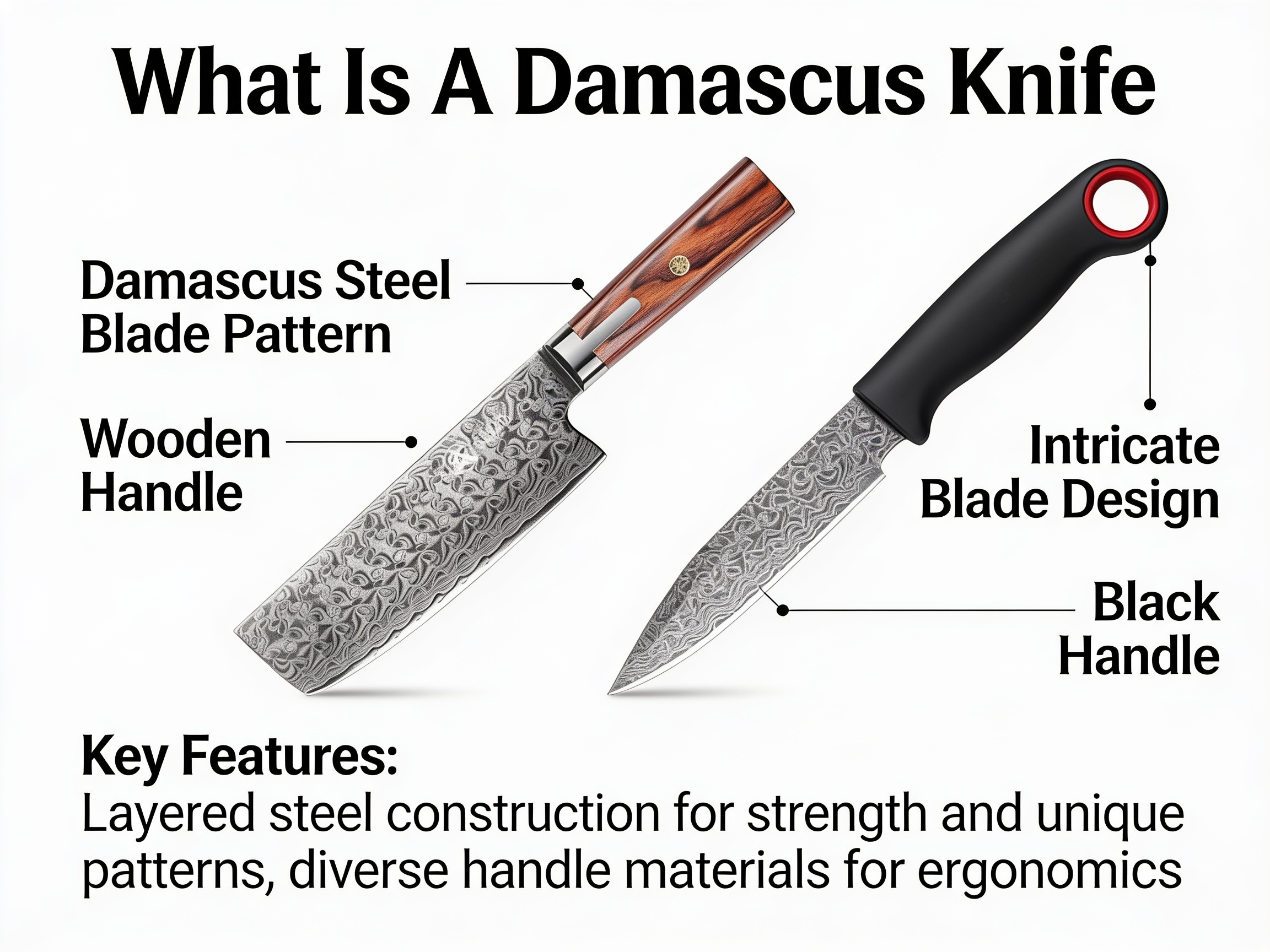
In modern listings, a pattern can come from steel welded in layers, patterned cladding around a core, or a decorative finish on a plain blade. The first two describe blade construction. The third describes appearance. An etched finish can also be used to reveal genuine layers, so the word “etched” by itself does not settle the question.
Different steels forge-welded together. Their layers can be revealed on the finished blade.
Patterned outer layers around a named core, like VG-10 or AUS-10. The core does the cutting.
A decorative pattern can be applied to a plain blade. Etching may also reveal real layers, so ask which process the maker used.
The clad construction is common in modern kitchen listings: the core reaches the cutting edge, while the patterned layers sit on either side. That tells you where to start reading the specification. It does not prove that one knife is tougher or sharper than another.
Researchers who study modern pattern-welded blades have mapped how carbon migrates between the welded layers during forging, which is part of why the pattern is not simply decoration. It is a record of the steel being worked. Interest in welded and layered blades goes back further, with metallurgists sectioning and analysing welded knife billets to see how the layers actually bond.
Why is it called Damascus at all?
Historic Damascus blades were associated with crucible steel and a distinctive watered pattern. Their production and metallurgy have been studied and reproduced in experiments, though the historical methods are still discussed. Modern pattern-welded knives use a different approach to producing visible layers.
Real pattern or surface effect?
A photograph can show you the pattern. It cannot, on its own, prove the blade's construction. Read the listing for a named steel, the maker's explanation of the layers, and a clear description of what reaches the cutting edge.
Quick check before you buy. If a listing says only “Damascus pattern” and gives no steel or construction details, ask the seller what makes the pattern before assuming the blade is layered. Price alone does not prove authenticity. The real vs fake Damascus guide explains what a listing can and cannot establish.
-
Look for a named core. VG-10, AUS-10, 10Cr15CoMoV, SG2. A named core helps identify the steel at the edge. “High carbon steel” is too broad to identify an alloy.
-
Ask how the pattern got there. Look for a specific description of pattern-welding, patterned cladding, or an applied finish. Vague wording needs a follow-up question.
-
Use photos for context. A spine photo may add context, but finishing and blade construction vary. It cannot confirm or rule out layered steel on its own.
-
Look beyond stock photos. Repeated images tell you little about the knife you will receive. Ask for the product specification instead of judging authenticity from matching photos.
What actually decides how good the knife is?
The pattern tells you about appearance and, when verified, construction. Cutting performance depends on the steel at the edge, heat treatment, blade geometry, sharpening and how you use the knife. A “67-layer” claim is not a sharpness or edge-retention score.
Four details that matter more than layer count
Compare the complete knife, not one number in a product title.
| Detail | What to ask |
|---|---|
| Cutting steel | Which named steel reaches the edge? |
| Heat treatment | Does the maker publish a credible hardness range for this knife? |
| Blade geometry | Does the profile suit the food and cutting style you use? |
| Upkeep | What care and sharpening does the maker recommend? |
Hardness is useful context, but a higher HRC figure does not automatically mean a knife will keep a better working edge. Steel composition, heat treatment and edge geometry matter together. Our VG-10 vs AUS-10 vs 10Cr15CoMoV comparison explains the differences.
Does a Damascus knife rust? Can it go in the dishwasher?
Some Damascus knives can stain or rust; others use corrosion-resistant stainless core and cladding. The pattern alone does not tell you which you have. Check the steel specification and follow the maker's care instructions. Hand washing and prompt drying are sensible for either type, particularly when the handle is wood.
The habit that fixes most problems. Wash by hand with mild soap, dry promptly, and store the knife so its edge does not knock against other utensils. Our cleaning and care guide covers stains and rust removal, and the sharpening guide covers keeping the edge honest.
How much should a Damascus knife cost?
There is no price that proves a knife is genuine Damascus. You can find different constructions at different prices, and a higher price can reflect the maker, finish, handle, distribution or a particular steel. Compare the specification with the current asking price rather than using a fixed price band as an authenticity test.
| Listing detail | What it helps you judge | What it does not prove |
|---|---|---|
| Named cutting steel | What alloy the maker says reaches the edge | That heat treatment or sharpening is good |
| Patterned construction | How the visible layers were made | That more layers cut better |
| Handle and finish | Materials, fit and likely care needs | That the blade will suit your hand |
| Seller and returns | Who stands behind the description | That every product claim is verified |
Shopping to a budget? Compare the current options in our budget guide. Our price guide explains the features that can affect cost.
Where should you start?
If this is your first Damascus knife, buy for the job, not the pattern. A 20 cm chef knife with a named core is the most flexible start for most home cooks. Sets look great but often include knives you will not use; Japanese styles feel different in the hand, so try the shape before you commit to a set.
Is it legal to import a Damascus knife into Australia?
“Damascus” describes a blade pattern or construction, not a blanket import permission. Australian restrictions depend on the knife's design. Check the current Australian Border Force weapons guidance and any relevant state or territory rules before ordering, including through an Australian marketplace. The retailer's location does not establish that a particular knife is permitted.
Good questions make better buys
Is a Damascus knife real Damascus steel?
Sometimes it genuinely is layered steel, but the word is not a guarantee. Many kitchen knives use patterned cladding over a named core; other blades use pattern-welded steel or an applied decorative finish. Ask the maker how the pattern was produced. The real vs fake guide shows you how.
Does a higher layer count make a knife sharper?
No. Layer count describes construction, not edge quality. Sharpness comes from the core steel, the heat treatment, the grind, and the final edge. A 67-layer claim is a selling point, not a sharpness score.
Do Damascus knives rust?
They can, depending on the steels used. Stainless cores and cladding generally resist corrosion better than reactive carbon steels, but all kitchen knives benefit from hand washing and prompt drying. See the care guide for the full routine.
Can a Damascus knife go in the dishwasher?
Hand washing is the safer choice. Dishwasher heat, detergent and movement can be hard on the edge and handle. Wash and dry the knife by hand unless the maker specifically advises otherwise.
Is Damascus steel better than stainless steel?
Not automatically. A well-made Damascus knife can perform beautifully, but so can a plain stainless knife. Compare the steel at the edge, heat treatment, geometry and upkeep. The pattern alone does not decide performance. We compare the two properly in Damascus vs stainless steel.
What is the best first Damascus knife to buy?
A chef knife around 20 cm is a versatile first choice for many home cooks. Choose a handle and blade length that feel manageable, and look for a named edge steel and clear construction details. Browse the best chef knife guide to see current picks.
How can I tell if a Damascus knife is fake?
Ask the maker what steel reaches the edge and how the pattern was created. Neither a low price nor a product photo proves a blade is fake. More ways to assess the description are in the real vs fake Damascus guide.
- Sources: Verhoeven, J. D. and Pendray, A. H., The Mystery of Damascus Blades, Scientific American
- Verhoeven, J. D. and Pendray, A. H., Carbon diffusion between the layers in modern pattern-welded Damascus blades, Materials Characterization (1998)
- Lacey, B. and Brooks, C. R., Microstructural analysis of a welded Damascus knife blade billet, Materials Characterization (1992)
- Australian Border Force, Prohibited goods: weapons
How we approach this guide: we explain construction and buying criteria using the cited research and government guidance. We do not claim to have tested the knives linked from this page. Confirm product specifications with the maker and import rules with the relevant authorities before buying.