Best Japanese Damascus Knives by the job they do.
Eight Japanese-style kitchen knives, from a small petty to a long gyuto. Compare the blade shape and disclosed steel first, then decide how much the pattern and handle matter to you.
Which Japanese Damascus knife should I choose?
For one main knife, begin with a 20 cm chef knife or an 18 cm santoku. Choose the 18 cm nakiri if vegetables dominate your prep, the 13.5 cm petty for small tasks, or the 21.9 cm XINZUO gyuto if you want longer slicing strokes and have board space. The AUS-10 santoku and VG10-core PAUDIN chef knife disclose a specific edge-steel grade in their supplied titles. “Japanese-style” and “Japanese steel” do not confirm that a finished knife was made in Japan.
As an Amazon Associate, we earn from qualifying purchases. This article compares the product titles, photos and links supplied for the guide. We have not handled or performance tested these particular knives, confirmed their factory origins, measured their sharpness or checked live prices. Verify each retailer listing before purchasing.
Match the knife to the board.
Blade lengths and core-steel names come from the supplied product titles. These are fit-by-use suggestions, not lab rankings.
| Knife | Listed length | Shape and job | Steel disclosed | Details |
|---|---|---|---|---|
| MITSUMOTO SAKARI 18 cm Japanese Nakiri | 18 cm | Nakiri: For regular vegetable prep on a board. | Damascus named; core not stated in supplied title | Read ↓ |
| 18 cm Japanese-style Damascus Santoku with AUS-10 core | 18 cm | Santoku: For everyday prep on a smaller board. | AUS-10 core stated | Read ↓ |
| 13.5 cm VG10 Japanese utility and petty knife | 13.5 cm | Petty / utility: For small fruit, trimming and fine work. | VG10 stated | Read ↓ |
| MITSUMOTO SAKARI 20 cm VG-Pro Damascus chef knife | 20 cm | Chef / gyuto style: For one main knife covering most board work. | VG-Pro named; exact alloy not stated | Read ↓ |
| XINZUO 21.9 cm Japanese-style Damascus gyuto | 21.9 cm | Gyuto: For longer slices and a larger board. | 67 layers stated; core not stated in supplied title | Read ↓ |
| MITSUMOTO SAKARI 21 cm Damascus kiritsuke-style knife | 21 cm | Kiritsuke style: For a cook who wants a straighter profile and a fine tip. | Damascus named; core not stated in supplied title | Read ↓ |
| PAUDIN 8-inch VG10 Damascus chef knife | 8 in / about 20.3 cm | Chef / Japanese-style: For a general chef shape with a named cutting steel. | VG10 core stated; 67 layers stated | Read ↓ |
| hecef 8-inch Japanese-style Damascus chef knife | 8 in / about 20.3 cm | Chef knife: For a versatile chef knife with a resin grip and included guard. | 67 layers stated; core not stated in supplied title | Read ↓ |
“Not stated” means the supplied title does not give that specification. A live retailer page may provide more detail. The 8-inch conversions are approximate.
How the listed lengths compare
Bars show relative blade length only. They do not represent sharpness, edge retention or quality.
Four shapes, four starting points.
These simple silhouettes show general blade families. Actual knives vary in thickness, curve and grind.
Gyuto
An all-purpose chef shape with reach for longer slices.
Santoku
A versatile profile that often feels manageable on a compact board.
Nakiri
A taller, straighter vegetable-focused blade.
Petty
A short blade for smaller produce and detail work.
A santoku and gyuto can both handle everyday food prep, but the blade profiles and working lengths may change the rhythm of the cut. A nakiri is a more focused vegetable tool. A petty is meant for jobs that feel clumsy with a long blade. Kiritsuke-style knives have an angled tip, but a retail style name does not prove that the knife has a traditional single-bevel grind.
Pick the shape you will use most, then compare balance, handle, steel, maintenance and your board size. If you are buying for someone else, start with how they cook rather than a dramatic Damascus pattern.
What makes each one different.
Product-specific reasons to consider it, alongside the details still missing from the supplied titles.
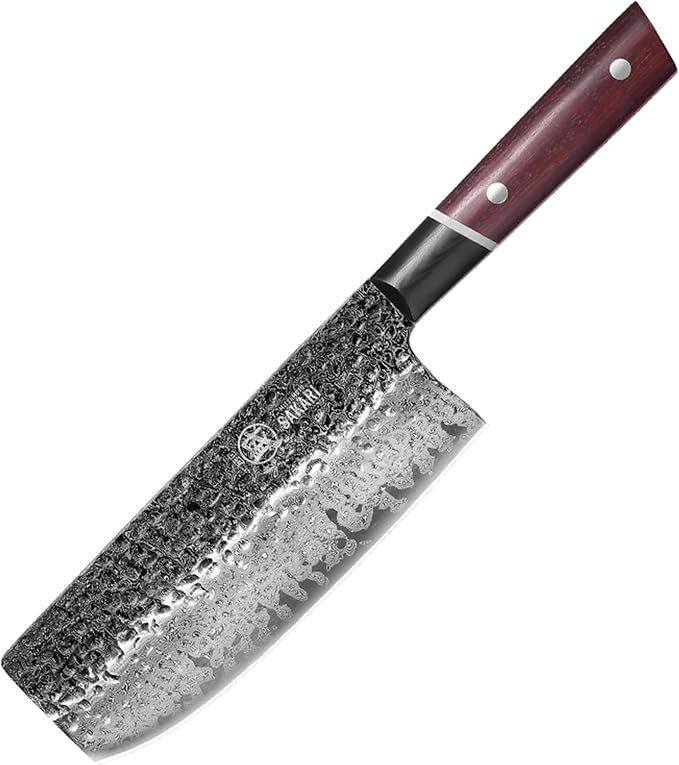
MITSUMOTO SAKARI 18 cm Japanese Nakiri
Best fit: For regular vegetable prep on a board.
A nakiri has a tall blade and a relatively straight edge. That combination suits repeated up-and-down work on cabbage, onions and other vegetables. The height gives room for a guiding hand and makes the blade different from a curved, general-purpose gyuto.
This is the clearest vegetable specialist in this shortlist. If you already own a main chef knife, it may add a genuinely different job; if you want only one knife for everything, a gyuto or santoku may be more flexible.
Check before buying: The supplied title does not name the cutting core, edge angle or country where the completed knife was made. Confirm the construction and maker guidance before purchase.
View the listing ↗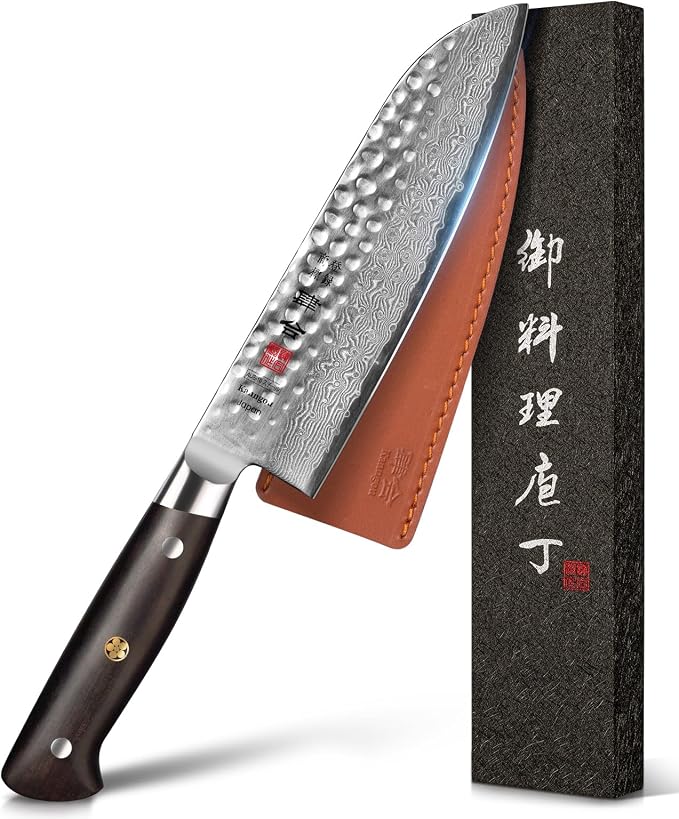
18 cm Japanese-style Damascus Santoku with AUS-10 core
Best fit: For everyday prep on a smaller board.
The 18 cm santoku is a useful middle ground: shorter than the 21.9 cm XINZUO gyuto, but suited to common slicing and chopping. Its supplied title names an AUS-10 core, giving you a more specific steel claim to investigate than “67 layers” alone.
Choose it when a full-length gyuto feels awkward in your kitchen. Aichi Steel publishes general information about AUS-10, but the knife’s actual heat treatment, grind and sharpness still require product-specific evidence.
Check before buying: Check the current brand, handle, patterned outer steel, edge construction and place of manufacture. The supplied title does not establish those details.
View the listing ↗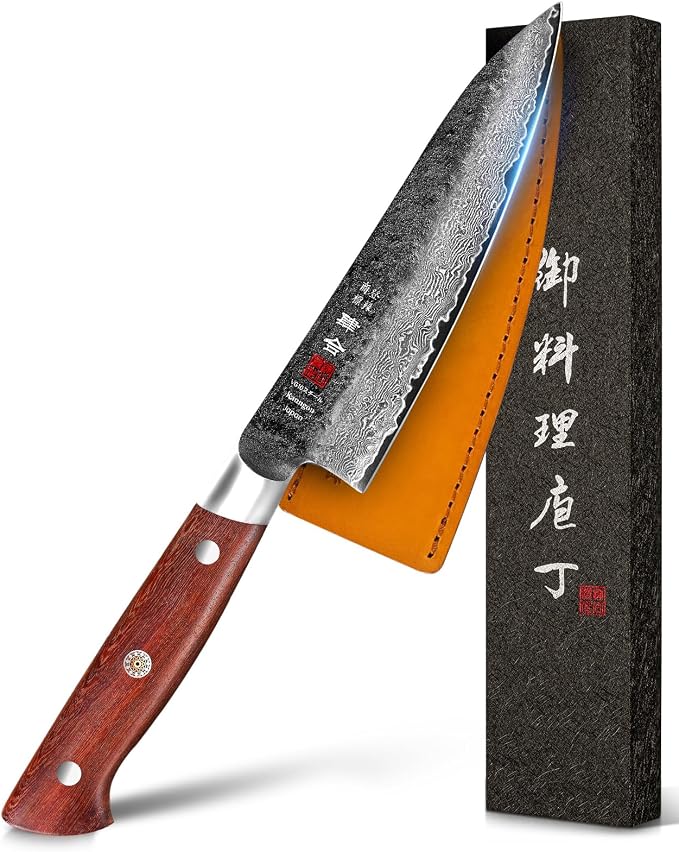
13.5 cm VG10 Japanese utility and petty knife
Best fit: For small fruit, trimming and fine work.
A petty knife lets you work close to the food when a 20 cm chef knife feels bulky. At 13.5 cm, this is the shortest blade in the shortlist. The supplied title names VG10, full-tang construction, red sandalwood and a gift box.
This is a complementary knife, rather than the only prep knife most kitchens need. It is worth considering if you already have a larger blade and want a distinct small shape.
Check before buying: Confirm that VG10 is the actual edge steel, inspect the handle construction and follow the maker’s wood-care instructions.
View the listing ↗
MITSUMOTO SAKARI 20 cm VG-Pro Damascus chef knife
Best fit: For one main knife covering most board work.
A 20 cm chef knife is the middle length here. It gives more working edge than the petty and takes less room than the XINZUO gyuto. The name VG-Pro appears in the supplied title alongside Damascus.
The balanced size is its practical appeal. “VG-Pro” is a product label in this listing, not evidence that the steel has the same composition as VG10. The steel at the edge should be checked on this exact model.
Check before buying: Ask for the full edge-steel specification, knife weight, handle material and whether its pattern comes from layered cladding.
View the listing ↗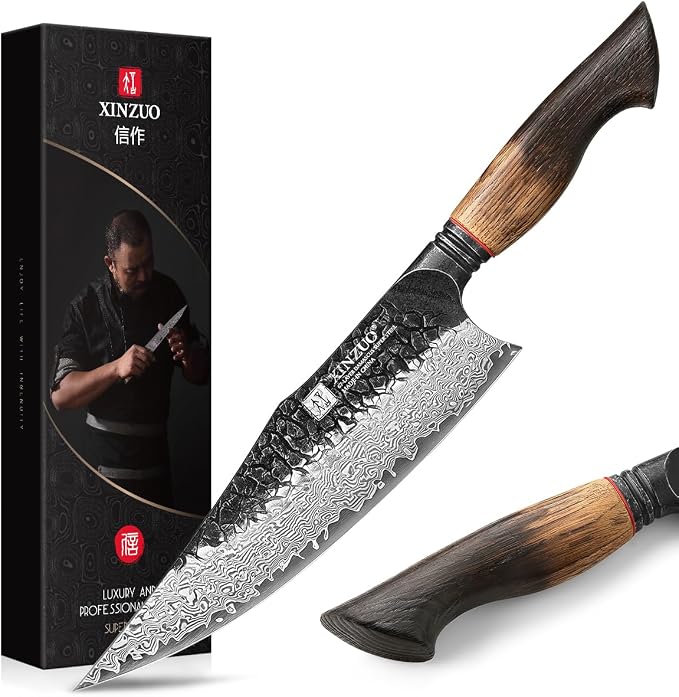
XINZUO 21.9 cm Japanese-style Damascus gyuto
Best fit: For longer slices and a larger board.
The longest blade in this selection gives more travel through larger produce or proteins. The supplied title calls it Japanese-style, describes 67 layers and lists a burnt-wood handle with red G10 detail. Those design cues make it visually different from the resin and all-G10 options.
Buy the length because it helps your cutting tasks, not because a larger number or a layer count automatically means a better edge. Plan for the full board and storage space that 21.9 cm needs.
Check before buying: Check which steel actually forms the edge, overall weight, exact handle material and manufacturer care instructions.
View the listing ↗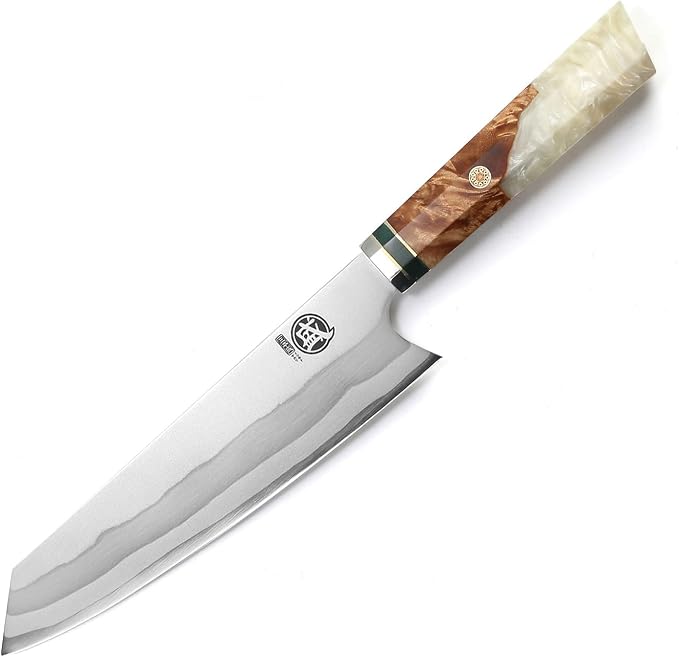
MITSUMOTO SAKARI 21 cm Damascus kiritsuke-style knife
Best fit: For a cook who wants a straighter profile and a fine tip.
The angled tip is the feature you notice first. A kiritsuke-style retail knife can offer a different profile for controlled push cuts and detailed tip work, while its 21 cm length still gives useful reach across the board.
The style name alone does not establish a traditional single-bevel Japanese kiritsuke. Many kitchen listings use the term for a double-bevel hybrid. Compare the actual edge and profile with what you expect to use.
Check before buying: Confirm single or double bevel, core steel, weight, handle and the finished knife’s country of manufacture.
View the listing ↗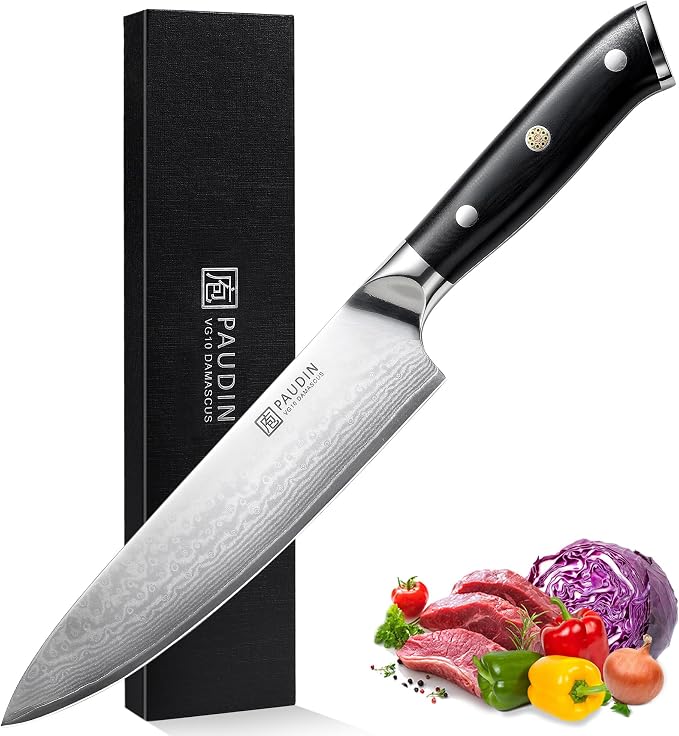
PAUDIN 8-inch VG10 Damascus chef knife
Best fit: For a general chef shape with a named cutting steel.
The supplied title identifies a VG10 core, 67 layers, an 8-inch chef blade and an ergonomic G10 handle. Of the larger all-purpose knives here, it gives one of the clearest claimed core-steel specifications.
VG10 is a Japanese-developed steel grade, but its presence in a listing does not prove the finished PAUDIN knife was made in Japan. The G10 handle is another point of difference if you prefer it to the wood on the XINZUO and petty knives.
Check before buying: Confirm the actual blade construction, brand specification, edge steel and origin in the current product page.
View the listing ↗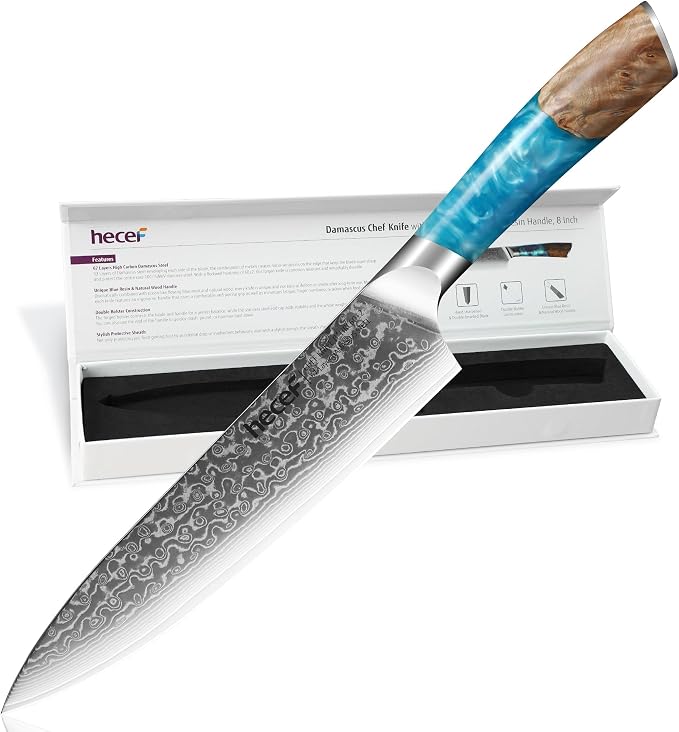
hecef 8-inch Japanese-style Damascus chef knife
Best fit: For a versatile chef knife with a resin grip and included guard.
This listing puts together the familiar 8-inch chef format, a resin handle and a knife protector. A protector matters if the knife will be stored in a drawer or moved between kitchens. The supplied title describes 67 layers.
Against the PAUDIN chef knife, the choice here turns on handle feel and storage accessories as well as the missing edge-steel disclosure. A layer count is not a substitute for a named core or measured sharpness.
Check before buying: Check the actual cutting-core steel, guard fit, blade thickness and handle material on the live listing.
View the listing ↗Japanese steel, style and origin.
These terms describe different things. A product can have a Japanese-style shape without being manufactured in Japan.
What is Japanese about these knives?
Nakiri, santoku, gyuto, petty and kiritsuke are familiar knife-style names. VG10 and AUS-10 are named steel grades associated with Japanese steelmakers. None of those words, on its own, establishes where a particular finished knife was forged, ground or assembled. We have not verified manufacturing country for the eight listings. Ask the seller for a clear origin statement if that is part of your decision.
Which named core steels appear here?
The 13.5 cm petty and PAUDIN 8-inch chef titles mention VG10. Takefu Special Steel describes its VG10 grade as containing chromium, molybdenum, cobalt and vanadium. The 18 cm santoku title names AUS-10; Aichi Steel describes carbon, vanadium and molybdenum additions in its AUS-10 family. These are alloy references, not independent verification of steel in a retail knife. The MITSUMOTO chef title says VG-Pro, which must not be treated as proof of VG10 composition.
What does Damascus mean on a modern kitchen knife?
It can describe pattern-welded layers or patterned cladding around a separate core; a surface pattern is also possible. Ask which steel reaches the edge and how the visible pattern was produced. Research on modern pattern-welded Damascus blades explains carbon diffusion and visual contrast between layers. It does not test the eight products on this page. Our Damascus knife guide and authenticity guide unpack the terminology.
Core steel
The alloy that forms the edge is more informative than a layer count. A listing that names VG10 or AUS-10 gives you a specific claim to check.
Blade geometry
Thickness behind the edge and the blade profile affect the way the knife moves through carrots, onions and proteins. A razor-sharp title cannot describe that.
Sharpness test
A BESS reading measures the force needed to sever standard test media. Lower means sharper at that moment, according to Edge On Up. No verified readings were supplied for these knives.
That is why there is no invented “sharpness index,” HRC figure or performance score in this guide. A knife can feel sharp after fresh sharpening yet have a thicker blade that pushes food apart. Edge retention and hand comfort are separate questions, and honest answers require product-specific testing.
Care and buying checks.
Protect the edge
Wash by hand, dry promptly and avoid loose drawer storage where the cutting edge can strike other metal. Use an appropriate board and follow the maker’s sharpening and handle-care instructions. Wood, resin and G10 handles have different upkeep needs. See our cleaning guide and sharpening guide for more detail.
Start small if you are undecided
One useful 20 cm chef knife can do more for a kitchen than several poorly matched specialist blades. For a wider comparison, see best Damascus knives, our chef knife guide or the knife sets guide.
Check the live retailer page
Product names, seller, blade dimensions, handle construction and price can change. Confirm the actual origin if “made in Japan” matters to you. For the longer knives, check board and storage dimensions as well as the listed blade length.
Buying from overseas in Australia
Rules depend on the knife’s design, not its Damascus pattern. The Australian Border Force guidance on restricted items is a starting point for checking a specific import. Also check any relevant state or territory rules before ordering.
Before you order.
Are these Japanese Damascus knives made in Japan?
The supplied listings do not establish the manufacturing country for these particular products. Japanese-style describes a blade design; a named Japanese steel grade also does not confirm where the finished knife was made. Check the manufacturer’s country-of-origin statement.
Which Japanese-style Damascus knife should a beginner buy first?
Compare a manageable 20 cm chef or gyuto-style knife, or the shorter 18 cm AUS-10 santoku if you have a compact board. The right fit depends on your hand, the food you prepare and the room you have.
Nakiri or santoku: which is better for vegetables?
A nakiri is a more dedicated vegetable tool with a tall, relatively straight blade. A santoku is a broader general-purpose option that can also handle vegetable prep. Your preferred board motion and other knives matter.
Is a kiritsuke always single bevel?
No. Kiritsuke-style listings may describe a hybrid shape with a double-bevel edge. Check the exact bevel on the retailer page instead of assuming it from the name.
Does 67-layer Damascus mean the knife is sharper?
No. Layer count describes a claimed construction and does not give a measured sharpness result or guarantee edge retention. Compare the edge steel, geometry and maker specification.
Are VG-Pro and VG10 the same steel?
Their names are not enough to establish equivalence. VG10 is a named grade in the petty and PAUDIN titles here; VG-Pro appears in the MITSUMOTO chef title. Ask for the exact VG-Pro composition and edge construction.
Can I use a nakiri or thin gyuto on bones?
Do not assume so. Use each knife only for tasks permitted by its manufacturer. A vegetable knife or thin kitchen gyuto is not automatically a heavy bone cleaver.
Have these knives been tested and ranked?
No. This is a use-based comparison of the supplied retailer titles and images plus cited steel research. It does not claim hands-on tests, numerical sharpness scores or verified customer ratings.
Editorial method: The eight listings and images were supplied for this article. We compared blade shape, disclosed steel and likely kitchen use without assigning unverified performance ranks. No purchase, hands-on test, factory verification, measured BESS score, price or customer-review statistic is claimed.
- Steel grades: Takefu Special Steel on VG10 and Aichi Steel on AUS-10.
- Layered blade research: Verhoeven and Clark, Materials Characterization.
- Sharpness test: Edge On Up PT50 instructions.
- Australia: Australian Border Force weapons guidance.