VG10 vs AUS10 vs 10Cr15CoMoV: Which Knife Steel Is Better?
VG10, AUS10 and 10Cr15CoMoV all sit in the useful high-carbon stainless kitchen-knife category, but the names do not tell the whole story. Their chemistry differs, manufacturer traceability differs, and the finished knife can change dramatically depending on heat treatment, hardness, blade geometry and sharpening.
VG10, AUS10 or 10Cr15CoMoV?
VG10 is the easiest of the three to verify when it is genuine Takefu VG10, AUS10 is an excellent everyday stainless steel with a slightly different alloy recipe, and properly made 10Cr15CoMoV can sit remarkably close to VG10 on paper.
That does not mean every VG10 knife automatically outcuts every AUS10 knife, or that 10Cr15CoMoV is simply another name for VG10. Heat treatment, actual hardness, carbide structure, edge angle and blade thickness can have as much influence on the finished knife as the steel name printed in the listing.
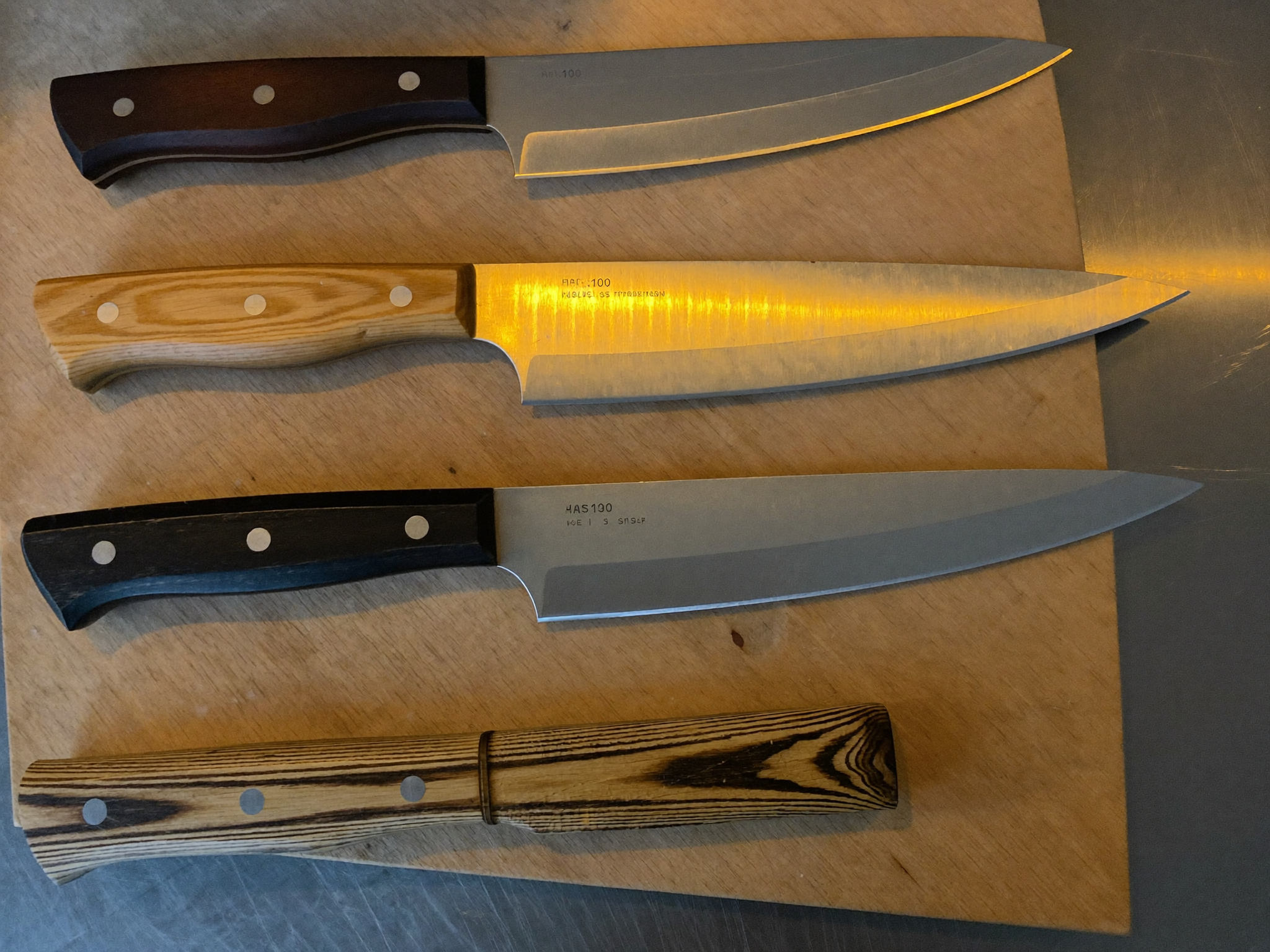
VG10 vs AUS10 vs 10Cr15CoMoV comparison
These are material-level tendencies rather than guaranteed performance figures for every knife. A finished knife should be judged using its actual hardness, geometry, heat treatment and manufacturer documentation.
| Factor | VG10 | AUS10 | 10Cr15CoMoV |
|---|---|---|---|
| Steel family | High-carbon martensitic stainless | High-carbon martensitic stainless | High-carbon martensitic stainless |
| Common origin | Japan | Japan | China |
| Published carbon | About 1.00% | About 0.95 to 1.10% | About 0.95 to 1.05% in one supplier specification |
| Published chromium | About 15.00% | About 13.00 to 14.50% | About 14.50 to 15.50% in one supplier specification |
| Cobalt | About 1.55% | Not part of the usual AUS10 reference composition | Present in the supplier specification reviewed |
| Corrosion behaviour | Good stainless performance with normal care | Good stainless performance with normal care | Good stainless potential when correctly processed |
| Sharpening | Generally manageable on normal water stones | Generally manageable | Generally manageable at typical kitchen-knife hardness |
| Biggest advantage | Strong producer-level documentation when genuine | Balanced everyday characteristics | Potentially strong value for similar alloy chemistry |
| What to verify | Authenticity, HRC and maker | HRC, heat treatment and geometry | Actual material source, HRC and heat treatment |
Genuine VG10 data is published by Takefu Special Steel. AUS10 reference ranges can be compared through the ZKnives steel database.
What are these three knife steels?
What is VG10?
VG10 is an original stainless blade steel produced by Takefu Special Steel in Japan.
Takefu lists representative chemistry of about 1% carbon, 15% chromium, 1% molybdenum, 0.25% vanadium and 1.55% cobalt. The company lists a hardness capability of HRC 60 or above and describes VG10 as suitable for kitchen knives and other cutting tools.
What is AUS10?
AUS10, also written AUS-10 or AUS-10A, is a Japanese stainless knife steel associated with the AUS family.
Commonly published reference ranges place its carbon around 0.95 to 1.10%, chromium around 13 to 14.5%, with smaller additions of molybdenum and vanadium plus nickel.
What is 10Cr15CoMoV?
10Cr15CoMoV is a high-carbon stainless blade-steel designation commonly encountered in Chinese knife manufacturing.
Published specifications can place it around 0.95 to 1.05% carbon, 14.5 to 15.5% chromium, roughly 1% molybdenum and smaller additions of vanadium and cobalt.
That explains why it is frequently compared with VG10, but similar chemistry does not prove every 10Cr15CoMoV blade is identical to genuine Takefu VG10.
Chemical composition: what actually changes?
The three steels overlap heavily in carbon and chromium, but alloying details are not identical. More importantly, percentages do not operate independently. Heat treatment determines how the alloy develops into the microstructure of the finished blade.
Published alloy fingerprint
The following bars illustrate approximate published chemistry. They are not performance scores.
Alloy percentages should not be converted directly into edge-retention, toughness or corrosion scores.
| Element | VG10 | AUS10 reference range | 10Cr15CoMoV reference range | Why it matters |
|---|---|---|---|---|
| Carbon | ~1.00% | 0.95-1.10% | 0.95-1.05% | Supports hardness and carbide formation. |
| Chromium | ~15.00% | 13.00-14.50% | 14.50-15.50% | Supports corrosion resistance and hardenability. |
| Molybdenum | ~1.00% | 0.10-0.30% | ~0.90-1.00% | Contributes to hardenability and wear behaviour. |
| Vanadium | ~0.25% | 0.10-0.25% | 0.25-0.35% | Can support grain refinement and carbide formation. |
| Cobalt | ~1.55% | Not usually listed | 1.30-1.80% | Influences heat-treatment response. |
| Nickel | Not highlighted in Takefu's VG10 table | ~0.49% | Specification dependent | Can influence toughness and corrosion behaviour. |
Which holds an edge longest?
There is no defensible universal answer saying every VG10 blade holds an edge longer than every AUS10 or 10Cr15CoMoV blade.
Cutting performance depends strongly on hardness, carbide structure, edge angle, thickness behind the edge and sharpening quality.
A thin, well heat-treated AUS10 chef knife can therefore outperform a poorly ground VG10 knife in actual kitchen use. The same principle applies to 10Cr15CoMoV.
For more background, read our complete Damascus steel guide.
VG10 vs AUS10 vs 10Cr15CoMoV for toughness and chipping
Harder is not automatically better
Hardness can help a thin edge resist deformation and wear, but it should not be treated as a standalone quality score. Poor heat treatment, inappropriate geometry or misuse can still cause chipping.
Geometry changes the equation
Very thin Japanese-style edges are designed for efficient slicing. They should not be used like thick outdoor blades for twisting through joints, frozen food or hard bone.
AUS10 contains a different combination of alloying elements from VG10 and should be treated as its own steel rather than VG10 under another name.
VG10 also sometimes receives a reputation for being "chippy", but the steel name alone does not reveal the edge angle, hardness, microstructure or how the knife was used.
Which steel resists rust better?
All three are high-chromium stainless steels intended to offer much easier corrosion management than traditional non-stainless carbon knife steels.
VG10's published composition contains about 15% chromium. Common AUS10 reference data places chromium around 13 to 14.5%, while published 10Cr15CoMoV specifications can fall around 14.5 to 15.5%.
You should not simply rank those numbers and assume the steel with the most chromium always wins. Chromium tied up in carbides does not contribute to the stainless matrix in exactly the same way as chromium remaining in solid solution.
See our guide to cleaning and caring for a Damascus knife.
Which is easiest to sharpen?
All three can be sharpened successfully with normal quality water stones. The hardness and edge condition of the actual knife matter more than the steel name alone.
VG10
Takefu describes VG10 as having good machinability and sharpening characteristics. At normal kitchen-knife hardness it responds well to quality water stones.
AUS10
AUS10 is generally straightforward to maintain and can usually be sharpened effectively without specialised super-abrasive stones.
10Cr15CoMoV
Properly made 10Cr15CoMoV is also manageable on water stones. Exact sharpening feel depends on hardness, carbide structure and heat treatment.
Read our full Damascus knife sharpening guide.
Why heat treatment matters as much as the steel name
Steel chemistry is the recipe. Heat treatment determines what microstructure the knife maker creates from that recipe.
Studies of martensitic stainless steels used for cutting tools demonstrate how quenching and tempering can alter carbide dissolution, retained austenite, hardness and corrosion behaviour.
This is also why an unexplained "61 HRC" marketing claim tells you less than a manufacturer that publishes its steel source, intended hardness and processing approach.
The US National Institute of Standards and Technology provides detailed guidance on Rockwell hardness measurement.
Is 10Cr15CoMoV the same as VG10?
No. It is safer to treat them as separate designations unless the material producer provides documentation proving otherwise.
The confusion makes sense. Published 10Cr15CoMoV chemistry can look extremely close to Takefu's published VG10 formula, including roughly 1% carbon, around 15% chromium and additions of molybdenum, vanadium and cobalt.
The ZKnives database discusses the similarity between the two steels but also identifies the uncertainty behind treating them as universally identical.
"Similar chemistry", "functional alternative" and "the same proprietary steel" are different claims.
What do VG10, AUS10 and 10Cr15CoMoV mean in a Damascus knife?
The core does the cutting
In many modern Damascus chef knives, VG10, AUS10 or 10Cr15CoMoV forms the hard cutting core while additional stainless layers surround it.
Layer count is not an edge score
A 67-layer knife does not automatically hold its edge longer than a lower-layer knife. Decorative layer count does not magically improve the properties of the core steel.
Pattern is not proof of performance
Damascus waves can look beautiful, but the pattern alone tells you nothing about hardness, grinding quality, heat treatment or edge retention.
Start with what a Damascus knife actually is and our guide to real vs fake Damascus.
We also explain the difference in Damascus steel vs stainless steel.
Four claims worth questioning before you buy
"Higher HRC always means a better knife"
HRC is useful, but hardness is only one measurement. Geometry, toughness, microstructure and edge finish still matter.
"67 layers means 67 times better"
Layer count mainly describes the construction and appearance. It is not a multiplier for sharpness or edge retention.
"10Cr15CoMoV is always VG10"
Published chemistry can be close, but similar formulas do not establish that every material carrying the two names is identical.
"Japanese steel guarantees a better knife"
Material origin can improve traceability, but excellent raw steel can still become an average knife through poor heat treatment or grinding.
So which steel should you choose?
When traceability matters
Genuine Takefu VG10 has clear producer-level documentation and is a sensible choice when you want a well-established Japanese stainless blade steel.
For a balanced everyday knife
AUS10 combines roughly 1% carbon with useful chromium, molybdenum, vanadium and nickel. A well-made AUS10 knife can be an excellent practical chef knife.
When the maker earns your trust
The chemistry can be highly attractive for the money. Verify the manufacturer, heat treatment and finished hardness rather than buying solely because the listing compares the steel with VG10.
What matters more than the logo on the steel?
- Who made the knife and who supplied the steel?
- Does the manufacturer state the finished hardness?
- Does the blade geometry suit the way you cook?
- Is the blade thin behind the edge?
- Does the manufacturer explain more than just the layer count?
- Is the knife comfortable and appropriately balanced?
- Can you maintain the edge with your preferred sharpening method?
Compare complete knives in our best Damascus chef knives and best Damascus knives in Australia guides.
You can also read how much a Damascus knife costs to understand what actually affects pricing.
There is no magic steel name
VG10 is a proven, well-documented Japanese blade steel. AUS10 is a legitimate high-carbon Japanese stainless steel in its own right. 10Cr15CoMoV can have chemistry remarkably close to VG10 and can be a compelling knife steel when it comes from a manufacturer that controls its material and heat treatment properly.
If material traceability matters most, genuine VG10 has an obvious advantage because Takefu publishes what VG10 is.
If you find a well-made AUS10 knife with excellent geometry, there is no good reason to reject it simply because it does not say VG10.
If a 10Cr15CoMoV knife comes from a credible manufacturer with documented hardness and good construction, the country of origin alone should not tell you whether the knife performs well.
Buy the finished knife, not just the alloy name.
Frequently asked questions
Is VG10 better than AUS10?
Is 10Cr15CoMoV the same as VG10?
Is AUS10 good knife steel?
Is 10Cr15CoMoV good knife steel?
Which holds an edge longer?
Which is easiest to sharpen?
Does VG10 rust?
Is VG10 good for a Damascus knife?
Does a higher Damascus layer count mean better steel?
What HRC should a VG10 knife have?
Research and technical sources
This comparison separates manufacturer specifications from general metallurgical evidence and avoids assigning artificial performance scores where controlled finished-knife testing is unavailable.
- Takefu Special Steel: official VG10 specification - Producer information covering representative composition and blade-steel properties.
- National Institute of Standards and Technology: Rockwell hardness measurement - Government technical guidance on Rockwell hardness measurement.
- Research on heat treatment of martensitic stainless steel - Peer-reviewed research examining microstructure, hardness and corrosion behaviour.
- Carbide dissolution and hardness in martensitic stainless knife steel - Research covering carbide dissolution, retained austenite and hardness.
- Knife Steel Nerds: CATRA edge-retention testing - Discussion of geometry, hardness and carbide effects on slicing performance.
- ZKnives AUS10 steel reference - Reference chemistry for AUS10.
- ZKnives 10Cr15CoMoV steel reference - Reference information and discussion of comparisons with VG10.