KITCHENDAO 67-Layer Chef Knife Review: Is It Worth Buying?
Short answer: the KITCHENDAO 67-Layer Chef Knife deserves consideration if you want a full-size everyday chef knife with a clearly identified 9Cr18MoV cutting core, manufacturer-stated 59 to 61 HRC hardness, layered Damascus construction and an unusual rosewood and resin handle. The interesting part is not simply that it has 67 layers. It is that KITCHENDAO publishes enough underlying specifications for buyers to look beyond the pattern.
Is the KITCHENDAO 67-Layer Chef Knife good?
On specification, it is a convincing everyday chef knife for its intended role. KITCHENDAO identifies a 9Cr18MoV high-carbon stainless steel core, a 304 stainless steel exterior, 67-layer construction and a manufacturer-stated hardness of 59 to 61 HRC. The company also states that the blade is hand-sharpened to 15°. That combination is more informative than simply advertising a decorative Damascus pattern.
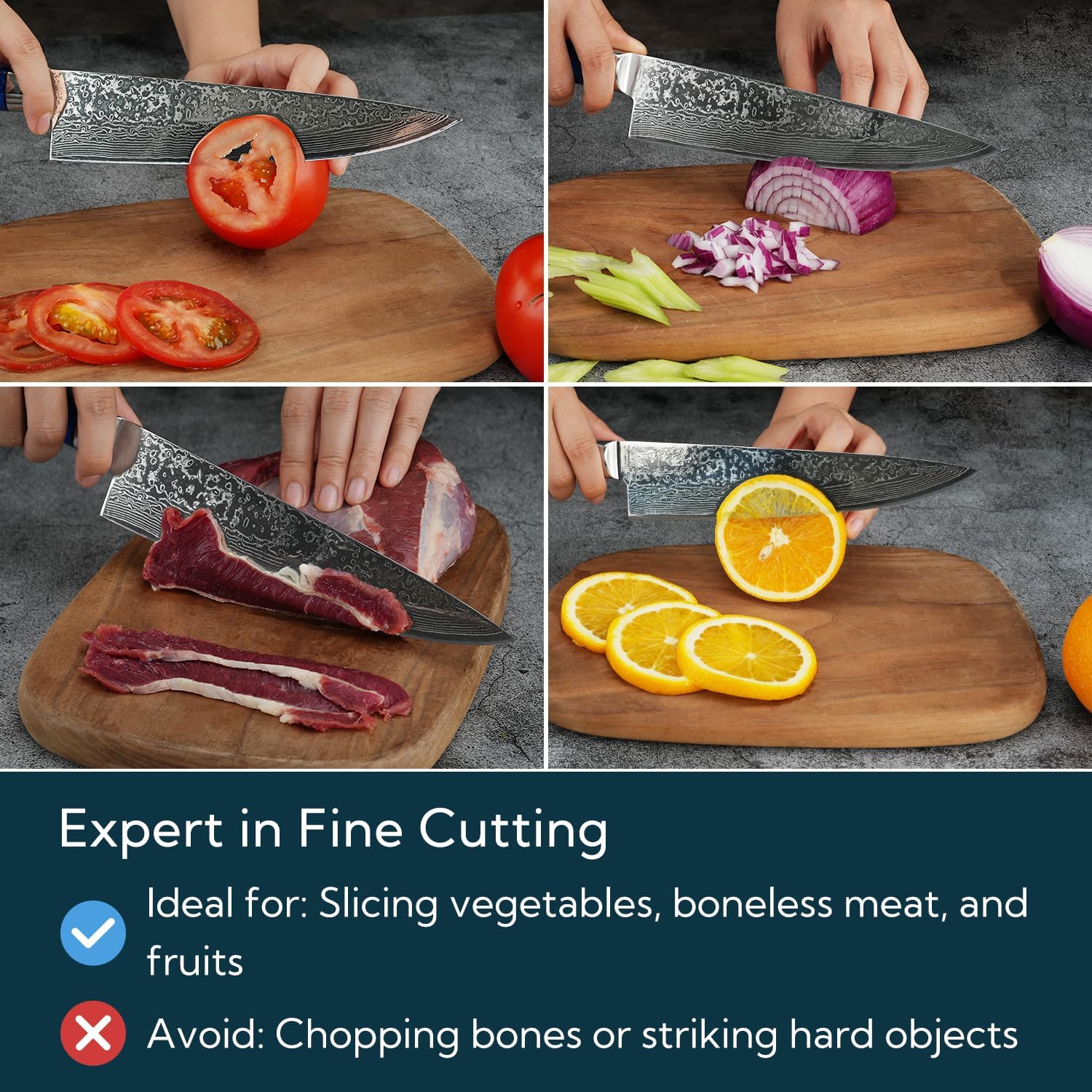
It is best suited to slicing, chopping and general preparation of vegetables, fruit, herbs and boneless proteins. It is not a substitute for a bone cleaver, frozen-food chopper or rough utility blade.
Review transparency: this is a research-based editorial review. We have not represented laboratory measurements, long-term personal ownership or cutting tests that we have not independently performed.
KITCHENDAO gives buyers more to evaluate than a Damascus pattern
The easiest way to market a Damascus knife is to photograph the pattern and stop there. That may look impressive, but it does not tell you what material forms the cutting edge, how hard the blade is claimed to be or how the knife is intended to perform.
KITCHENDAO provides considerably more useful information for this model. The company's product page identifies a 9Cr18MoV high-carbon stainless steel core, describes a 304 stainless steel exterior, states a hardness range of 59 to 61 HRC and says the knife is hand-sharpened to 15°.
The company also specifies an 8-inch chef knife format. Your Amazon Australia listing describes the same model as 20CM. Those descriptions place it in the familiar full-size chef knife category rather than a short utility knife or oversized specialty blade.
Want to check the actual listing?
Use the current Amazon Australia listing rather than relying on a static price in a review.
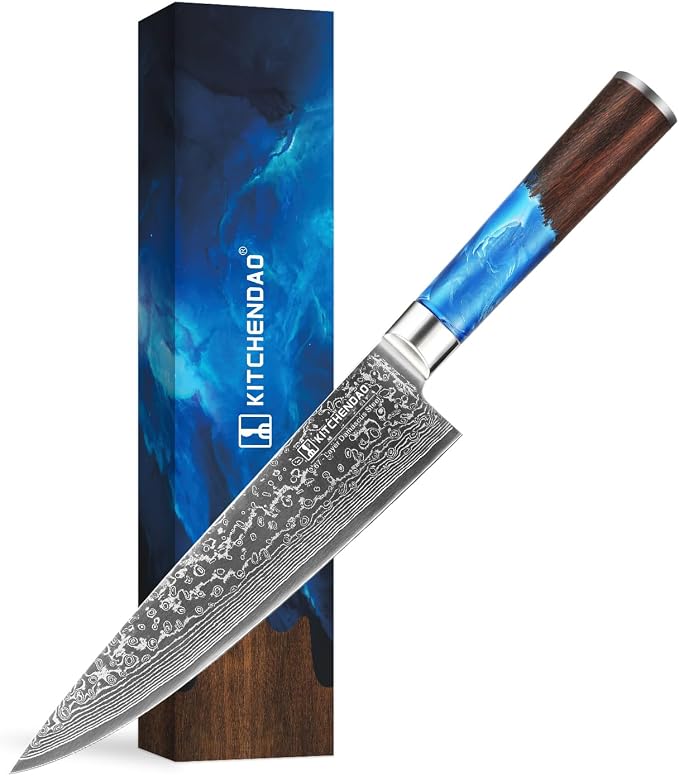
See the KITCHENDAO chef knife from multiple angles
These images help show the knife's blade shape, patterned finish, handle construction and overall proportions. The gallery uses each product image once and preserves different source-image dimensions instead of forcing them into aggressive crops.
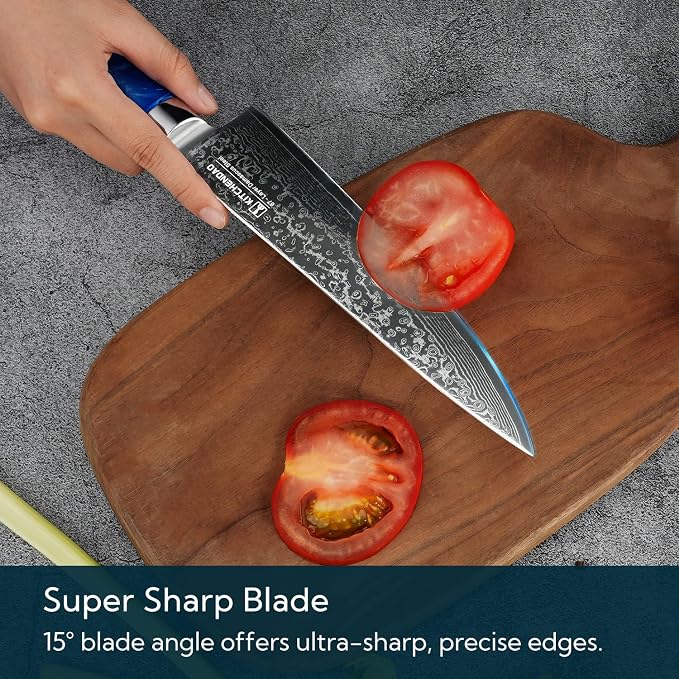
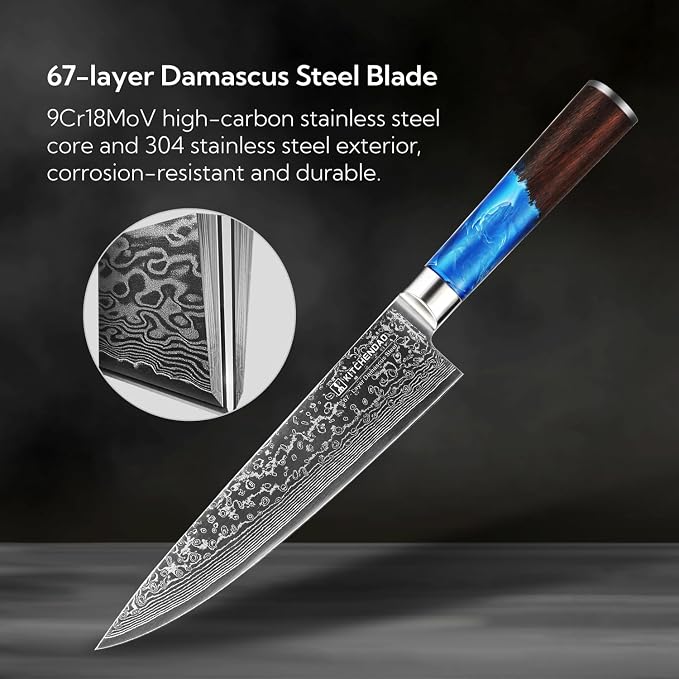
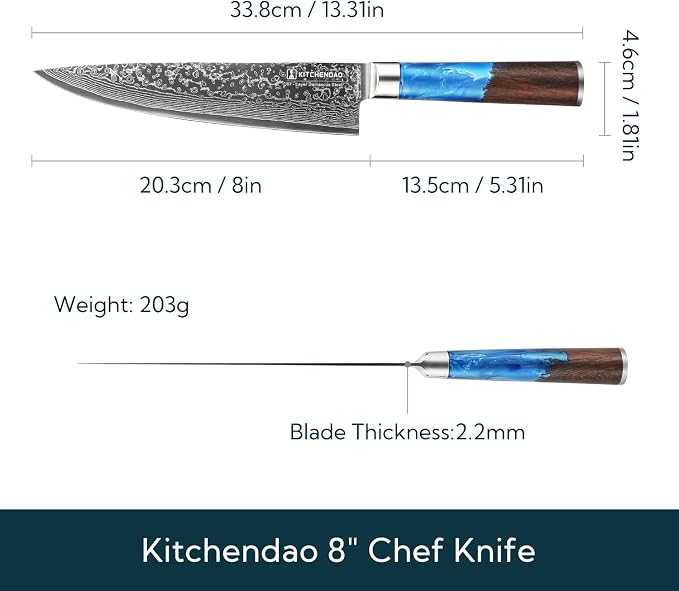
See the knife being used
Open the Amazon product video to see additional views of the blade, handle and cutting demonstration supplied with the listing.
What is verified, what is a manufacturer claim, and what is editorial analysis?
Product reviews become much more useful when different types of information are not blended together. Here is how we treat the main claims on this page.
Steel designation, layer count, exterior material, stated hardness, sharpening angle, handle material and blade size come from KITCHENDAO's own product information.
Metallurgical research is used to explain general pattern-welded steel concepts. It does not test this individual KITCHENDAO blade.
Task suitability, buying advice and comparisons are based on the documented chef knife format and intended use, not invented laboratory measurements.
The official KITCHENDAO product page is the primary source for the product-specific technical claims in this review.
KITCHENDAO 67-Layer Chef Knife specifications
| Specification | KITCHENDAO states | Why it matters |
|---|---|---|
| Knife type | Chef knife | A general-purpose blade shape for normal kitchen preparation. |
| Blade size | 8 inch on manufacturer page, 20CM on Amazon AU listing | Both descriptions place it in the conventional full-size chef knife category. |
| Core steel | 9Cr18MoV high-carbon stainless steel | Identifies the material KITCHENDAO says forms the cutting core. |
| Exterior | 304 stainless steel | KITCHENDAO identifies this as part of the surrounding blade construction. |
| Layer count | 67 layers | Describes construction and visual patterning, not a universal quality score. |
| Hardness | 59-61 HRC | Gives useful context for the manufacturer's intended blade hardness. |
| Sharpening | Hand-sharpened to 15° | Suggests relatively fine kitchen geometry, although the manufacturer does not clarify whether the figure is per side or inclusive. |
| Handle | Rosewood and resin | Combines natural wood appearance with resin in the handle design. |
| Presentation | Gift box | Useful for buyers considering the knife as a present. |
What does the 9Cr18MoV core actually tell you?
The most important steel detail on this product page is not the number 67. It is the fact that KITCHENDAO identifies the core as 9Cr18MoV.
On a layered kitchen knife, the core is especially relevant because the cutting edge is formed from the core material. The surrounding construction contributes to the overall blade structure and visual appearance, but the number of visible or advertised layers should not be used as a simple ranking system.
Does having 67 layers automatically make it better?
No. Layer count can describe how a patterned blade is constructed, but it is not a universal measure of sharpness or edge retention.
Research by metallurgists John D. Verhoeven and Howard F. Clark examined modern pattern-welded Damascus blades and found that carbon diffusion during forging can eliminate the simple hard-layer versus soft-layer structure that people sometimes assume is responsible for the pattern. Their work points instead to alloy differences as important to differential etching and the visible pattern.
That study did not test this KITCHENDAO knife. It is useful background because it demonstrates why a visible layered pattern should not be treated as automatic evidence of superior cutting performance.
For a wider explanation, read our Damascus steel guide .
What does KITCHENDAO's 15° sharpening claim mean?
KITCHENDAO says the chef knife is hand-sharpened to 15°. That sounds like useful information, but there is a detail worth noting: the manufacturer's current product page does not specify whether 15° means the angle on each side of the blade or a total included angle.
Rather than guessing, we leave the specification exactly where the evidence leaves it: the manufacturer states 15°.
In practical terms, the product is clearly presented as a precision kitchen knife rather than a thick, impact-focused chopping tool. That is consistent with how you should treat it in use.
What jobs suit this chef knife?
The KITCHENDAO is built around one of the most useful knife formats in a home kitchen. A full-size chef knife gives you enough blade length for larger produce while still being manageable for repetitive chopping, slicing and mincing.
That makes the knife naturally suited to onions, carrots, capsicum, herbs, fruit, cabbage and boneless proteins. It can handle many everyday jobs, but versatility should not be confused with indestructibility.
The visual below represents task fit based on the chef knife format. It is not a physical test score.
Rosewood and resin give this knife a distinctive identity
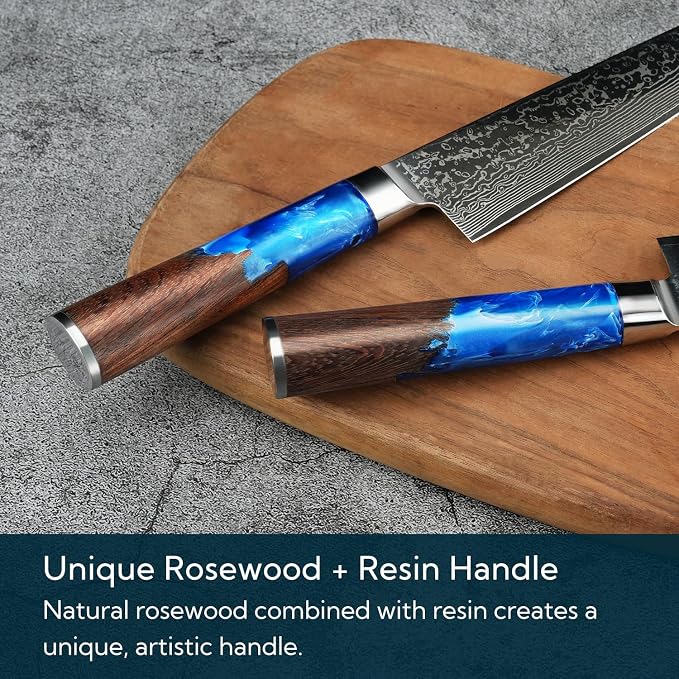
The handle is one of the more unusual parts of the KITCHENDAO design. Rather than using plain synthetic scales or only natural wood, KITCHENDAO states that the handle combines natural rosewood with resin.
The manufacturer says the rosewood receives a curing treatment intended to improve durability and resistance to deformation. That is the manufacturer's claim, not an independent long-term durability result from this review.
From a buying perspective, the material combination matters most if you want a knife that looks different from conventional black-handled kitchen knives. The appearance can also make it more attractive as a gift, particularly since KITCHENDAO supplies the knife in a gift box.
Why buyers may like it
- More distinctive appearance than a plain synthetic handle
- Combines natural wood character with resin
- Complements the patterned blade visually
- Gift box adds presentation value
What you still cannot know from a photo
- Whether the handle perfectly fits your hand
- How its balance feels with your grip style
- Whether you prefer its contour during long prep sessions
- How the surface feels when wet
The useful advantages and the real trade-offs
What stands out
- KITCHENDAO identifies the core as 9Cr18MoV rather than relying only on Damascus marketing.
- Manufacturer publishes a 59-61 HRC hardness range.
- Manufacturer states that the knife is hand-sharpened to 15°.
- Full-size chef knife format is useful for a broad range of daily food preparation.
- Rosewood and resin handle gives the knife a distinctive appearance.
- 67-layer construction provides the patterned visual finish buyers often want from Damascus knives.
- Gift box improves presentation if the knife is being purchased for someone else.
What to consider
- The manufacturer does not clarify whether its 15° figure is per side or total.
- Layer count does not independently prove sharpness or edge retention.
- This is not a bone cleaver or frozen-food chopper.
- We do not have an independently measured BESS sharpness score for this knife.
- Handle comfort still depends on your hand and grip.
- Product-page durability language should not be treated as a substitute for long-term independent testing.
How should you care for the KITCHENDAO chef knife?
A knife like this should be treated as a precision kitchen tool. Hand washing, prompt drying, an appropriate cutting surface and protected storage are straightforward habits that help preserve a fine edge and keep the knife in good condition.
After normal use
- Remove food residue promptly.
- Wash the knife carefully.
- Dry the blade and handle thoroughly.
- Store the edge so it cannot strike other utensils.
- Maintain the edge before it becomes severely dull.
Avoid
- Leaving the knife wet in a sink
- Cutting directly on glass or stone
- Twisting the edge through hard ingredients
- Bones
- Frozen blocks of food
- Throwing the knife loose into a crowded drawer
Food-safety context
Food Standards Australia New Zealand says knives and other utensils used during food preparation need to be thoroughly cleaned, and it advises separating utensils used for raw meat from those used with ready-to-eat foods unless the utensils have been thoroughly cleaned and sanitised.
You can read the current guidance directly from Food Standards Australia New Zealand .
For edge maintenance, see our guide to sharpening Damascus knives .
Who is this KITCHENDAO knife actually for?
It is easiest to decide whether a knife makes sense when you start with the person using it rather than the pattern on the blade.
The everyday home cook
A strong fit if you want one main knife for vegetables, herbs, fruit and boneless proteins.
The Damascus buyer
Relevant if visual pattern matters to you but you also want a product with a named core steel and published hardness specification.
The gift buyer
The patterned blade, rosewood-resin handle and supplied gift box make presentation part of the appeal.
| Buyer or task | Fit | Why |
|---|---|---|
| One main home kitchen knife | Strong fit | Chef knife shape is designed for broad everyday preparation. |
| Vegetables and herbs | Strong fit | Full-size chef knives naturally suit repetitive board work. |
| Gift purchase | Worth considering | Distinctive handle, patterned blade and included presentation box. |
| Tiny precision work | Consider a smaller knife | A petty or paring knife may be more convenient for very small in-hand tasks. |
| Bread | Use a serrated knife | Crusty bread is better matched to a dedicated serrated blade. |
| Bone chopping | Poor fit | Use a heavy tool designed specifically for impact work. |
Want another Damascus chef knife to compare?
See our XINZUO Yu Series review or browse the broader chef knife guide before deciding.
A practical note about buying knives in Australia
A Damascus pattern does not by itself determine whether a knife is restricted. Australian import controls apply to specific classes and designs of weapons, while state and territory rules can separately govern possession and carrying.
An ordinary kitchen chef knife should not be casually grouped together with prohibited designs such as butterfly knives, push knives or other specifically controlled weapon types. If you are importing a knife and are uncertain about its classification, check official guidance rather than relying on a product description.
The Australian Border Force weapons guidance is the appropriate federal starting point.
This is general information, not legal advice.
Where the information in this review comes from
We want readers to be able to distinguish a product claim from independent background research. These are the principal sources used for this review.
- KITCHENDAO product specifications: KITCHENDAO official product page . Used for the stated 9Cr18MoV core, 304 stainless exterior, 67-layer construction, 59-61 HRC range, 15° sharpening claim, handle material and size.
- Pattern-welded steel research: John D. Verhoeven and Howard F. Clark, Carbon Diffusion Between the Layers in Modern Pattern-Welded Damascus Blades . This research is used only for general metallurgy context. It did not test this KITCHENDAO knife.
- Food hygiene: Food Standards Australia New Zealand .
- Australian import information: Australian Border Force .
Useful next pages
KITCHENDAO 67-Layer Chef Knife questions answered
Is the KITCHENDAO 67-Layer Chef Knife worth buying?
It is worth considering if you want a full-size chef knife with a manufacturer-identified 9Cr18MoV core, a published 59-61 HRC hardness range, Damascus construction and a distinctive rosewood and resin handle. Whether it is the right purchase depends on your preferred handle feel, budget and intended kitchen tasks.
What steel does the KITCHENDAO chef knife use?
KITCHENDAO states that the cutting core is 9Cr18MoV high-carbon stainless steel and describes the exterior as 304 stainless steel.
Is the KITCHENDAO knife really 67-layer Damascus?
KITCHENDAO markets this model as a 67-layer Damascus steel blade and identifies the core and exterior materials on its own product page. This review does not independently destructively analyse the blade to count its layers.
How hard is the blade?
The manufacturer states a hardness range of 59 to 61 HRC. That is a manufacturer specification rather than an independent hardness measurement performed for this review.
What is the sharpening angle?
KITCHENDAO says the blade is hand-sharpened to 15°. The current manufacturer wording does not clarify whether that figure means 15° per side or a 15° total included angle, so this review does not guess.
Is this knife good for vegetables?
Yes. A full-size chef knife is naturally suited to chopping and slicing vegetables, herbs and fruit. That assessment is based on the blade format rather than a laboratory performance score.
Can I use the KITCHENDAO chef knife on meat?
It is suitable in format for preparing and slicing boneless proteins. It should not be treated as a heavy bone cleaver.
Can it cut through bones?
Do not treat it as a bone chopper. Use a cleaver or other tool specifically designed for hard-impact work when bones are involved.
What is special about the handle?
KITCHENDAO describes the handle as combining natural rosewood and resin. The manufacturer also says the rosewood receives a curing treatment intended to improve durability and resistance to deformation.
Is 67 layers better than 33 layers?
Not automatically. Layer count is a construction specification, not a universal performance scale. Core steel, heat treatment, blade geometry, sharpening quality and intended use all matter.
Has Damascus Knife Australia physically tested this knife?
This article is a research-based review built from manufacturer specifications, product imagery, authoritative guidance and independent metallurgy research. It does not claim hands-on laboratory testing or long-term ownership that did not occur.
The strongest part of the KITCHENDAO specification is what sits underneath the pattern
The 67-layer pattern is what will probably make somebody stop scrolling. The rosewood and resin handle gives the knife another point of visual distinction. Those features matter when you are buying something you will see and handle every day.
The more useful information, though, is less dramatic. KITCHENDAO names the 9Cr18MoV cutting core, identifies the surrounding material as 304 stainless steel, publishes a 59-61 HRC hardness range and states that the blade is hand-sharpened to 15°.
That does not prove that this knife will outperform every competing chef knife, and we would not turn those figures into a fabricated rating. What the specifications do provide is enough information to understand the product's intended role.
This is a full-size chef knife aimed at everyday preparation. Vegetables, herbs, fruit and boneless proteins are sensible territory. Bones, frozen blocks and other hard-impact work are not.
The main unresolved detail is the 15° specification. KITCHENDAO does not clarify on its current product page whether that figure is measured per side or as a total included angle. That is worth knowing, especially if you plan to reproduce the factory geometry during sharpening.
For buyers who want the Damascus look but also want a named core steel, published hardness range and an unconventional wood-resin handle, the KITCHENDAO belongs on the shortlist.