XINZUO Yu Series Chef Knife Review: Is This Damascus Knife Worth It?
The XINZUO Yu Series Chef Knife is a compelling option for home cooks who want the visual appeal of Damascus steel without giving up the familiar versatility of a full-size chef knife. Its specification includes a named cutting core, layered Damascus construction, rosewood handle and a fine kitchen edge. The important question is not whether it looks impressive. It is whether the design makes sense for everyday food preparation.
Quick answer: Is the XINZUO Yu Series Chef Knife worth considering?
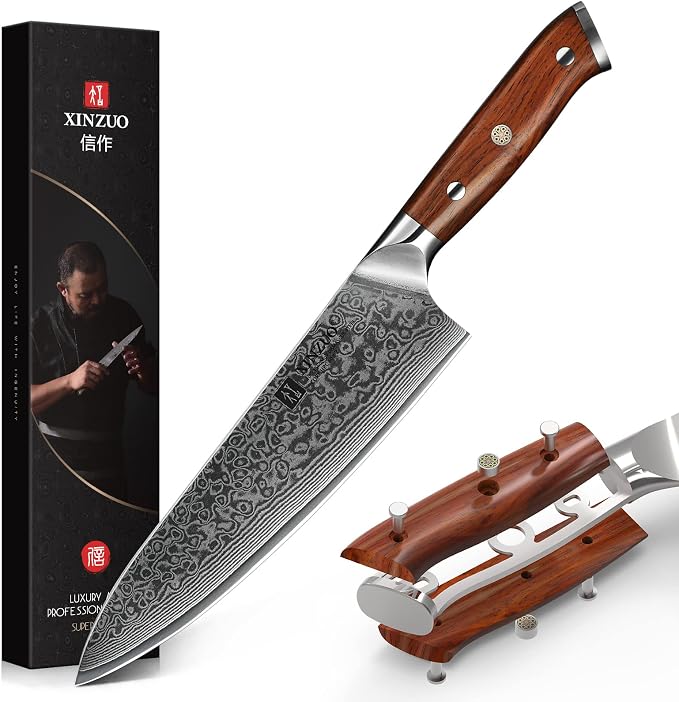
Yes, for the right kitchen. It makes the most sense for someone who wants one attractive chef knife for vegetables, herbs, fruit and boneless proteins, while also appreciating the patterned Damascus finish and natural rosewood handle. It is less suitable if you want a dishwasher-friendly knife, a heavy bone chopper or something designed to tolerate rough treatment.
This is a research-based review. We do not claim laboratory testing, personal long-term ownership or sharpness measurements that we have not independently performed.
Why the XINZUO Yu Series gets attention
Damascus knives are easy to sell with photographs. Flowing patterns across polished steel immediately look different from an ordinary stamped kitchen knife. The problem is that appearance can become a distraction from the questions that actually matter at the cutting board.
The XINZUO Yu Series is more interesting because the manufacturer gives buyers details beyond the pattern. XINZUO identifies a 10Cr15CoMoV cutting core, a 67-layer Damascus construction, a full-size chef knife profile, a rosewood handle and a relatively fine kitchen edge specification.
That combination puts the Yu Series into a useful category. It is designed as an everyday chef knife first and a visually distinctive Damascus knife second.
Interested in the Yu Series?
Check the current Amazon Australia listing before deciding.
A closer look at the XINZUO Yu Series Chef Knife
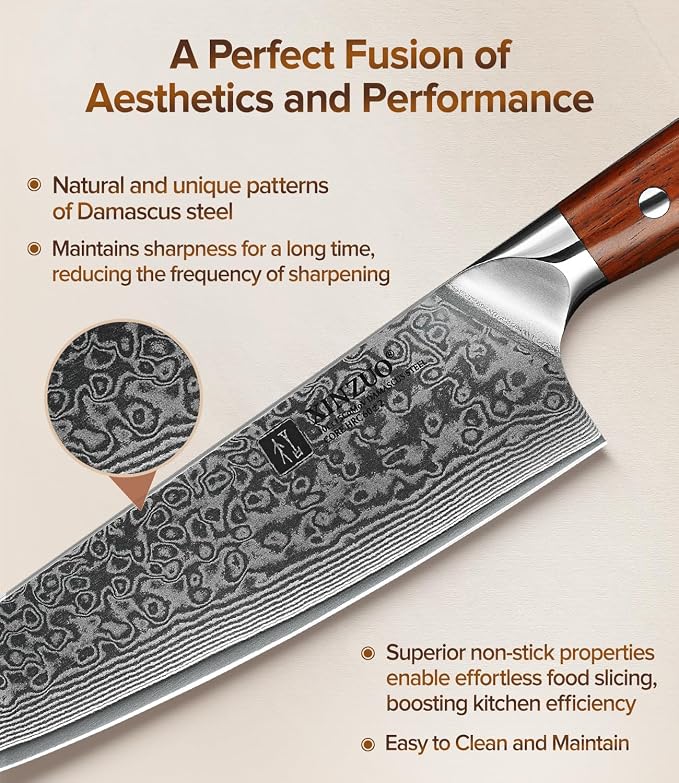
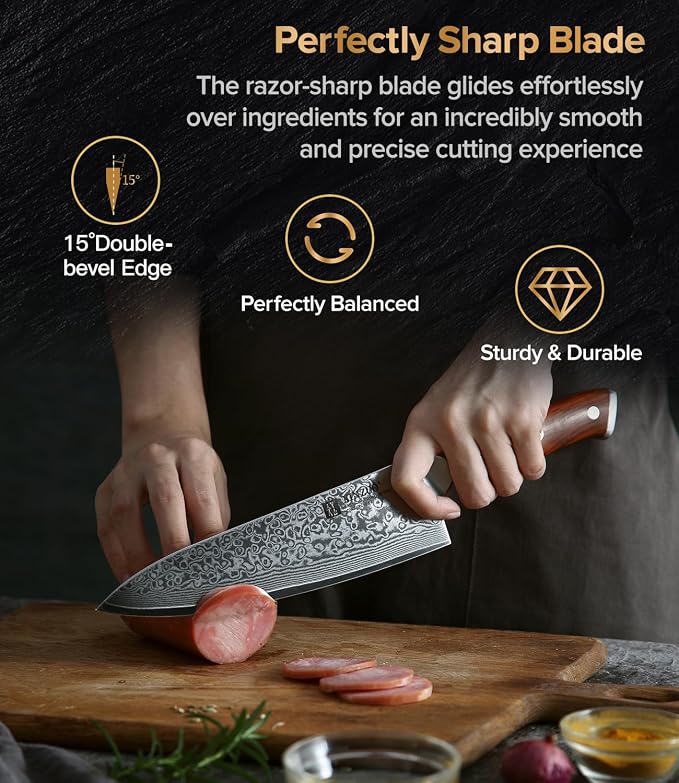
These product images give you a closer look at the knife's proportions, Damascus pattern, rosewood handle and overall presentation. The gallery deliberately preserves the different image dimensions rather than stretching everything into identical crops.
See the XINZUO Yu Series in motion
Open the Amazon product video for additional views of the knife, blade finish and handle.
The specifications that matter more than the pattern
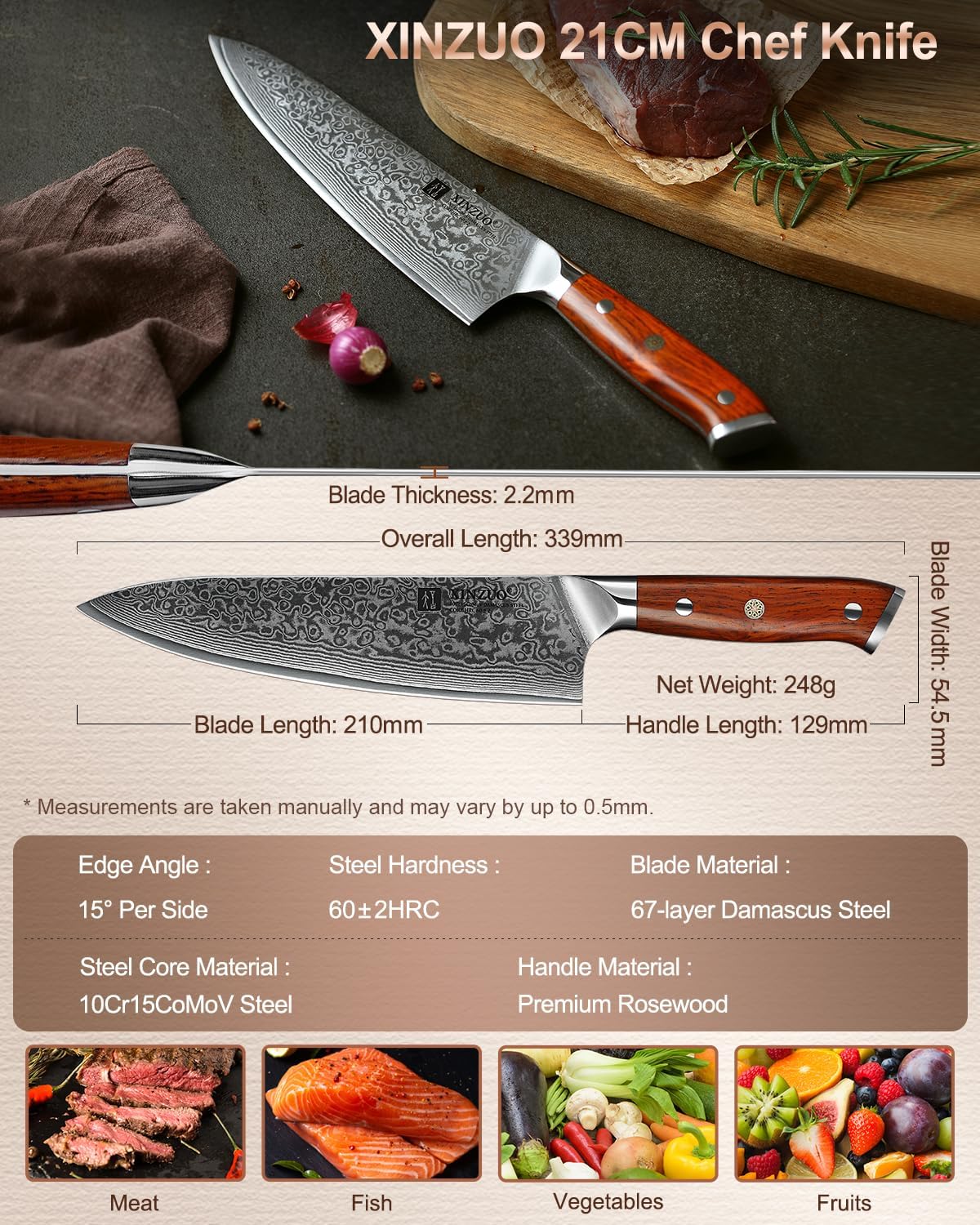
XINZUO identifies the Yu Series chef knife as using a 10Cr15CoMoV cutting core with layered Damascus construction. Manufacturer information also describes the knife as having a full tang, rosewood handle and approximately 15-degree-per-side edge.
| Feature | Yu Series | Why it matters |
|---|---|---|
| Knife type | Chef knife / gyuto-style kitchen knife | Designed to cover a wide range of everyday kitchen jobs. |
| Blade size | Approximately 8 to 8.3 inches depending on marketplace description | A familiar full-size chef knife format. |
| Cutting core | 10Cr15CoMoV | The core reaches the cutting edge, making this more useful information than layer count alone. |
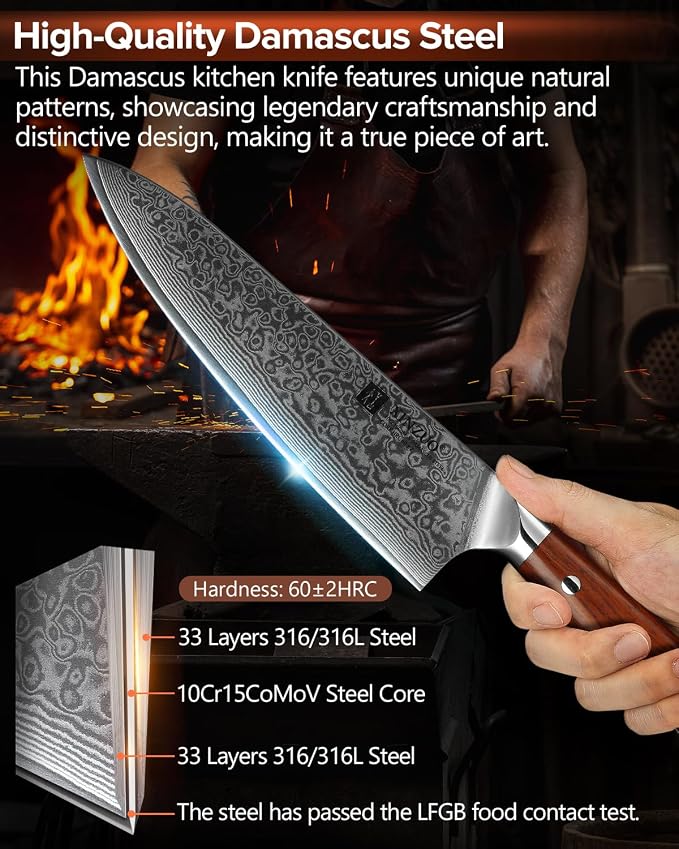
| Construction | 67-layer Damascus | Creates the layered construction and characteristic patterned appearance. |
| Hardness | 60±2 HRC, manufacturer stated | Provides context for how the edge is designed to behave. |
| Edge angle | Approximately 15° per side | A relatively fine kitchen edge intended for slicing rather than heavy impact. |
| Handle | Rosewood | Offers a natural appearance but benefits from careful washing and drying. |
| Tang | Full tang | The steel extends through the handle construction. |
What does 67-layer Damascus mean?
The visible pattern is probably the first thing most people notice, but the cutting core deserves more attention. In the Yu Series, XINZUO identifies 10Cr15CoMoV as the core material while the surrounding Damascus construction produces the layered visual effect.
Layer count is therefore a construction detail, not a performance score. A knife with more visible layers is not automatically sharper, tougher or better at retaining an edge.
Metallurgical research into modern pattern-welded blades also provides useful background. John D. Verhoeven and Howard F. Clark examined carbon diffusion in modern pattern-welded Damascus blades and showed why the structure is more complicated than the simple idea of alternating hard and soft layers.
Their research does not test this specific XINZUO knife. It is useful here because it explains why the visual pattern itself should not be treated as proof of superior cutting ability.
If you want to understand Damascus construction more deeply, continue with our Damascus Steel Guide .
What is the Yu Series designed to do?
This is fundamentally an all-purpose chef knife. The profile is intended for the kind of work that dominates normal home cooking: onions, herbs, carrots, capsicum, cabbage, fruit and boneless meat.
Its full-size chef knife geometry gives it enough blade length for larger ingredients while still remaining manageable for normal board work.
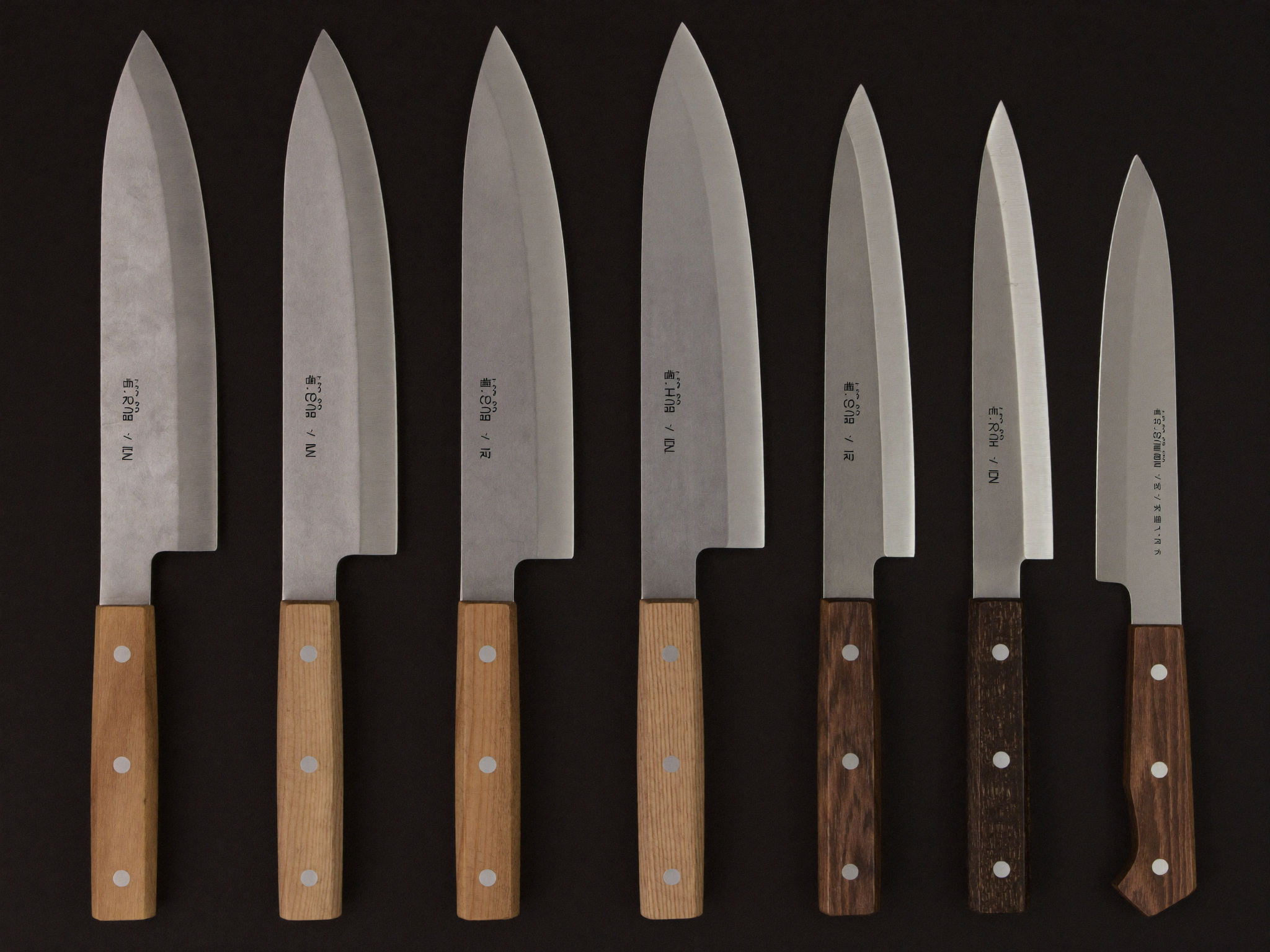
Rosewood gives the Yu Series a more traditional character
One reason the Yu Series looks different from many mass-market chef knives is its rosewood handle. Natural wood gives the knife warmth and visual character that moulded plastic or composite handles do not provide.
XINZUO also describes the knife as having full-tang construction. That means the blade steel extends through the handle rather than terminating near the bolster.
A full tang does not automatically mean a knife will feel perfectly balanced to every person. Hand size, grip style, handle geometry and weight distribution all influence how a chef knife feels.
What stands out, and what should give you pause?
What we like
- The manufacturer identifies the cutting core rather than relying only on a Damascus layer count.
- The chef knife profile suits a broad range of normal kitchen jobs.
- The patterned blade provides the visual appeal buyers expect from Damascus.
- Rosewood gives the handle a traditional, premium appearance.
- The published hardness and edge-angle specifications provide useful buying context.
- Full-tang construction is clearly disclosed.
What to consider
- It is not intended for bones or other hard-impact chopping.
- The wood handle makes hand washing the sensible care routine.
- A fine kitchen edge requires more care than a rough utility blade.
- Layer count should not be confused with an independent performance score.
- We do not have an independently measured BESS sharpness result for this individual knife.
How to look after the XINZUO Yu Series
A good chef knife does not require complicated ownership, but it does benefit from basic care. Hand washing, prompt drying and edge-safe storage make far more sense than treating it like an inexpensive dishwasher knife.
Good habits
- Wash the blade carefully by hand.
- Remove food residue before it dries.
- Dry the blade and handle promptly.
- Use wood or another suitable cutting surface.
- Store the edge so it cannot strike loose utensils.
- Maintain the edge before it becomes severely dull.
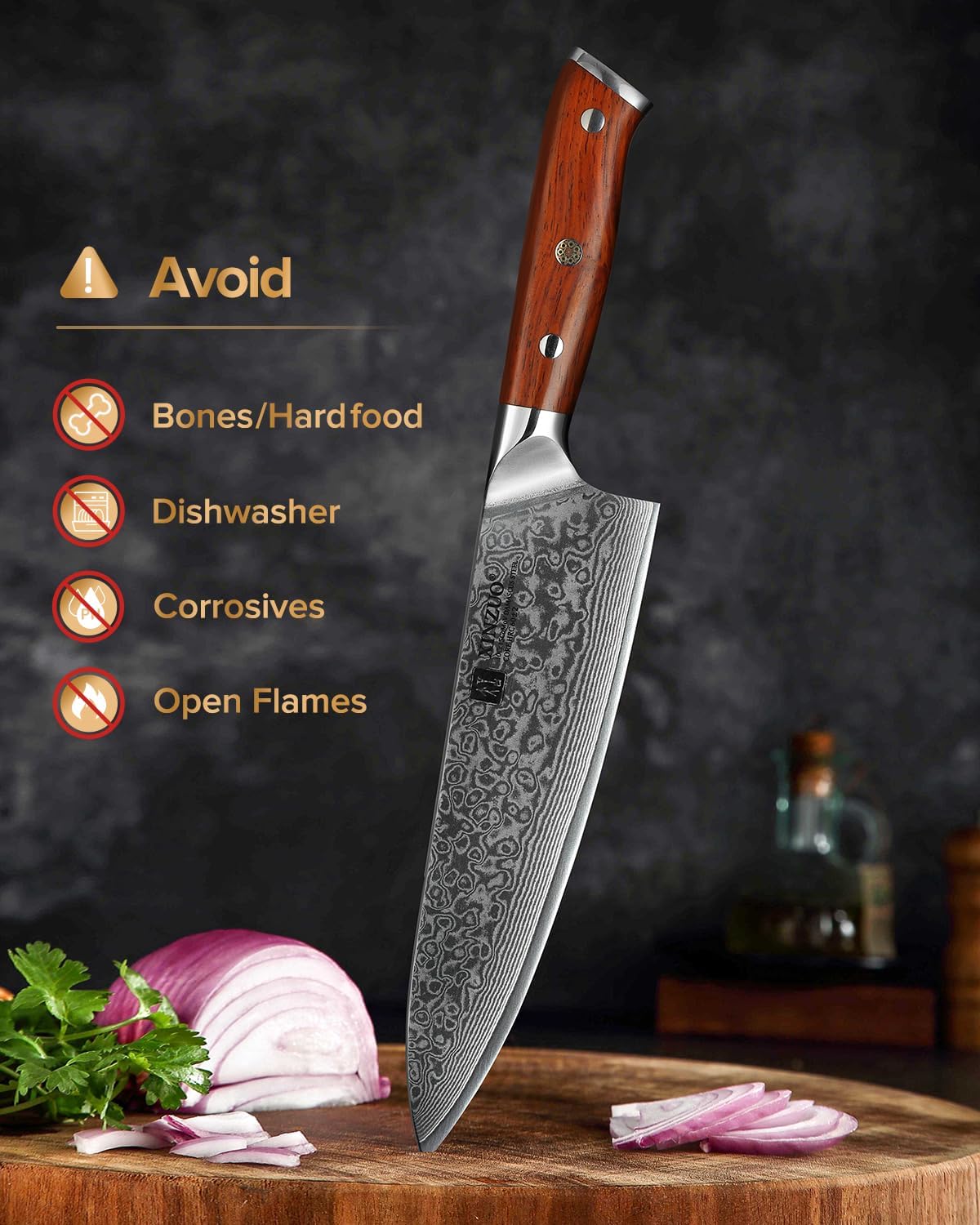
Avoid
- Dishwasher cycles
- Leaving the knife soaking in the sink
- Glass or stone cutting surfaces
- Twisting the edge through hard ingredients
- Frozen food
- Bone chopping
For sharpening advice, see our complete guide to sharpening Damascus knives .
For food-preparation hygiene information, see Food Standards Australia New Zealand .
Who should consider the XINZUO Yu Series?
This knife makes the most sense for someone who wants one substantial everyday chef knife and likes the visual character of Damascus steel. It also suits buyers moving beyond inexpensive generic knife sets who want a more distinctive main kitchen knife.
| Buyer | Fit | Reason |
|---|---|---|
| Home cook wanting one main chef knife | Strong fit | The full-size chef profile covers most normal prep work. |
| Buyer attracted to Damascus styling | Strong fit | The layered pattern is a prominent part of the knife's design. |
| Gift buyer | Potentially good fit | The patterned blade and rosewood handle provide strong visual presentation. |
| Vegetable-only specialist | Consider alternatives | A nakiri may better match a vegetable-heavy cutting style. |
| Heavy bone chopping | Poor fit | A proper cleaver designed for impact is more appropriate. |
| Dishwasher convenience is essential | Poor fit | The natural wood handle and fine edge are better suited to hand care. |
Compare before you decide
The Yu Series is one option. Our chef knife guide will help you compare different designs and steel disclosures.
What about knife rules in Australia?
The fact that a blade has a Damascus pattern does not determine its legal classification. Knife rules depend on the type and characteristics of the item and can vary by jurisdiction.
If you are importing a knife rather than buying stock already located in Australia, the Australian Border Force guidance on prohibited weapons is an appropriate government starting point.
State and territory laws may also apply to possession and carrying. This section is general information rather than legal advice.
Sources behind this review
We separate product specifications, general metallurgy research and government guidance rather than presenting them as the same kind of evidence.
- XINZUO product specifications: XINZUO Australia Yu Series Chef Knife .
- Pattern-welded blade metallurgy: J.D. Verhoeven and H.F. Clark, Carbon Diffusion Between the Layers in Modern Pattern-Welded Damascus Blades . This research provides general metallurgical context and did not test this individual XINZUO knife.
- Food hygiene: Food Standards Australia New Zealand .
- Australian import guidance: Australian Border Force .
More Damascus knife guides
XINZUO Yu Series Chef Knife FAQ
Is the XINZUO Yu Series Chef Knife worth buying?
It is worth considering if you want an attractive full-size Damascus chef knife for normal kitchen preparation and are comfortable with the care expected from a fine edge and natural wood handle.
What steel does the XINZUO Yu Series use?
XINZUO identifies 10Cr15CoMoV as the cutting core and describes the blade as having a 67-layer Damascus construction.
Is 67-layer Damascus automatically better?
No. Layer count describes part of the construction. It does not independently establish sharpness, edge retention, toughness or overall quality.
What is the sharpening angle?
XINZUO states an edge of approximately 15 degrees per side for this model.
Can I put the XINZUO Yu Series in the dishwasher?
Hand washing and prompt drying are the sensible approach for protecting the fine edge and natural rosewood handle.
Can I use it to cut bones?
It should be treated as a chef knife rather than a bone cleaver. For hard-impact bone chopping, use a tool designed specifically for that job.
Is the XINZUO Yu Series good for vegetables?
Yes. A chef knife profile is well suited to onions, herbs, carrots, capsicum, cabbage and many other common vegetables.
Is this knife good for beginners?
It can make sense for a beginner who wants one capable main kitchen knife and understands basic knife care. Someone wanting maximum dishwasher convenience or rough-use durability may prefer a simpler alternative.
Has Damascus Knife Australia physically tested this knife?
This article is a research-based editorial review using published product specifications, relevant scientific research and authoritative guidance. It does not claim laboratory testing or personal long-term use that did not occur.
The Yu Series makes the most sense when you look beyond the Damascus pattern
The XINZUO Yu Series will probably first attract you because of the blade. The layered pattern is dramatic, the rosewood handle adds warmth and the finished knife has the kind of visual presence that ordinary kitchen knives often lack.
The more important reason to consider it is underneath that appearance. XINZUO identifies the cutting core, publishes useful hardness and edge information and puts those specifications into a familiar full-size chef knife format.
That makes the Yu Series relevant for someone who wants a primary kitchen knife for vegetables, herbs, fruit and boneless proteins but also wants something more distinctive than a plain stainless blade.
There are sensible limits. Do not buy it as a bone cleaver. Do not treat a 67-layer label as proof of magical cutting performance. And if you choose a knife with a natural wood handle and relatively fine edge, expect to hand wash it and store it carefully.
If those trade-offs fit the way you cook, the XINZUO Yu Series deserves a place on your comparison list.