Damascus Knife Australia

Damascus Knife Australia — Header + Footer (Final)
Hand-picked Damascus knives for Australian kitchens · Prices in AUD · Independent Buying Guides
The Australian kitchen knife shortlist

Best Damascus knives for your kitchen.

Choose a blade for the food you cut, the space on your board, and the handle you want to hold. Then read the steel specification. The pattern is only part of the story.

FORM • STEEL • EDGE
9 listings • 8 Damascus listings • 1 stainless companion

Quick answer: For one general kitchen knife, start by comparing the MITSUMOTO SAKARI 20 cm chef knife with the longer XINZUO 21.9 cm gyuto. Choose the 18 cm MITSUMOTO SAKARI nakiri if vegetables are your priority, the 18 cm AUS-10 santoku if you prefer a shorter all-rounder, or the SHAN ZU three-piece set if you need several blade sizes. These are choices by task and disclosed specifications, not results of hands-on tests.

As an Amazon Associate, we earn from qualifying purchases. The buttons below take you directly to the supplied Amazon listings. Product descriptions are based on the titles supplied for this guide; confirm the current steel, dimensions, price, seller and availability before ordering.

The quick comparison

Start with the job.

The table distinguishes named core steels from listings that only state a pattern or layer count.

KnifeListed bladeGood fit forSteel detail suppliedListing
MITSUMOTO SAKARI nakiri18 cmVegetable prepDamascus; core not stated hereDetails ↓
Japanese santoku18 cmGeneral prep in a shorter bladeAUS-10 core statedDetails ↓
hecef resin-handle chef knife8 inchDaily chef-knife tasks67 layers stated; core not stated hereDetails ↓
PAUDIN bread knife8 inchCrusty breadGerman high-carbon stainless, not DamascusDetails ↓
MITSUMOTO SAKARI chef knife20 cmOne main kitchen knifeVG-Pro named; verify exact constructionDetails ↓
XINZUO gyuto21.9 cmLonger slicing strokes67 layers stated; core not stated hereDetails ↓
SHAN ZU three-piece set3 knivesBuilding a small knife kit67 layers stated; verify each bladeDetails ↓
Japanese petty knife13.5 cmSmaller, precise cutsVG10 statedDetails ↓
hecef olive-wood chef knife8 inchChef knife with wood handleDamascus stainless stated; core not stated hereDetails ↓

“Not stated here” means the product title supplied for this article did not identify the core. It does not mean the manufacturer has no specification. Check the linked listing before buying.

What matters beyond the pattern

Steel, sharpness and the edge.

A good knife earns its place when its shape and edge work for the food you prepare.

Why do cooks choose Damascus knives?

For many buyers, the first attraction is the flowing pattern: it gives each knife a distinctive look and makes a kitchen tool feel gift worthy. Practical reasons matter as well. These listings offer different shapes, handle materials and, in some cases, named cutting steels. A short petty knife feels different from a long gyuto even when both have patterned blades. The pattern is a visual feature; it does not by itself tell you how sharp the knife is or how long that edge will last.

What is a knife sharpness index?

A commonly used sharpness measurement is the BESS test described by Edge On Up. Its instrument records the force, in grams, needed for an edge to sever standard test media. Lower BESS means a sharper edge at the time of that test. None of the nine listings in this guide comes with a BESS measurement we can verify. We therefore give no numerical sharpness index or sharpness ranking for these products.

Sharpness is a measured condition, not a steel grade.
Steel and heat treatmentBlade and edge geometrySharpening conditionCutting task

A knife can test sharp immediately after sharpening yet feel thick behind the edge when cutting a dense carrot. Edge retention describes how well it keeps cutting after use; hardness, usually reported as HRC, describes resistance to indentation. Neither number is interchangeable with a BESS reading. A serrated bread knife also calls for a different cutting method from a plain-edge chef knife.

VG10

The 13.5 cm petty listing names VG10. Its steelmaker, Takefu Special Steel, describes chromium, molybdenum, cobalt and vanadium in the alloy. The named grade helps you research the core, but it does not prove this particular knife's heat treatment or sharpness. VG-Pro on the MITSUMOTO chef knife is a different label; do not assume it means VG10.

AUS-10

The 18 cm santoku title names an AUS-10 core. Aichi Steel lists AUS-10 among its blade steels and describes added carbon, vanadium and molybdenum for hardness and wear resistance. The final knife still depends on heat treatment and grind. Check the live listing for the maker's full construction.

67 layers

The hecef resin model, XINZUO gyuto and SHAN ZU set advertise 67 layers. This number describes a claimed layered construction, not the composition of the cutting core, an edge measurement or a guarantee of performance. Ask which steel actually reaches the edge and whether the visible pattern comes from layered steel or a surface finish.

What makes a Damascus blade different?

Modern pattern-welded steel can reveal contrast between layers after finishing and etching. Some kitchen knives put patterned cladding around a separate hard core. The useful comparison is between the entire blades: core steel, heat treatment, thickness and shape, comfortable handle, and care requirements. A materials study of modern pattern-welded blades explains how layered steel develops its pattern. It does not test any of the nine knives here.

The full shortlist

Nine knives, nine different jobs.

Each card tells you why the knife is here and what to confirm at the retailer.

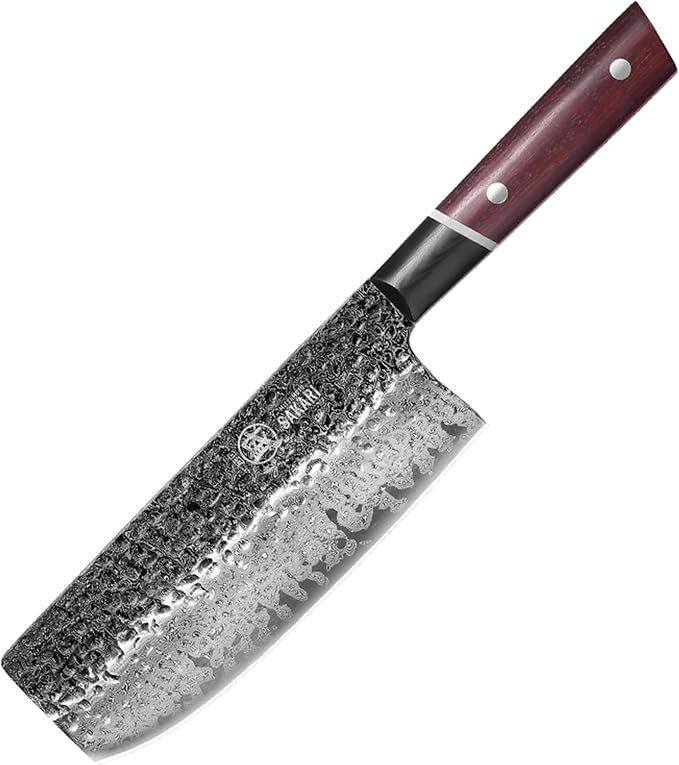
MITSUMOTO SAKARI 18 cm Japanese nakiri knife
Vegetable specialist • 18 cm

MITSUMOTO SAKARI nakiri

The broad, relatively straight nakiri shape suits vegetable prep and gives you room to guide slices with your knuckles. Pick it for its shape, especially if another knife already handles meat and bread.

The draw is the tall, almost straight blade: repeated push cuts through cabbage, herbs and other vegetables feel natural when you have enough board space. It can also help gather sliced ingredients from the board without using the cutting edge as a scraper.

Steel and specs: What is known: 18 cm and Damascus appearance. The supplied title does not name the cutting core, blade thickness or edge angle.

Check the exact edge steel and construction in the current listing. A nakiri is not a substitute for a serrated bread knife or a boning knife.

See it on Amazon ↗
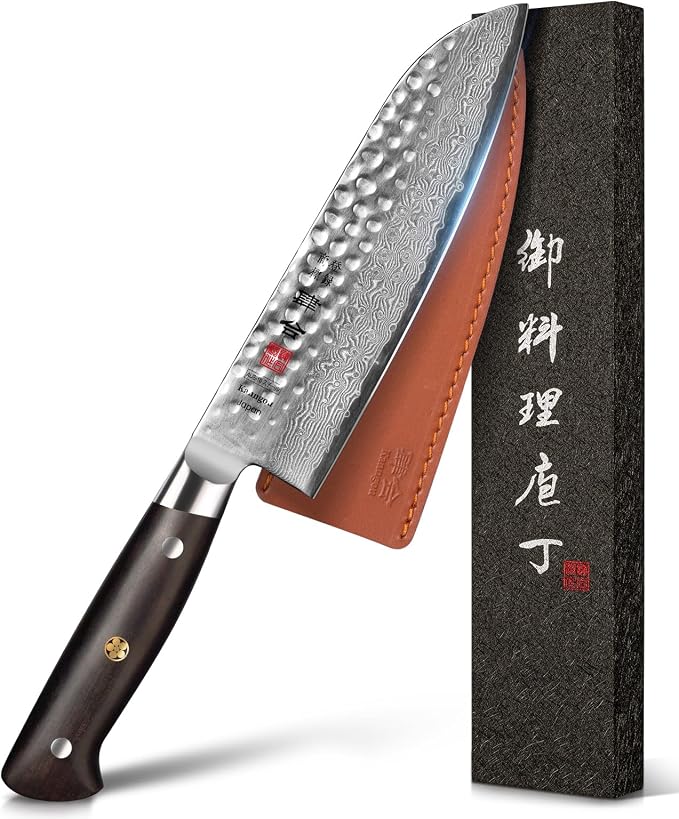
18 cm Damascus santoku knife with listed AUS-10 steel core
Shorter all-rounder • 18 cm

AUS-10 Damascus santoku

The supplied title names an AUS-10 core, useful information when comparing blades. Its 18 cm santoku format may feel more manageable than a longer gyuto on a compact board.

This is the compact generalist on the list. A santoku is built around everyday slicing, dicing and chopping, so it suits someone who wants reach without moving up to the 21.9 cm gyuto. AUS-10 is a more useful steel disclosure than layer count alone.

Steel and specs: What is known: 18 cm blade and a named AUS-10 core in the supplied title. Handle, hardness and actual out-of-box sharpness still need confirmation.

Confirm the manufacturer, handle material and patterned cladding on the live listing.

See it on Amazon ↗
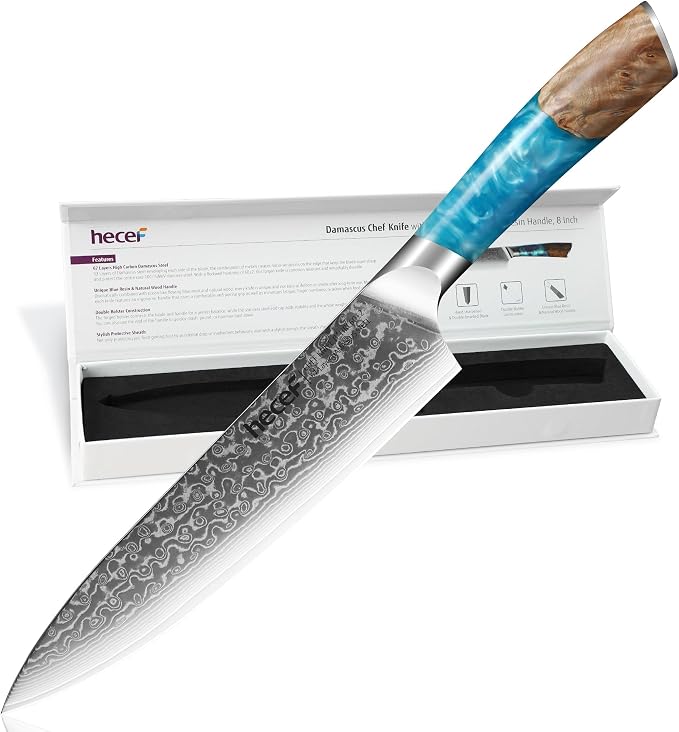
hecef 8-inch Damascus chef knife with resin handle and knife protector
Chef knife • 8 inch

hecef resin-handle chef knife

This listing combines the familiar chef-knife length with a resin handle and a knife protector. The title advertises 67 layers, which describes its claimed construction rather than how well the edge cuts.

Its appeal is the pairing of patterned steel and a resin grip, plus an included protector for storage. Compare its 8-inch chef profile with the olive-wood hecef below: the cutting jobs overlap, while the handle feel and appearance are the real choice.

Steel and specs: What is known: 8-inch length, resin handle, protector and claimed 67 layers. Do not treat the layer count as a measured sharpness score.

Ask what steel forms the cutting edge, then compare the handle and overall weight.

See it on Amazon ↗
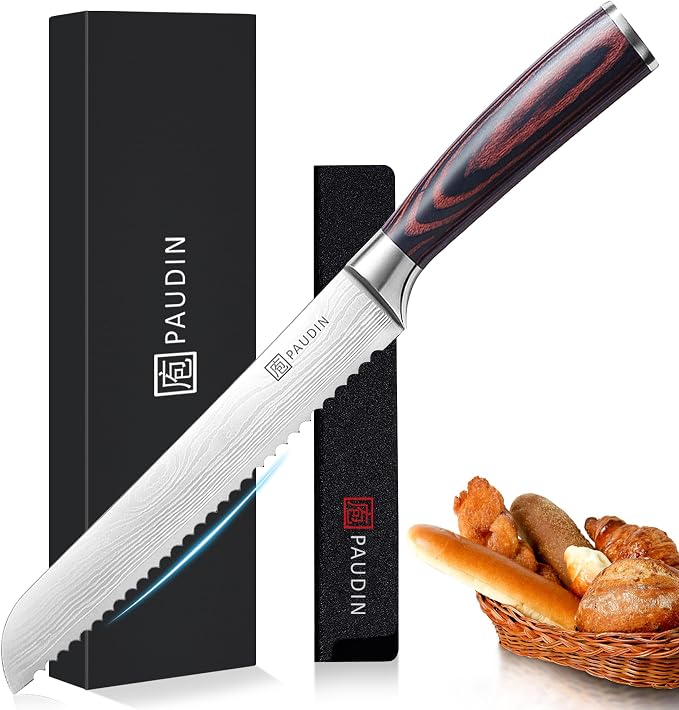
PAUDIN 8-inch serrated stainless steel bread knife
Stainless companion • not Damascus

PAUDIN bread knife

The serrated edge gives this knife a different job from the straight-edged blades on this page: cutting through a crust without flattening the loaf. The supplied title calls its steel German high-carbon stainless, not Damascus.

This one earns space because a serrated edge grips the hard crust of sourdough and uses a sawing motion to cut without pressing down as much as a straight edge might. It complements a chef knife for loaves and soft interiors.

Steel and specs: What is known: 8-inch serrated blade and German high-carbon stainless in the supplied title. Its steel is not advertised as Damascus.

Included as a useful companion knife. Do not count it as a Damascus purchase.

See it on Amazon ↗
MITSUMOTO SAKARI 20 cm VG-Pro Damascus chef knife
Main kitchen knife • 20 cm

MITSUMOTO SAKARI chef knife

A 20 cm chef knife is a sensible size to compare if you want one blade for most everyday chopping and slicing. This listing names VG-Pro; confirm exactly what that term means for this model and which steel reaches the edge.

For a single everyday knife, 20 cm offers a middle ground between the 18 cm santoku and longer XINZUO gyuto. The curved chef-knife profile gives space for board work and longer slices; balance and handle comfort will decide whether it suits your hand.

Steel and specs: What is known: 20 cm length and a VG-Pro label. VG-Pro is not proof of VG10 chemistry, an HRC figure or a sharpness measurement.

Compare blade weight, handle shape and retailer specifications with the XINZUO gyuto below.

See it on Amazon ↗
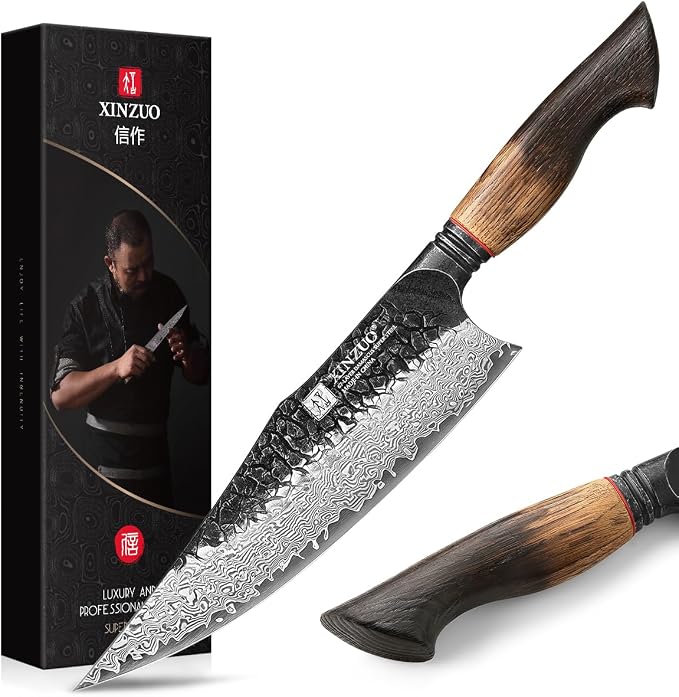
XINZUO 21.9 cm Japanese-style gyuto knife with wood and red G10 handle accents
Longer gyuto • 21.9 cm

XINZUO Japanese-style gyuto

The longest single knife here offers more blade length for continuous slicing. The supplied title advertises 67 layers and a burnt-wood handle with red G10 accents, details worth checking against the current listing photos.

The extra reach is the selling point: a longer drawing cut can help with larger produce or proteins if your board and storage have room. The burnt wood with red G10 accent also gives it a different look from the plain wood and resin options.

Steel and specs: What is known: 21.9 cm gyuto shape, claimed 67 layers and a wood/G10-accented handle in the supplied title. Check core steel and weight.

Check the exact edge steel and whether the extra length fits your board and storage.

See it on Amazon ↗
Blade-shape illustration
Three-piece set

SHAN ZU Damascus knife set

If you need several cutting tools, compare this set against buying one chef knife first. The supplied title says three pieces, 67 layers and G10 handles, but it does not name every blade or the core steel.

The attraction is covering several kitchen jobs in one purchase and keeping a matching G10 handle style. Before choosing a set, compare the actual blade shapes with your needs: a duplicate knife in a boxed set adds little if you mostly need one chef knife.

Steel and specs: What is known: three pieces, claimed 67 layers and G10 handles. The supplied title does not specify every blade or core; inspect the live bundle.

The illustration is generic. Check the actual set contents, lengths and steels at Amazon.

See it on Amazon ↗
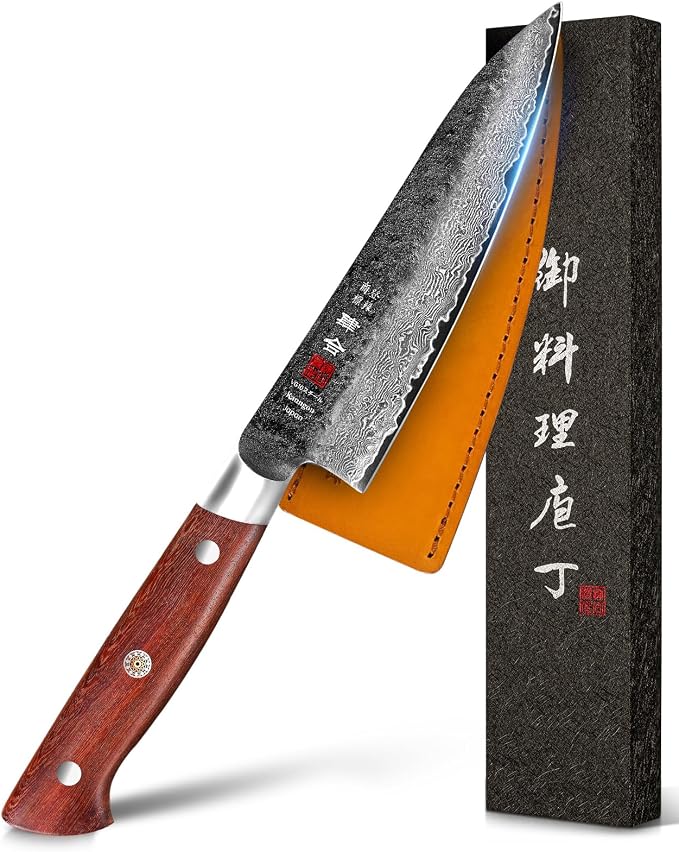
13.5 cm Japanese utility or petty knife with listed VG10 steel and red sandalwood handle
Smaller tasks • 13.5 cm

VG10 Japanese utility knife

Also described as a petty knife, this shorter blade can suit trimming, small produce and tasks that feel awkward with a 20 cm chef knife. Its title names VG10 and a full-tang red sandalwood handle.

A 13.5 cm petty gives you control for strawberries, garlic, citrus and small trimming jobs. It is the clearest small-blade option here, while the listed full-tang red sandalwood handle and gift box make it a distinct choice for someone buying a present.

Steel and specs: What is known: VG10 named as edge steel and a full-tang handle in the supplied title. Verify the actual construction and finish.

Check the actual handle care, construction and blade length in the listing.

See it on Amazon ↗
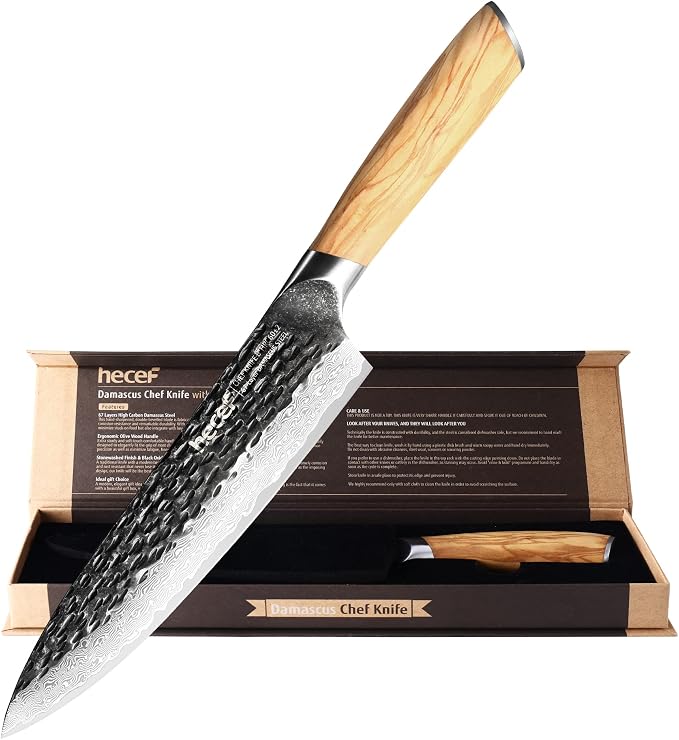
hecef 8-inch Damascus chef knife with olive wood handle and gift box
Wood-handle chef knife • 8 inch

hecef olive-wood chef knife

This version pairs an 8-inch chef-knife profile with an olive-wood handle and gift box, according to the supplied listing title. It is a useful comparison with the resin-handle hecef above if the handle is part of your decision.

Choose this profile if you want an everyday chef knife with the natural grain of olive wood and a gift-box presentation. Against the hecef resin-handle option, its practical difference is mainly grip material and the wood care that comes with it.

Steel and specs: What is known: 8-inch chef profile, Damascus stainless description, olive-wood handle and gift box. The title does not identify a precise core grade.

Confirm the edge steel and care needs, particularly for the wood handle.

See it on Amazon ↗
Look closer

“67 layers” tells you less than the edge steel.

The layer count describes a construction claim. To compare how two knives may feel in use, look for the steel at the cutting edge, blade dimensions and a handle you can control. Read our Damascus steel guide for the fuller explanation.

Illustrated guide to details worth checking on a Damascus knife
The buying method

How to choose without guessing.

A knife should make the tasks you do every week easier. Start there.

One knife or a set?

For many kitchens, one comfortable chef knife does most of the work. A nakiri adds a flatter edge for vegetable prep. A petty knife handles smaller cuts. A bread knife earns its place when you slice crusty loaves. Buy a set if the included shapes solve separate jobs you actually have.

What does “Damascus” mean in a listing?

Modern Damascus kitchen knives can use pattern-welded steel or patterned cladding around a cutting core. A decorative surface pattern is another possibility. The photo alone cannot establish which you are buying. Research on modern pattern-welded blades describes forged layers and the way carbon diffuses between them. Read the metallurgy paper, then see our plain-English guide.

Can the product title prove quality?

No. A layer count, “Japanese-style” label or broad phrase like “high-carbon steel” cannot tell you how the finished edge cuts. Look for a named core, blade dimensions, a clear handle description and a seller that explains returns. Our authenticity guide covers what can be checked without treating price as a test.

01

Choose the blade shape.
Nakiri for vegetables, santoku for compact general prep, gyuto or chef knife for more reach, petty for smaller tasks.

02

Check what forms the edge.
Where the title names VG10 or AUS-10, verify it on the current product page. Where it does not name a core, ask the seller.

03

Check the hand and board fit.
A longer blade needs more board space. Compare handle shape, weight and safe storage before paying.

04

Confirm the current offer.
Product photos, contents, seller, delivery and price can change. Use each button to check the live listing.

After you buy

Keep the edge ready.

Follow the maker's instructions for the specific steel and handle.

Wash by hand

Use mild soap and water, then dry the blade and handle promptly. A wood handle may need additional care.

Use a suitable board

Wood or a suitable plastic board is kinder to the edge than glass or stone. Avoid twisting the blade through hard material.

Store it separately

Use a guard, block or suitable rack so the edge is not knocked by other utensils. See our care guide and sharpening guide.

Questions before checkout

The useful answers.

Which Damascus knife should I buy first?

Start by comparing a chef knife around 20 cm if you want one knife for most prep. A shorter santoku may suit a small board. The best fit depends on your grip and the food you cut most often.

Is a 67-layer knife automatically better?

No. Layer count alone cannot establish edge quality. Compare the steel at the edge, blade geometry, heat treatment and how you plan to maintain it.

What is a good sharpness index for these knives?

There is no verified BESS reading for any knife on this page. If you want to compare measured sharpness, look for the same test instrument and test method across all knives. A lower BESS result indicates a sharper tested edge at that moment; it does not predict edge retention or how the knife will feel in every ingredient.

Does VG-Pro mean VG10?

No equivalence is established by these product titles. VG10 is a named alloy used in the petty listing. Ask the retailer to identify the exact VG-Pro core and its composition for the MITSUMOTO chef knife.

Why is a stainless bread knife in this guide?

It is a clearly labelled companion for bread, not a Damascus selection. A serrated bread knife solves a different cutting task from the straight-edged Damascus knives listed above.

Are the listed knives tested or ranked by performance?

No. This is a use-based comparison of the product titles and images supplied for the guide. We have not claimed hands-on testing, measured sharpness or assigned performance scores.

Can I import a Damascus knife into Australia?

Rules depend on the knife's design rather than the Damascus pattern alone. Check the current Australian Border Force weapons guidance and relevant state or territory requirements before ordering, including from an online marketplace.

Editorial note: Product titles and images were supplied for this guide. We grouped the knives by task and flagged missing core details rather than inventing test results, customer ratings or prices. Amazon links are affiliate links; confirm each live listing before purchase.